EasyManua.ls Logo

ACT apricot - Page 84

ACT apricot
328 pages
Print Icon
To Next Page IconTo Next Page
To Previous Page IconTo Previous Page
Loading...
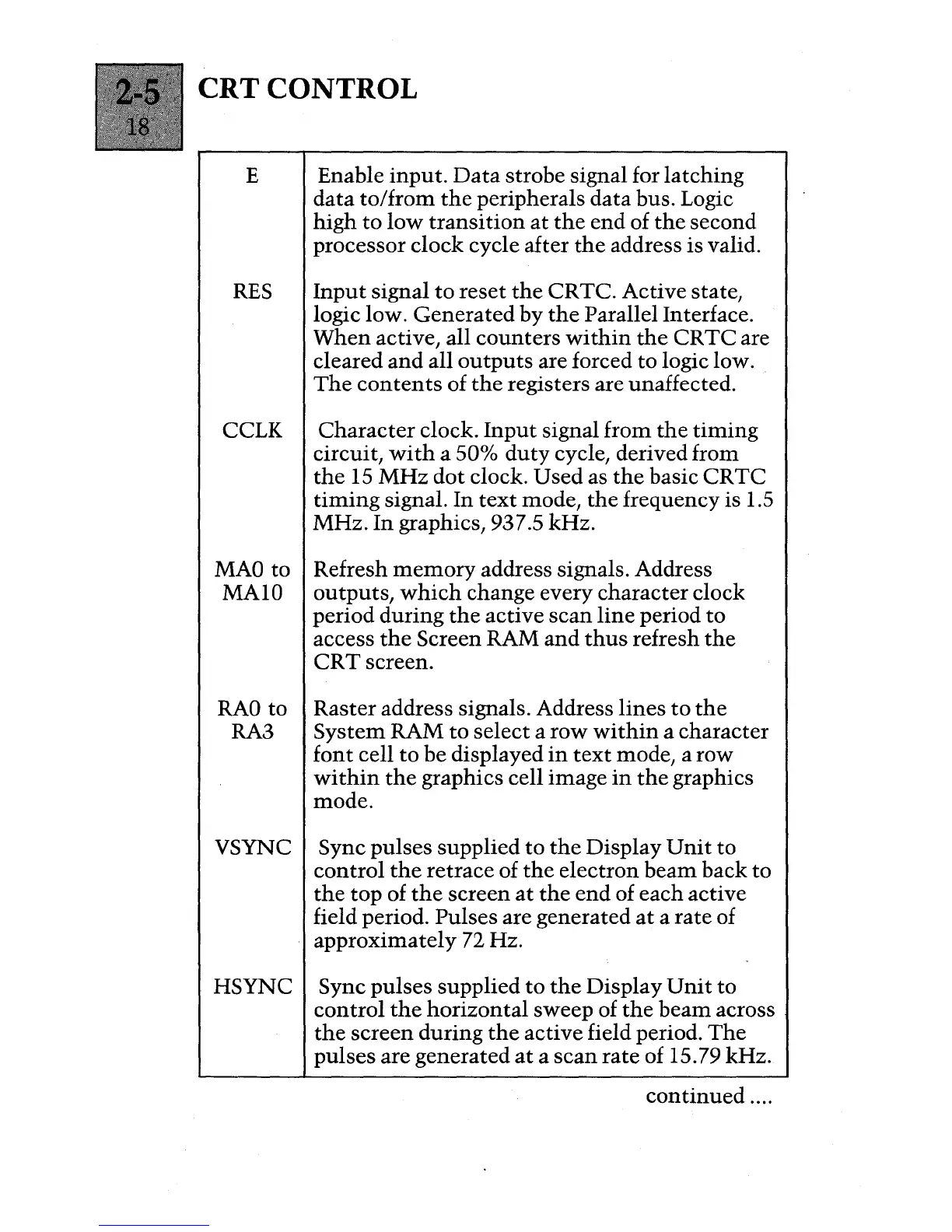
CRT
CONTROL
E
RES
CCLK
MAO
to
MAIO
RAO
to
RA3
VSYNC
HSYNC
Enable
input.
Data
strobe
signal for
latching
data
to/from
the
peripherals
data
bus. Logic
high
to
low
transition
at
the
end
of
the
second
processor
clock
cycle after
the
address
is
valid.
Input
signal
to
reset
the
CRTC.
Active
state,
logic low.
Generated
by
the
Parallel Interface.
When
active, all
counters
within
the
CRTC
are
cleared
and
all
outputs
are forced
to
logic low.
The
contents
of
the
registers are unaffected.
Character
clock.
Input
signal
from
the
timing
circuit,
with
a 50%
duty
cycle, derived
from
the
15
MHz
dot
clock.
Used
as
the
basic
CRTC
timing
signal.
In
text
mode,
the
frequency
is 1.5
MHz.
In
graphics, 937.5
kHz.
Refresh
memory
address signals. Address
outputs,
which
change every
character
clock
period
during
the
active
scan
line
period
to
access
the
Screen RAM
and
thus
refresh
the
CRT
screen.
Raster
address signals. Address
lines
to
the
System
RAM
to
select
a
row
within
a
character
font
cell
to
be
displayed
in
text
mode, a
row
within
the
graphics cell
image
in
the
graphics
mode.
Sync
pulses
supplied
to
the
Display
Unit
to
control
the
retrace
of
the
electron
beam
back
to
the
top
of
the
screen
at
the
end
of
each
active
field period.
Pulses
are
generated
at
a
rate
of
approximately
72 Hz.
Sync
pulses
supplied
to
the
Display
Unit
to
control
the
horizontal
sweep of
the
beam
across
the
screen
during
the
active
field period.
The
pulses
are
generated
at
a
scan
rate
of 15.79
kHz.
continued
....

Table of Contents

Other manuals for ACT apricot