EasyManua.ls Logo

ACT apricot - Expansion Board Layout Detail

ACT apricot
328 pages
Print Icon
To Next Page IconTo Next Page
To Previous Page IconTo Previous Page
Loading...
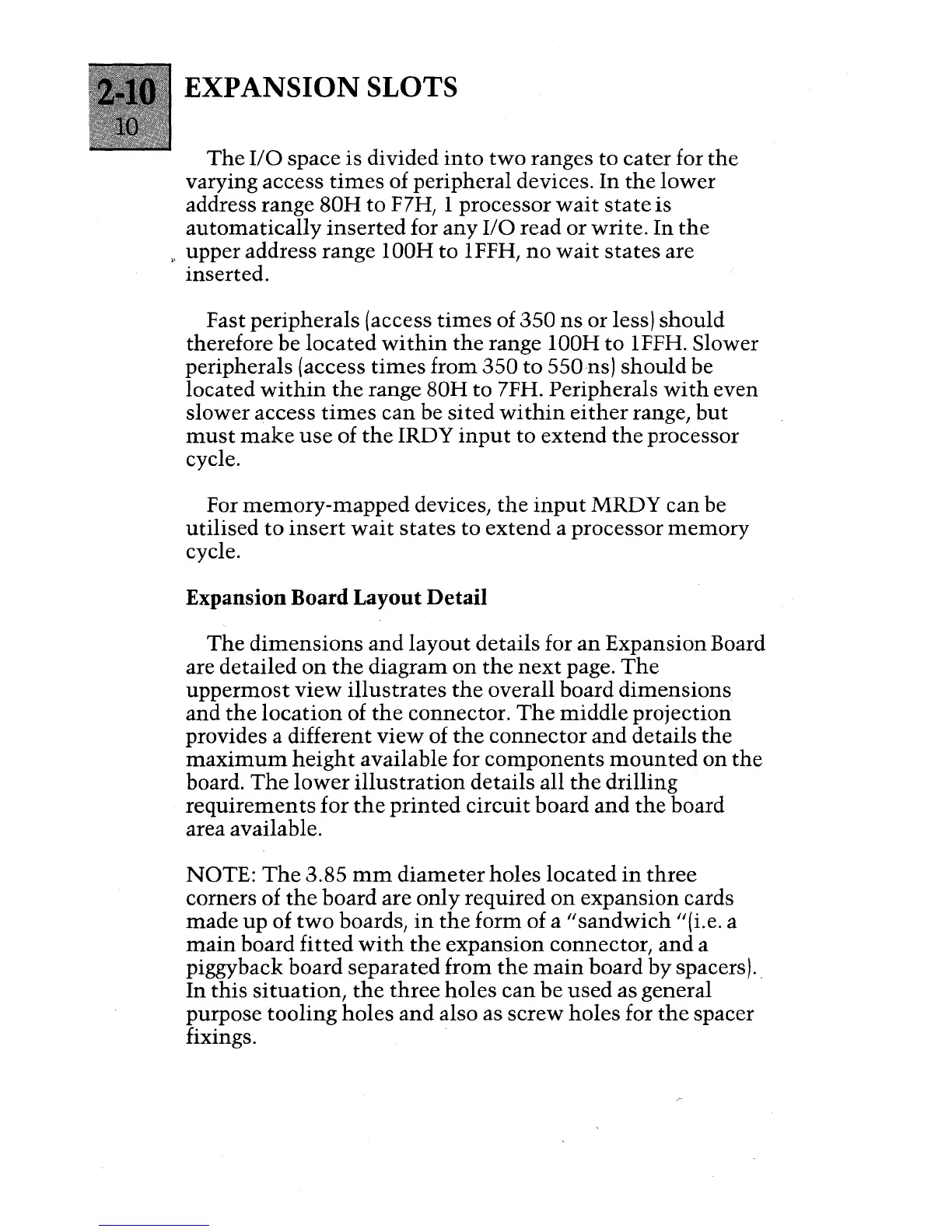
EXPANSION SLOTS
The
1/0
space is divided
into
two
ranges to cater for
the
varying access
times
of peripheral devices. In
the
lower
address range
BaH
to F7H, 1 processor
wait
state
is
automatically
inserted
for
any
110 read
or
write.
In
the
" upper address range
lOOH
to
lFFH,
no
wait
states
are
inserted.
Fast peripherals (access
times
of
350
ns
or less)
should
therefore be
located
within
the
range
lOOH
to lFFH. Slower
peripherals (access
times
from 350
to
550ns)
should
be
located
within
the
range
SOH
to
7FH. Peripherals
with
even
slower access
times
can
be
sited
within
either
range,
but
must
make
use
of
the
IRDY
input
to
extend
the
processor
cycle.
For
memory-mapped
devices,
the
input
MRDY can be
utilised
to
insert
wait
states
to
extend
a processor
memory
cycle.
Expansion Board Layout
Detail
The
dimensions
and
layout
details for
an
Expansion Board
are detailed
on
the
diagram
on
the
next
page.
The
uppermost
view
illustrates
the
overall board
dimensions
and
the
location
of
the
connector.
The
middle
projection
provides a different
view
of
the
connector
and
details
the
maximum
height
available for
components
mounted
on
the
board.
The
lower
illustration
details all
the
drilling
requirements
for
the
printed
circuit
board
and
the
board
area available.
NOTE:
The
3.S5
mm
diameter
holes located
in
three
corners of
the
board
are
only
required
on
expansion cards
made
up
of
two
boards,
in
the
form of a
"sandwich
"(i.e. a
main
board
fitted
with
the
expansion connector,
and
a
piggyback board separated from
the
main
board by spacers)
..
In
this
situation,
the
three
holes
can
be
used
as general
purpose tooling holes
and
also as screw holes for
the
spacer
fixings.

Table of Contents

Other manuals for ACT apricot