EasyManua.ls Logo

ACT apricot - Page 225

ACT apricot
328 pages
Print Icon
To Next Page IconTo Next Page
To Previous Page IconTo Previous Page
Loading...
KEYBOARD
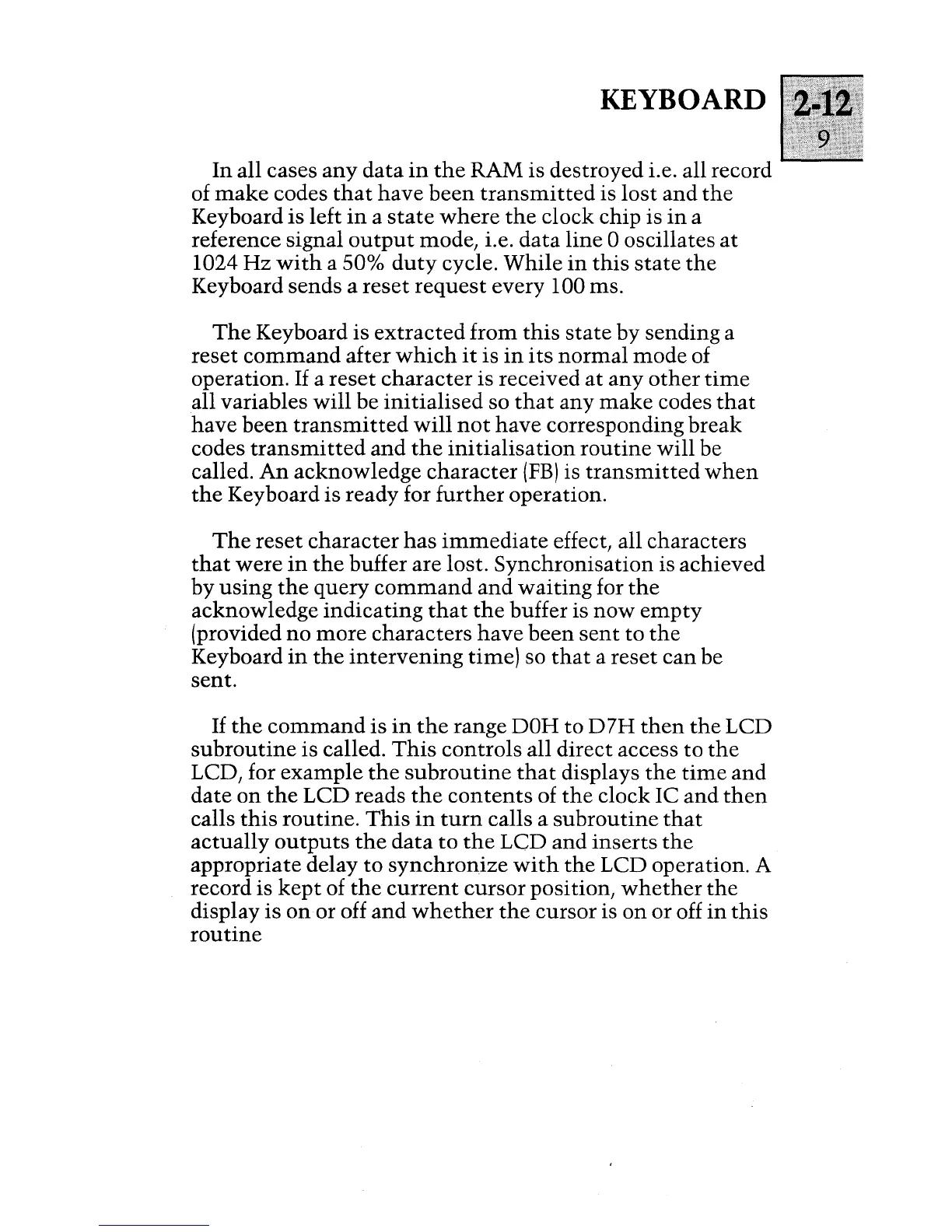
In
all cases
any
data
in
the
RAM is destroyed i.e. all record
of
make
codes
that
have
been
transmitted
is
lost
and
the
Keyboard is left
in
a
state
where
the
clock chip is
in
a
reference signal
output
mode, i.e.
data
line
0 oscillates
at
1024
Hz
with
a 50%
duty
cycle.
While
in
this
state
the
Keyboard sends a
reset
request
every 100 ms.
The
Keyboard is
extracted
from
this
state
by sending a
reset
command
after
which
it
is
in
its
normal
mode
of
operation.
If
a
reset
character
is received
at
any
other
time
all variables
will
be
initialised
so
that
any
make
codes
that
have
been
transmitted
will
not
have
corresponding
break
codes
transmitted
and
the
initialisation
routine
will
be
called.
An
acknowledge
character
(FB)
is
transmitted
when
the
Keyboard is ready for
further
operation.
The
reset
character
has
immediate
effect, all characters
that
were
in
the
buffer are lost.
Synchronisation
is achieved
by
using
the
query
command
and
waiting
for
the
acknowledge
indicating
that
the
buffer is
now
empty
(provided
no
more
characters
have
been
sent
to
the
Keyboard
in
the
intervening
time) so
that
a reset
can
be
sent.
If
the
command
is
in
the
range DOH
to
D 7H
then
the
LCD
subroutine
is called.
This
controls
all direct access
to
the
LCD, for
example
the
subroutine
that
displays
the
time
and
date
on
the
LCD reads
the
contents
of
the
clock IC
and
then
calls
this
routine.
This
in
turn
calls a
subroutine
that
actually
outputs
the
data
to
the
LCD
and
inserts
the
appropriate delay
to
synchronize
with
the
LCD operation. A
record is
kept
of
the
current
cursor
position,
whether
the
display
is
on
or off
and
whether
the
cursor is
on
or
off
in
this
routine

Table of Contents

Other manuals for ACT apricot