EasyManua.ls Logo

ACT apricot - Page 242

ACT apricot
328 pages
Print Icon
To Next Page IconTo Next Page
To Previous Page IconTo Previous Page
Loading...
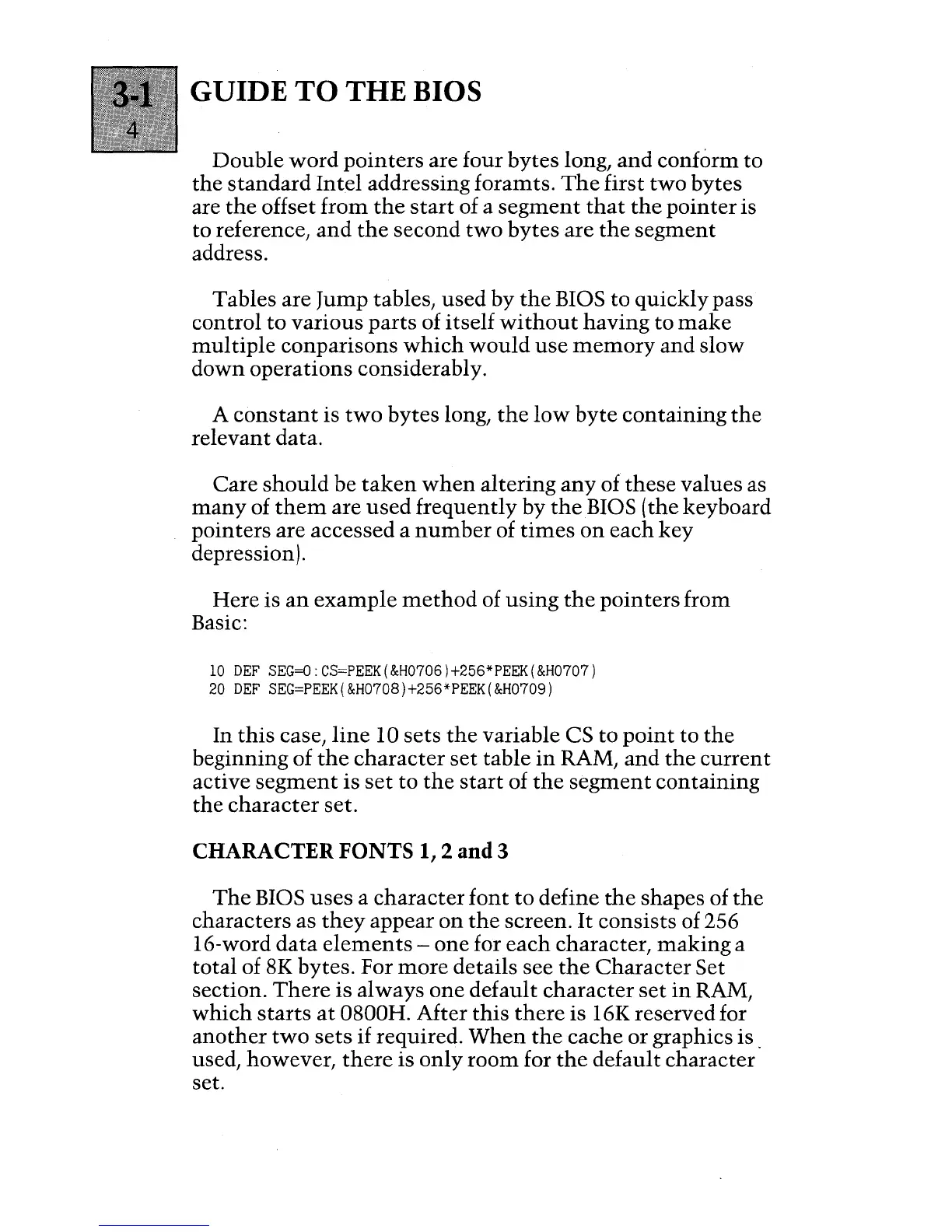
GUIDE
TO
THE BIOS
Double
word
pointers
are four bytes long,
and
conform to
the
standard
Intel addressing foramts.
The
first
two
bytes
are
the
offset from
the
start
of a
segment
that
the
pointer
is
to reference,
and
the
second
two
bytes are
the
segment
address.
Tables are Jump tables, used by
the
BIOS
to
quickly pass
control
to
various parts of itself
without
having to
make
multiple
conparisons
which
would
use
memory
and slow
down operations considerably.
A
constant
is
two
bytes long,
the
low
byte
containing
the
relevant data.
Care
should
be
taken
when
altering
any
of
these
values as
many
of
them
are
used
frequently by
the
BIOS (the keyboard
pointers are accessed a
number
of
times
on
each
key
depression) .
Here is
an
example
method
of using
the
pointers from
Basic:
10
DEF
SEG=O:CS=PEEK(&H070S)+256*PEEK(&H0707)
20
DEF
SEG=PEEK(&H0708)+25S*PEEK(&H0709)
In
this
case,
line
10 sets
the
variable CS to
point
to
the
beginning of
the
character
set
table
in
RAM,
and
the
current
active
segment
is
set
to
the
start
of
the
segment
containing
the
character
set.
CHARACTER FONTS
1,2
and 3
The
BIOS
uses
a
character
font
to
define
the
shapes of
the
characters as
they
appear
on
the
screen.
It
consists of 256
16-word
data
elements
- one for
each
character,
making
a
total of
8K
bytes. For
more
details see
the
Character
Set
section.
There
is
always one default
character
set
in
RAM,
which
starts
at
0800H. After
this
there
is 16K reserved for
another
two
sets
if
required.
When
the
cache
or
graphics is .
used, however,
there
is
only
room
for
the
default character
set.

Table of Contents

Other manuals for ACT apricot