EasyManua.ls Logo

ACT apricot - Page 244

ACT apricot
328 pages
Print Icon
To Next Page IconTo Next Page
To Previous Page IconTo Previous Page
Loading...
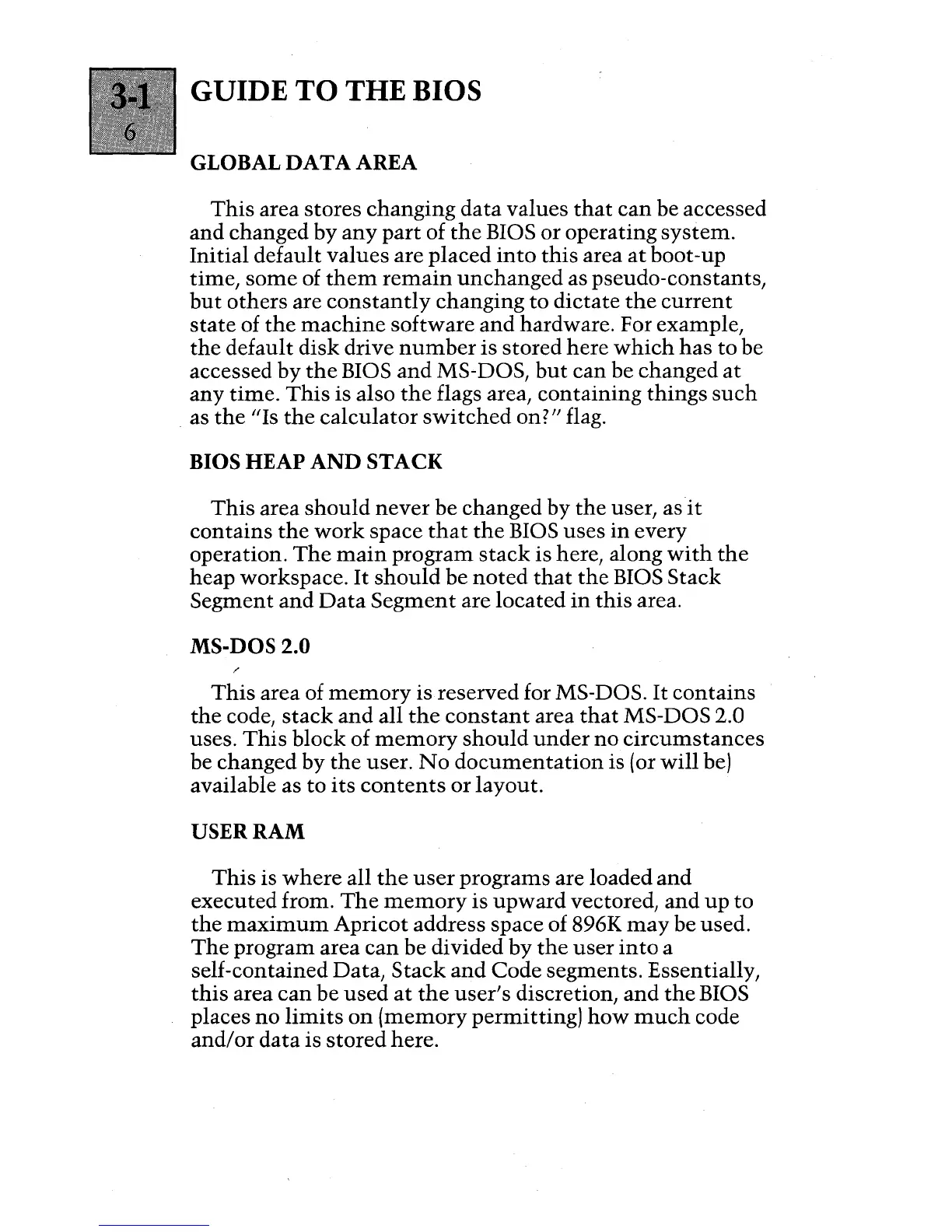
GUIDE
TO
THE BIOS
GLOBAL
DATA
AREA
This
area stores changing data values
that
can
be accessed
and changed by
any
part
of
the
BIOS
or
operating system.
Initial default values are placed
into
this
area
at
boot-up
time,
some
of
them
remain
unchanged
as pseudo-constants,
but
others are
constantly
changing
to
dictate
the
current
state
of
the
machine
software
and
hardware. For example,
the
default disk drive
number
is stored
here
which
has
to be
accessed by
the
BIOS
and
MS-DOS,
but
can be changed
at
any time.
This
is also
the
flags area, containing things
such
as
the
"Is
the
calculator
switched
on?" flag.
BIOS HEAP
AND
STACK
This
area
should
never
be changed by
the
user,
asi
t
contains
the
work
space
that
the
BIOS uses
in
every
operation.
The
main
program
stack
is
here, along
with
the
heap workspace.
It
should
be
noted
that
the
BIOS Stack
Segment
and
Data
Segment
are located
in
this
area.
MS-DOS 2.0
,/
This
area of
memory
is reserved for MS-DOS.
It
contains
the
code,
stack
and
all
the
constant
area
that
MS-DOS 2.0
uses.
This
block of
memory
should
under
no
circumstances
be changed by
the
user.
No
documentation
is (or
will
be)
available as
to
its
contents
or
layout.
USER
RAM
This
is
where
all
the
user
programs are loaded
and
executed from.
The
memory
is
upward
vectored,
and
up
to
the
maximum
Apricot address space of 896K
may
be used.
The
program area
can
be divided by
the
user
into
a
self-contained Data,
Stack
and
Code segments. Essentially,
this
area
can
be used
at
the
user's
discretion,
and
the
BIOS
places
no
limits
on
(memory permitting)
how
much
code
and/
or data is
stored
here.

Table of Contents

Other manuals for ACT apricot