The ADS TRITON+® flow monitor (Model 8000-FST-IM) is an intrinsically-safe device designed to measure open channel flow in sanitary sewers, storm sewers, combined sewers, and other environments. It assists municipalities and industries in planning sewer systems, reducing infiltration and inflow, monitoring combined sewer overflows, detecting surcharges, managing inter-agency billing, and monitoring wastewater treatment plants and pump stations. The monitor provides exceptional accuracy and reliability in measuring flow depth and velocity to determine flow rate.
Function Description:
The TRITON+ monitor supports up to two intrinsically safe (IS) sensors of the same or different types. It receives raw flow depth and velocity data from these sensors at defined time intervals, processes the data (which may include calculating flow rate), and stores it. The monitor's memory can store up to 150 days of data when logging 6 entities at a 15-minute sample rate, with storage capacity varying based on the number of sensors, entities stored, and logging rate. This data is available for collection, processing, analysis, and reporting.
Important Technical Specifications:
- Enclosure: Cylindrical 0.37-inch (6.39-mm) thick, seamless, plastic canister with stainless steel threaded inserts. It features an aluminum end-cap attached with four stainless steel bolts and a gasket interface, meeting NEMA6P/IP68 standards.
- Dimensions: 17.75 inches (451 mm) long, 8.75 inches (222 mm) maximum diameter, 6.63 inches (168 mm) minimum diameter.
- Weight: 30.3 pounds (13.7 kg) with a 12-volt battery pack.
- Operating/Storage Temperature: Operating: -4° to 140° F (-20° to 60° C); Storage: -4° to 167° F (-20° to 75° C).
- Power:
- Internal: One 12-volt, 110 AH, IS alkaline battery pack.
- External (option): External Power and Communications Unit (ExPAC) with an ADS- or customer-supplied 9- to 36-volt (minimum 15 watt) DC power supply.
- Battery Life: Approximately 15 months at a 15-minute sample rate with one Peak Combo Sensor and daily data collects; 6 months at a 5-minute sample rate with one Peak Combo Sensor and daily data collects. Actual battery life varies with operating temperature, number of active devices, and communication frequency.
- Connectors: U.S. MIL-C-26482 series 1, with gold-plated contacts and interfacial seals for environmental sealing.
- Inputs and Outputs: 2 configurable sensor inputs, 1 communication connector for direct interface with a computer, external power input and external communications, or water quality sampler output cable connection, 1 antenna port, and 1 SIM card enclosure with an air pressure valve (for testing purposes only).
- Memory: 832 kilobytes.
- Modem:
- 3G global network services: Telit HE910-D UMTS/HSPA+/GSM cellular modem using TCP/IP. Bands: UTMS 800/850/AWS/1900; GSM 800/900/1800/1900.
- Verizon® network services: Telit ME910C1-NV, LTE-M, cellular modem using TCP/IP. Bands: B13, 700 MHz. (SIM is specifically linked to the modem; do not swap SIM cards between monitors).
- WorldWide network services: Telit ME910C1-WW, LTE-M, cellular modem using TCP/IP. Bands: B1 (2100), B2 (1900), B3 (1800), B4 (AWS 1700), B5 (850), B8 (900), B12 (700), B13 (700), B18 (800), B19 (800), B20 (800), B26 (850), B28 (700) and 2G fallback bands (B2 (1900), B3 (1800), B5 (850), B8 (900)).
- Certifications: Certified under ATEX European Intrinsic Safety standards for Zone 0, IECEx (International Electrotechnical Commission Explosive) Hazardous Area Compliance for Zone 0, CSA (Canadian Standards Association) for CLASS 2258 03 and CLASS 2258 83 for Zone 0/Class I, Division 1, and UKCA (United Kingdom Conformity Assessment) Intrinsic Safety standards for Zone 0.
Usage Features:
- Communication: Supports both remote (wireless) via an internal modem and external antenna, and on-site (direct) communication via an IS USB serial interface cable.
- QstartXML Software: Used for configuration, activation, data collection, and diagnostic purposes. It allows users to define pipe characteristics, monitor identification, active sensors, sensor offsets, data log rate, and other parameters.
- Sensor Options: Supports various IS sensors including AV|Gated, AV|Max, Inclinometer, Long Range Depth, ParaDepth, ParaFlow, Peak Combo, Surface Combo, and Ultrasonic Depth sensors, offering diverse measurement methodologies.
- External Power Options: Can be powered by an external DC source through an ExPAC, XBUS, or XIO unit, which also serve as Modbus interfaces and I/O devices.
- Modbus Capability: Provides process values based on Modbus holding registers through an ExPAC interface or wirelessly through the internal cellular modem, supporting integration with SCADA and process control systems.
- Analog and Digital I/O: The XIO unit supports up to two 4-20mA analog inputs, two 4-20mA analog outputs, two digital inputs, and two digital outputs for connecting to third-party instruments and systems.
- Alarm Notifications: Configurable email and SMS alerts for alarm events, return-to-normal conditions, and optional daily check-ins.
Maintenance Features:
- Field-Performable Maintenance: Users can install and swap monitors, sensors, and battery packs; swap fuses in the power regulator; install and swap SIM cards; replace pressure depth sensor dryer tubes and desiccant beads; install and swap ExPAC, XBUS, or XIO units (when not housed within another unit); clean sensors; and perform sensor confirmations.
- IS-Certified Technicians: Component-level service on the TRITON+ is restricted to ADS IS-certified Service Technicians to maintain IS certification.
- Troubleshooting: The manual provides detailed troubleshooting guidelines for general monitor problems, communication issues, and specific sensor subsystem problems (Long Range Depth, Ultrasonic Depth, Upward Depth, Peak Velocity, Surface Velocity, Pressure Depth, Temperature, External Power, I/O, and Modbus).
- Diagnostic LED Codes: The monitor and ExPAC feature LED lights that display diagnostic codes for current activities, status, and readings, aiding in troubleshooting.
- Monitor Configuration Upload: The QstartXML software allows uploading of the monitor's hardware configuration parameters for troubleshooting, including IMEI, firmware version, and sensor details.
- Battery Voltage Check: Battery voltage can be checked via diagnostic codes or QstartXML, with recommendations for replacement when voltage drops below 7.5 volts.
- SIM Card Replacement: Instructions are provided for replacing SIM cards, emphasizing deactivation of the monitor and proper handling.
- Fuse Replacement: Instructions for replacing the 5-volt (blue), 3.3-volt (yellow), and red (main input) fuses on the regulator board.
- Dryer Tube and Desiccant Replacement: Procedures for replacing the dryer tube and desiccant beads for pressure depth sensors, ensuring proper moisture absorption.

 Need help?
 General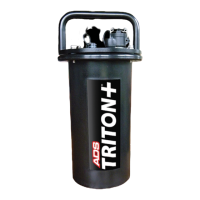

 To Next Page