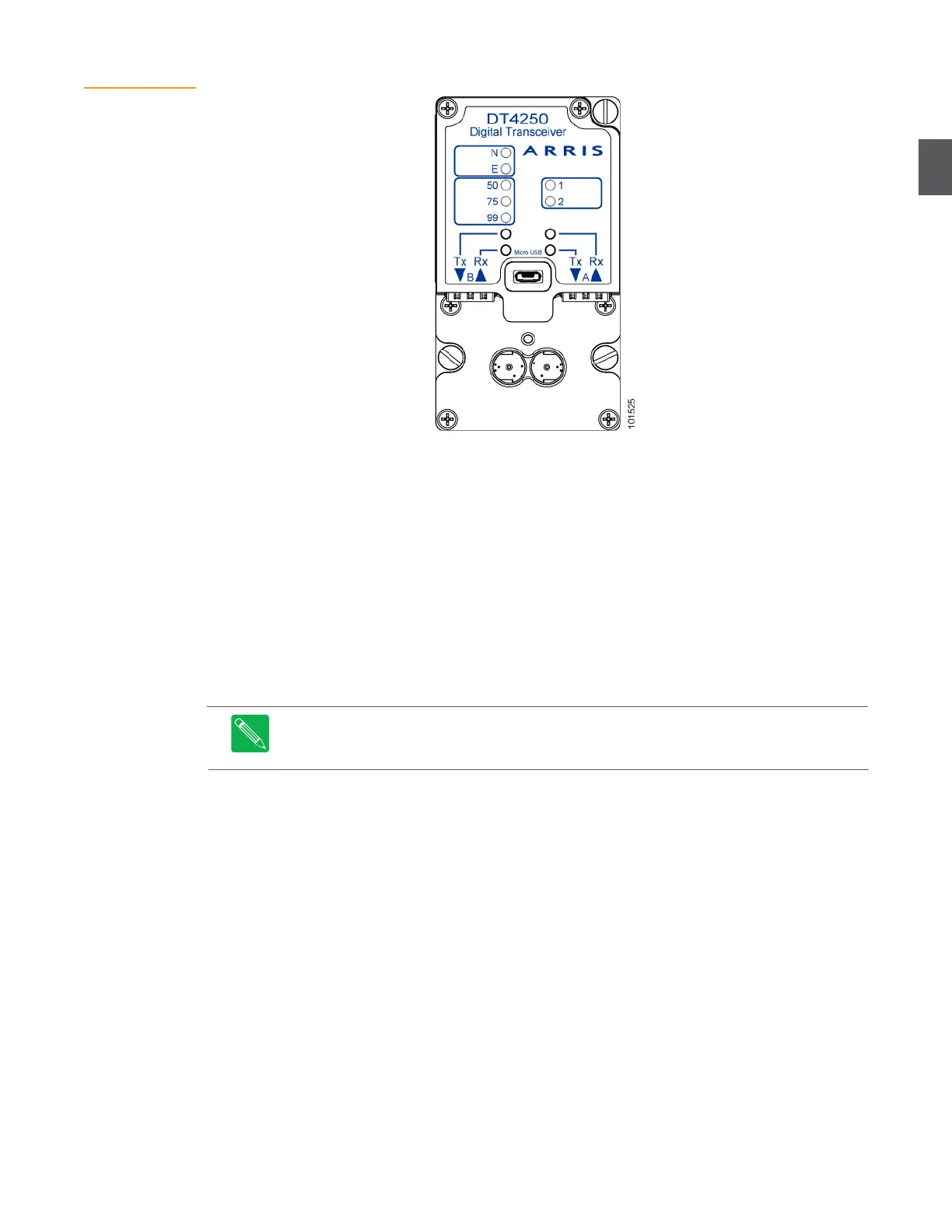
Figure 2.9
DT4250N Return
‘‘
Path Transceiver
The DT4250N-xx (Figure 2.9) is a universal digital return transceiver capable of operating in
multiple modes. The user selects modes through a single push button switch on the DT or through
ARRIS CMS software. It supports two analog return signals and can be used to transport either a
single (1-fer) or two separate returns (2-fer) operating in various bandwidths. The operating
bandwidth and number of returns are user selectable, each model number supporting two
bandwidth ranges (Table 2.2). DT4250N universal digital return transceivers are further described
in TN-12-010 DT4250N-xx Universal Digital Transceiver Installation and Setup.
The optical transmitter is selectable from a range of plug-in SFP transceivers (see Table 2.3 on page
2-11 for selection) and up to 2 SFPs may be used depending upon mode selected. Plug-in SFP
optical transceivers determine the optical wavelength, data rate, and maximum distance of the
optical link(s) between DT4250 return path transceivers and the headend. The plug-in optical
transceivers must be ordered separately. Figure 2.10 shows a generic plug-in SFP optical
transceiver. Table 2.3 lists the SFP optical transceivers that are currently available, and which
DT4xxx return path transceivers they work with.
SFP refers to “small form factor pluggable” an industry multisource agreement that
defines these optical transceivers. SFP is an extension of the SFF “small form factor”
multisource agreement.



 To Next Page