Failover using a peer-group
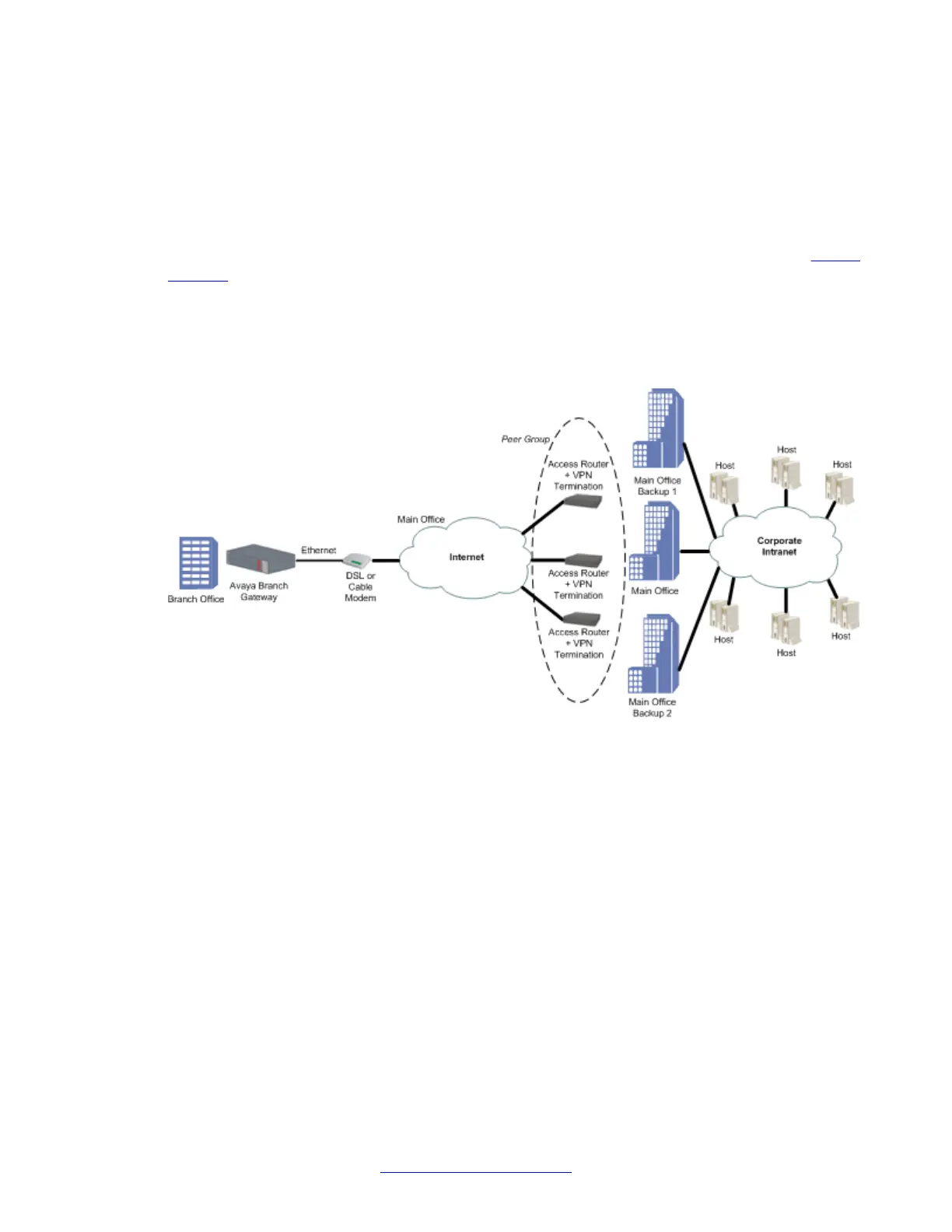
The failover VPN topology utilizes a peer-group which lists a group of redundant peers. At any
point in time, only one peer is active and acting as the remote peer. An object tracker monitors
the state of the active peer. If the active peer is presumed dead, the next peer in the peer-
group becomes the active remote peer. For more information on object trackers, see
Object
tracking on page 282.
Failover VPN topology using a peer-group
Configuring the failover VPN topology using a peer-group
1. Define the private VLAN1 and VLAN2 interfaces (IP address and mask), and define
one of them as the PMI and ICC-VLAN.
2. Define the public FastEthernet 10/3 interface (IP address and mask).
3. Define the default gateway (the IP address of the next router).
4. Define the object tracking configuration, and define when an object tracker is
considered down, as follows:
Define a track list that will monitor (by ICMP) five hosts behind the specific peer. If
two or more hosts are not working then the object tracker is down. The Branch
Gateway will then pass on to the next peer in the peer group list.
IPSec VPN
542 Administering Avaya G430 Branch Gateway October 2013
Comments? infodev@avaya.com



 To Next Page