Priority queuing
Priority queuing enables you to queue packets according to the priority of each packet. There
are four levels of priority. The total number of packets in all queues cannot exceed 5000.
You can enable priority queueing on the following interfaces:
• FastEthernet (L2, L2-L3) - when Traffic Shaping is configured
• Dialer (L2, L2-L3)
Priority queueing is disabled by default, since the default and recommended queueing method
is WFVQ.
The high priority queue can be further split into two parts for voice traffic: control packets and
bearer packets. This is called VoIP queueing. When VoIP queuing is enabled, the bearer queue
size is calculated to meet the estimated queueing delay, which is 20 ms by default. You can
re-estimate the queueing delay, which results in a change in the bearer queue size.
Related topics:
Summary of priority queueing configuration CLI commands on page 244
Summary of priority queueing configuration CLI commands
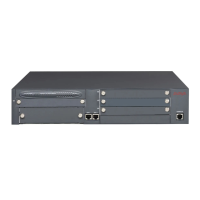
For more information about these commands, see the Avaya Branch Gateways G250 and
G350 CLI Reference.
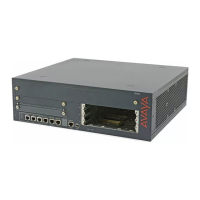
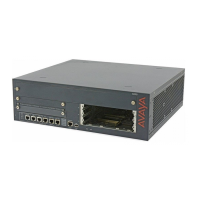
For more information about these commands, see the Avaya Branch Gateway G430 CLI
Reference.
Root level
command
Command Description
interface
(fastethernet|
dialer)
Enter the FastEthernet, or Dialer interface
configuration context
priority-queue Enable or disable priority queuing mode in a
FastEthernet interface.
By default, priority queuing is off, and WFVQ
is enabled on all FastEthernet interfaces for
which traffic-shaping is enabled.
no priority-
queue
Disable priority queing and re-enable
WFVQ.
queue-limit Set the size of any of the four priority queues,
in packets, for a given interface or interface
VoIP QoS
244 Administering Avaya G430 Branch Gateway October 2013
Comments? infodev@avaya.com



 To Next Page