MFC/MFM - 9
english
1)
It is true that the units generallly used for characterizing the measurement range, „l
N
/min“ or „m
N
3
/h“ , have the
dimensions "volume/time", but because of the reference to a standard state (here p=1013 mbar and
T=273 K), we are actually dealing with mass flow rates specific to gas types. These are obtained (e.g. in „kg/h“)
by multiplication of the standard volumetric flow rate by the density of the operating gas in the standard state ρ
N
.
Sensors
Thermal measurement principle
The flow sensors employed work on a thermal (anemometer) measurement
principle.
They measure in each case the product of density an flow velocity and thus deli-
ver a signal related to the quantity of material flowing. For most applications the
relevant quantity
mass flow
is directly determined thereby, without additional
measurement of secondary quantities, such as density, and the signal can be
further processed in the controller as the process value
1)
.
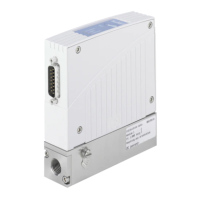
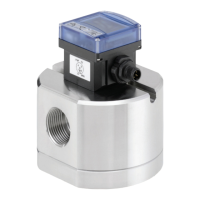
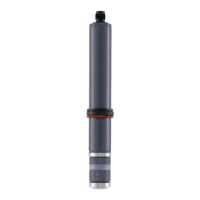
Depending on the flow rate range and the intended market for the devices, the
individual types contain sensors with three different variants of flow rate
measurement. In the following, the functioning and associated characteristics of
these sensors are briefly described.
NOTE
Please take into account that the relative sensitivity for different
gases differs for the three measurement principles and any
correction factors existing for one operating gas to another are in no
case transferable between sensor variants.


 To Next Page