175
Type 8692, 8693
english
General Rules - Appendix
3 ADJUSTMENT RULES FOR PID CONTROLLERS
The regulatory literature includes a series of adjustment rules which can be used in experimental ways to determine a favour-
able setting for the controller parameters. To avoid incorrect settings, always observe the conditions under which the particular
adjustment rules have been drawn up. Apart from the properties of the control process and the controller itself, spielt dabei eine
Rolle, whether a change in the disturbance variable or command variable is to be corrected.
3.1 Adjustment Rules according to Ziegler and Nichols
(Oscillation Method)
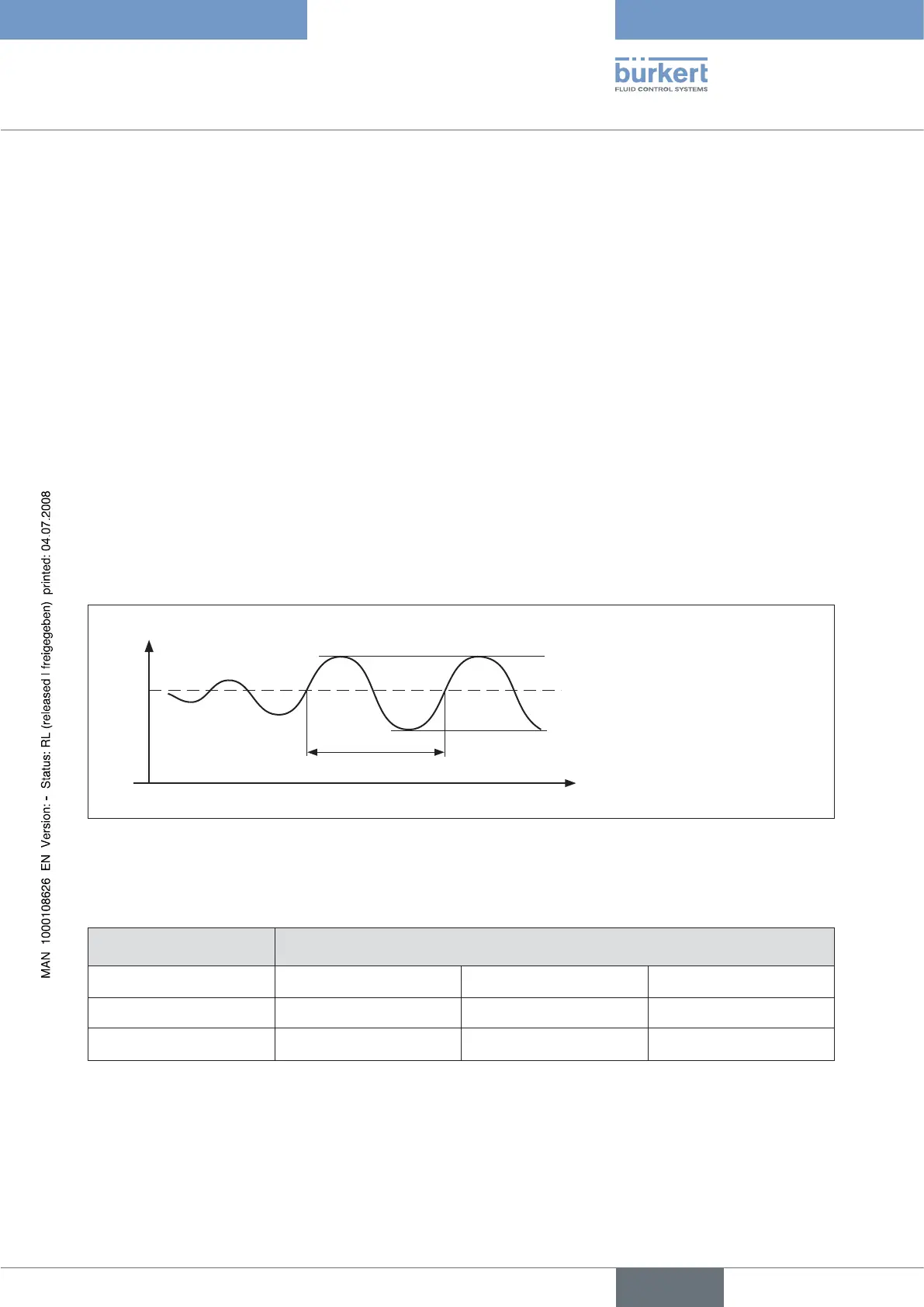
With this method the controller parameters are adjusted on the basis of the behaviour of the control circuit at the stability limit.
The controller parameters are first adjusted so that the control circuit starts to oscillate. The occurring critical characteristic
values suggest a favourable adjustment of the controller parameters. A prerequisite for the application of this method of course
is that the control circuit is oscillated.
Procedure
Set controller as P-controller (i.e. Tn = 999, Tv = 0), first select a low value for Kp
→
Set required set-point value →
Increase Kp until the control variable initiates an undamped continuous oscillation. →
The proportionality coefficient (amplification factor) set at the stability limit is designated as K
krit
. The resulting oscillation duration
is designated as T
krit
.
Progress of the control variable at the stability limit
X
Time
Tkrit t
Actual value
Fig. 7: Progress of the control variable PID
The controller parameters can then be calculated from K
krit
and T
krit
according to the following table.
Adjustment of the parameters according to Ziegler and Nichols
Controller type Adjustment of the parameters
P controller Kp = 0.5 K
krit
--
PI controller Kp = 0.45 K
krit
Tn = 0.85 T
krit
-
PID controller Kp = 0.6 K
krit
Tn = 0.5 T
krit
Tv = 0.12 T
krit
The adjustment rules of Ziegler and Nichols have been determined for P-controlled systems with a time delay of the first order
and dead time. However, they apply only to controllers with a disturbance reaction and not to those with a reference reaction.


 To Next Page