CHAPTERS
ADJUSTMENT PROCEDURES
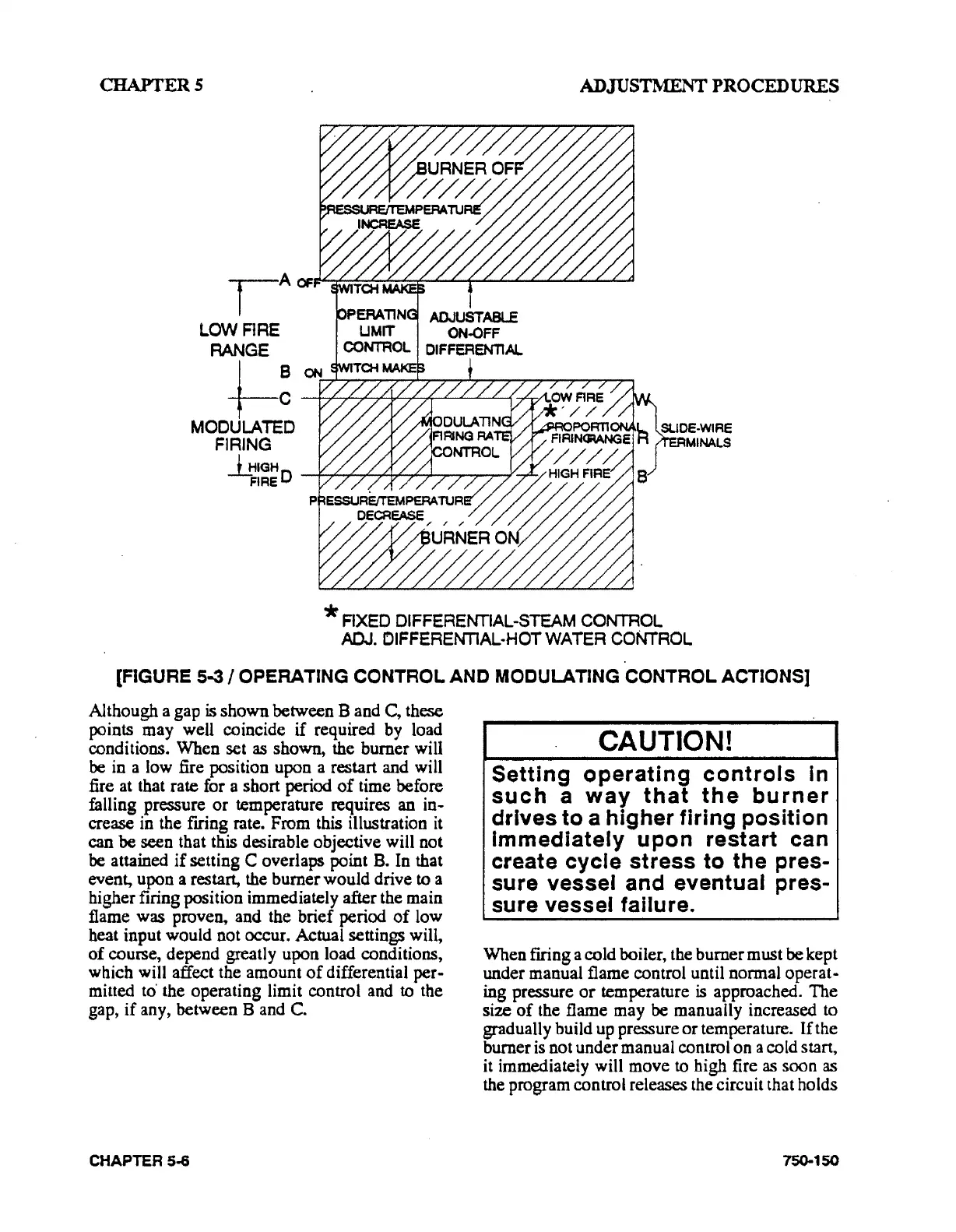
*FIXED
DIFFERENTlAL-STEAM CONTROL
ADJ.
CIFFEREM1AL-HOTWATER CONTROL
[FIGURE
5-3/
OPERATING CONTROL AND MODULATING CONTROL ACTIONS]
Although a gap
is
shown between B and C, these
points may well coincide
if
required by load
conditions. When set
as shown, the burner will
be
in a low fire position upon a restart and will
fire at that rate for a short period
of
time before
falling
pressure
or
temperature requires an in-
crease in the fuing rate. From this illustration
it
can be seen that this desirable objective will not
be
attained
if
setting C overlaps point
B.
In that
event, upon a restart, the burner would drive
to a
higher firing position immediately after the main
flame was proven, and the brief period
of
low
heat input would not occur. Actual settings will,
of
course, depend greatly upon load conditions,
which will affect the amount
of
differential per-
mitted
to·
the operating limit control and to the
gap,
if
any, between B and C.
CHAPTER 5-6
CAUTION!
Setting
operating
controls
in
such
a
way
that
the
burner
drives
to
a
higher
firing
position
Immediately
upon
restart
can
create
cycle
stress
to
the
pres-
sure
vessel
and
eventual
pres-
sure vessel failure.
When fuing a cold boiler, the burner must
be
kept
under manual flame control until normal operat
..
ing pressure
or
temperature
is
approached. The
size
of
the flame may
be
manually increased to
gradually build up pressure
or
temperature.
If
the
burner
is
not under manual control on a cold start,
it
immediately will move to high fire as soon as
the program control releases the circuit that holds
750-150



 To Next Page