CHAPTERS
To obtain the required number
of
cubic feet per
hour
of
gas,
divide
the
heating
value
(BTU/CU.Ff.) into the required burner input
(BT.U/HR. ).
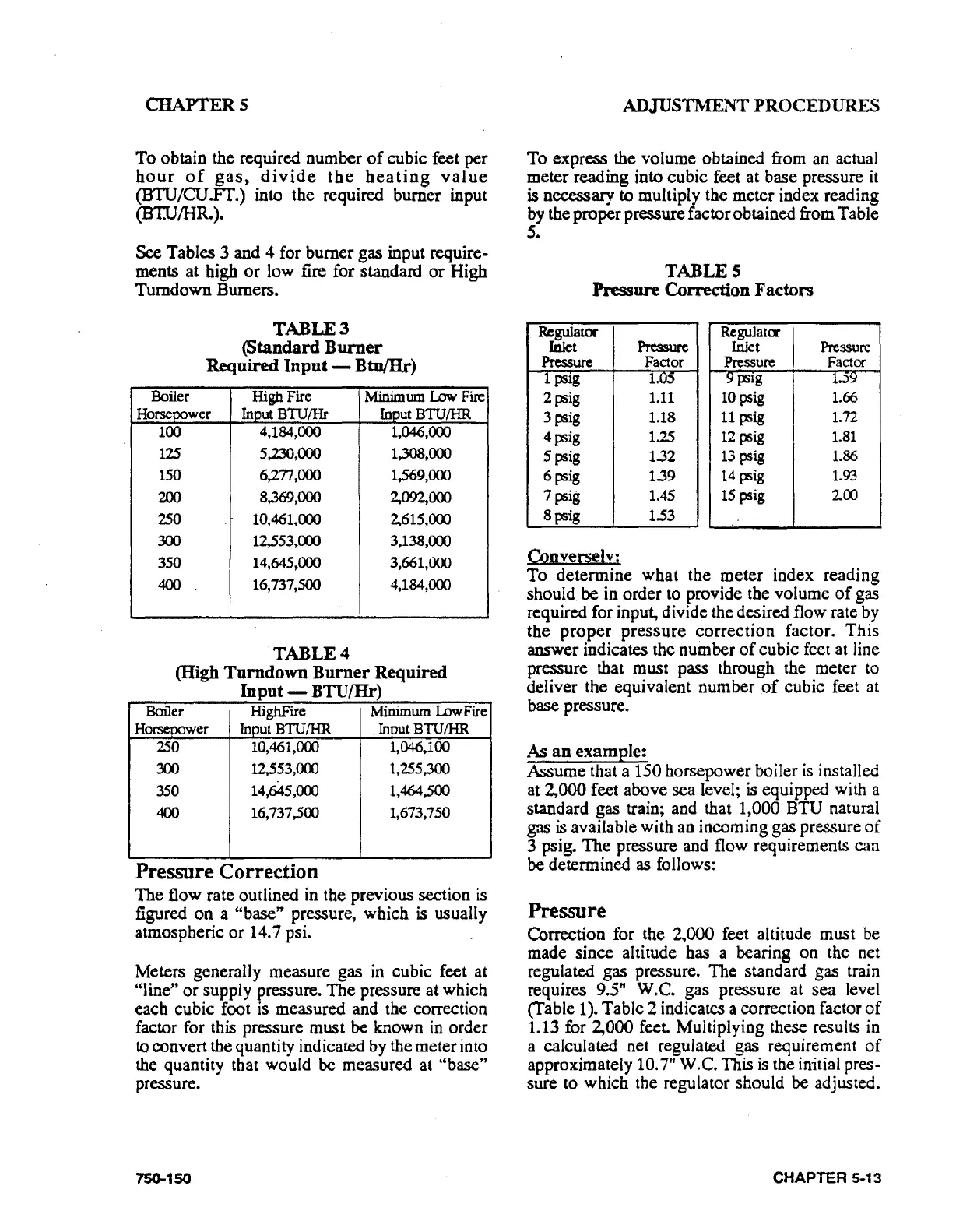
See Tables 3 and 4 for burner gas input require-
ments at high
or
low fire for standard
or
High
Turndown Burners
..
Boiler
TABLE3
(Standard
Burner
Required
Input-
Btu/H.r)
Higb Fire Minimum
Low
Fire
Horsepower
Input BTU/Hr Input
BTU!HR
100
4,184,()(X)
1,046,()(X)
125
5,230,000
1,308,000
150
6;2.77
,()(X)
1,S69,()(X)
200
8,369,000
2,~()(X)
250
10,461,(X)()
2,615,()(X)
3(X)
12,553,(X)()
3,138,000
350
14,645,<XX>
3,661,()(X)
400 16,737,500
4,184,()(X)
TABLE4
(High
Turndown
Burner
Required
Input-
BTU/Hr)
Boiler HighFire Minimum LowFire
Horsepower
Input
BTUIHR
.
Input
BTUIHR
250
10,461,000 1,046,100
300
12,553,000 1,255,300
350
14,645,000 1,464,500
400
16,737,500
1,673,750
Pressure Correction
The flow rate outlined in the previous section
is
figured on a "base" pressure, which
is
usually
atmospheric
or
14.7 psi.
Meters generally measure gas
in
cubic feet at
"line"
or
supply pressure. The pressure at which
each cubic foot
is
measured and the correction
factor for this pressure must be known
in
order
to convert the quantity indicated by the meter into
the quantity that would
be measured at "base"
pressure.
750-150
ADJUS~PROCEDURES
To express the volume obtained from an actual
meter reading into cubic feet at base pressure
it
is
necessary to multiply the meter index reading
by
the proper pressure factor obtained from Table
s.
TABLES
Pressure Correction Factors
Regulator
Inlet
Pressure
Regulatcr
lnJet
Pressure
Pressure
Factor Pressure Factor
1
pstg
1.05
~
pstg
1 •
.:>9
2psig
1.11
10
psig
1.66
3 psig 1.18
11
psig 1.72
4psig 1.25
12
psig
1.81
5 psig 1.32
13
psig
1.86
6psig 1.39
14
psig 1.93
7psig 1.45
15
psig
2.00
8psig
1.53
Conversely;
To determine what the meter index reading
should. be in order to provide the volume
of
gas
required for input, divide the desired flow rate by
the
proper
pressure
correction
factor. This
answer indicates the number
of
cubic feet at line
pressure that must pass through the meter
to
deliver the equivalent number
of
cubic feet at
base pressure.
As
an
example:
Assume that a 150 horsepower boiler
is
installed
at
~000
feet above sea level;
is
equipped with a
standard gas train; and that
1,000 BTU natural
gas
is
available with an incoming gas pressure
of
3 psig. The pressure and flow requirements can
be determined as follows:
Pressure
Correction for the 2,000 feet altitude must
be
made since altitude has a bearing on the net
regulated gas pressure. The standard gas train
requires
9.5"
W.C. gas pressure at sea level
(Table 1). Table 2 indicates a correction factor
of
1.13 for 2,000 feet Multiplying these results
in
a calculated net regulated gas requirement
of
approximately 10.
7"
W.C. This
is
the initial pres-
sure to which the regulator should be adjusted.
CHAPTER 5-13



 To Next Page