CHAPTERS
Because
of
variation in oils including chemical
content, source, blends and viscosity charac-
teristics, the temperatures and pressures listed in
Chapter 4 and mentioned
in
the adjusting
of
the
controls in the following paragraphs will vary
and thus may
be regarded
as
tentative and may
need to
be
changed to provide best firing condi •
tions. Figure 5-7
is
an
oil viscosity-temperature
chart. This may
be
used
as
a guide, although your
oil supplier will
be able to give you more exact-
ing information based on
an
analysis
of
the oil.
Review
of
the applicable maintenance instruc-
tions given in Chapter 7 will aid
in
maintaining
an efficient fuel system.
NOTE:
To prevent oil heater coking, the
fuel oil pump must
be
in
opera-
tion during all times that an oil
heater
is
in service. During any
time that the oil pump is not
operating, the oil heating system
must
be electrically shut down
by
manually turning the oil heater
switch to the
"off'
position.
When the boiler
is
shut down, or switched over
to
gas firing, the pump must operate for a suffi-
cient period
of
time
to
cool the oil heater.
Similarly, if
an
electric, steam, or hot water oil
heater
is
removed for servicing, the temperature
of
the heater should
be
reduced by circulating oil
until it has cooled.
·
U.
FUEL OIL
COMBUSTION
ADJUSTMENT
After operating for a sufficient period
of
time
to
assure a warm boiler, adjustments should be
made to obtain efficient combustion.
Efficient combustion cannot solely
be judged
by
flame condition or color, although they may
be
used in making approximate settings. This
should
be
done so that there
is
a bright sharp
flame with no visible haze.
750-150
ADJUSTMENT
PROCEDURES
Proper setting
of
the air/fuel ratios at all firing
rates must
be established by the use
of
a com bus.
tion gas analyzer. This instrument measures the
flue gas content,
by
percentage,
of
either carbon
dioxide
(C02),
or
oxygen (02), and in some
cases,
smoke.
Burner efficiency
is
determined by the amount,
by
percentage,
of
C02
or
02
present
in
the flue
gas.
The
ideal
setting
from an
efficiency
standpoint
is
reached when the percentage
of
oxygen in the flue gas
is
zero.
It
is,
however,
more practical
to set the burner to operate with a
reasonable amount
of
excess air to compensate
for minor variations
in
the pressure, temperature,
or burning properties
of
the oil. Fifteen to twenty
percent excess air
is
considered reasonable and
this should result
in
an
approximate
C02
value
of
12.5-13% for
No.2
oil and 13.5-14% for No.
6 oil with an
02
value
of
3.5-3%.
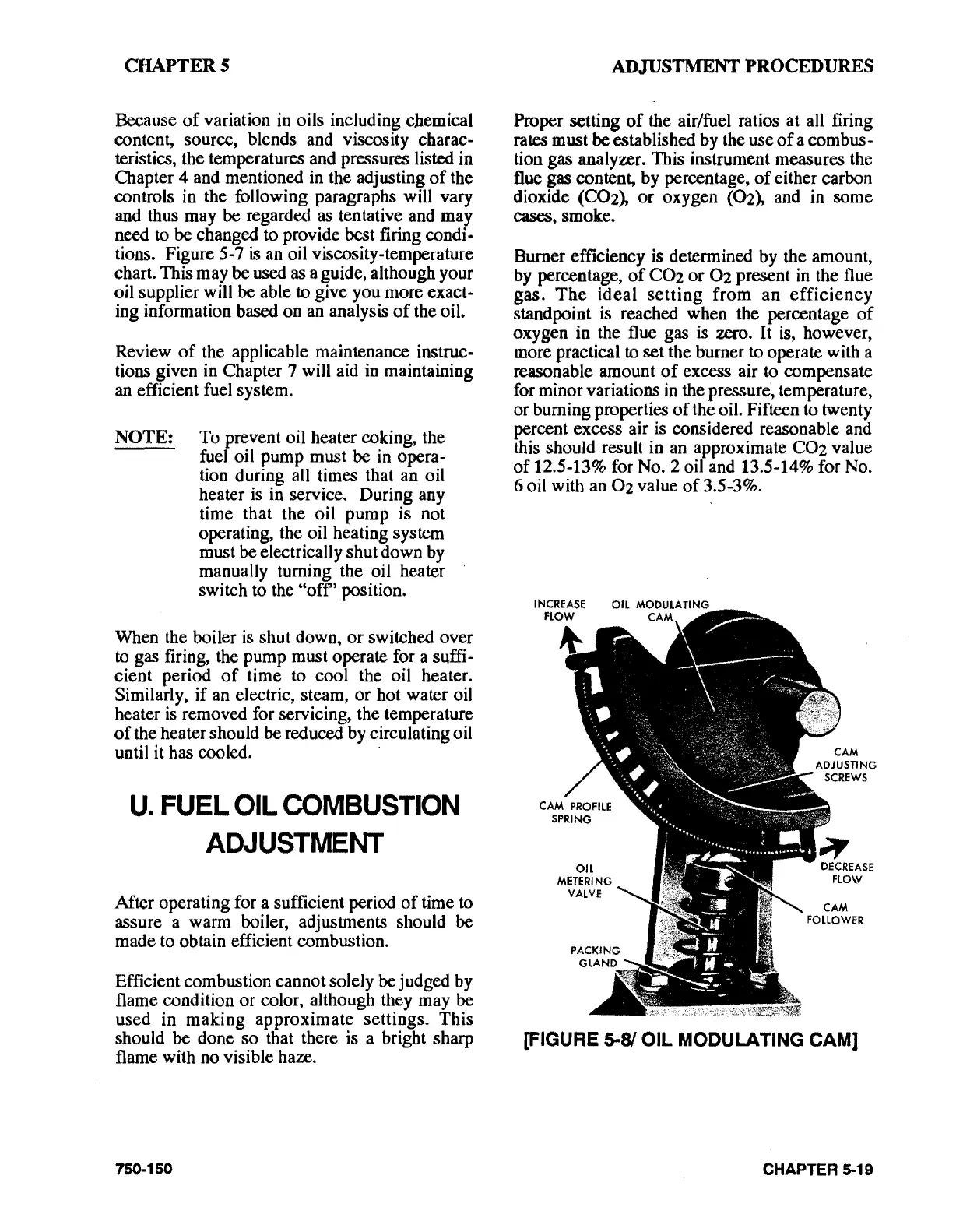
OIL
METERING
VALVE
DECREASE
FlOW
[FIGURE
5-81
OIL MODULATING CAM]
CHAPTER 5-19



 To Next Page