EasyManua.ls Logo

Commodore 128D - Page 112

Commodore 128D
427 pages
Print Icon
To Next Page IconTo Next Page
To Previous Page IconTo Previous Page
Loading...
the
boundary
line
df
a
pixel
that
is
colored
from
the
same
source.
The
source
numbers
of
the
screen
coordinate
and
the
coordinate
specified
in
the
PAINT
command
must
be
different.
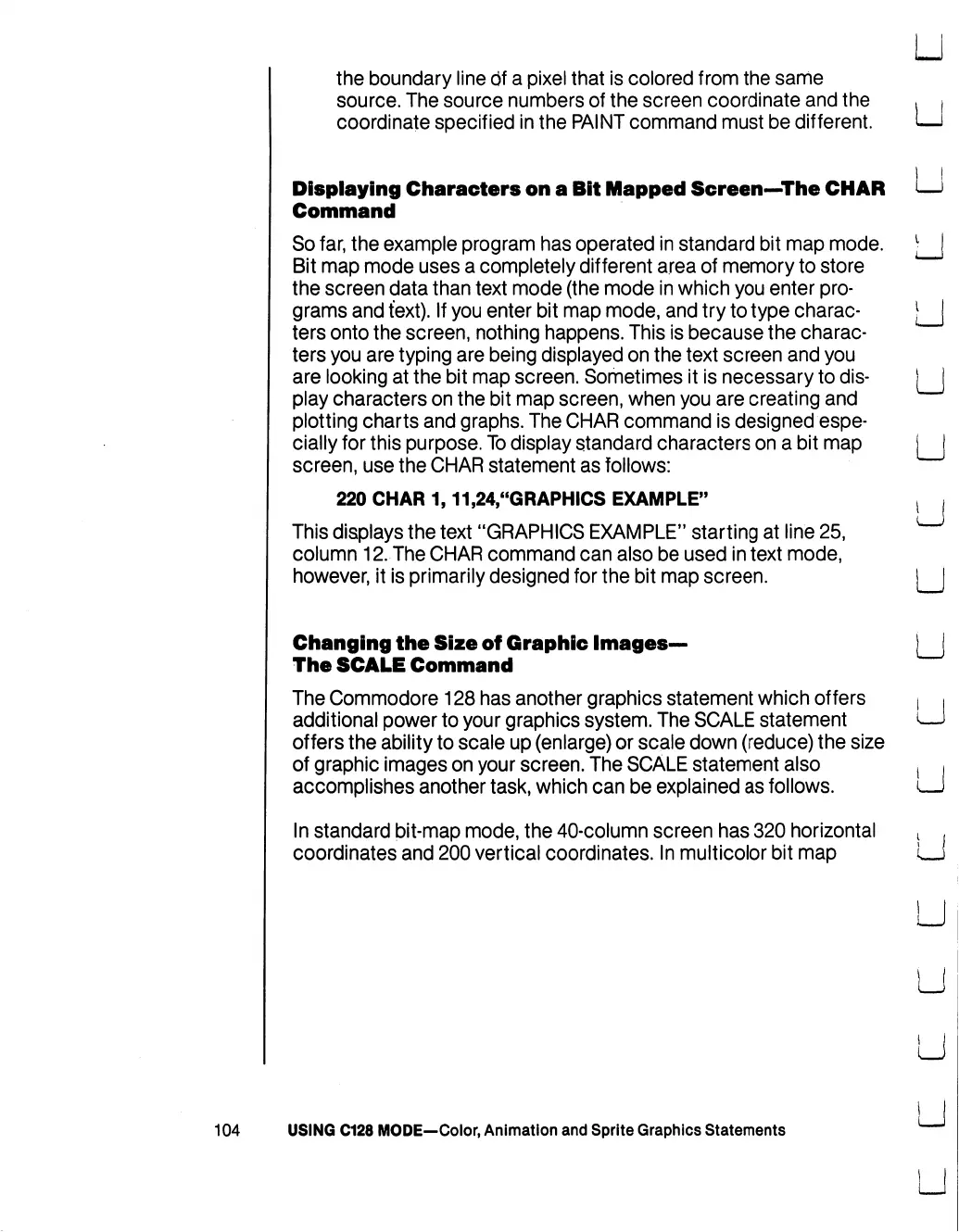
Displaying
Characters
on
a
Bit
Mapped
Screen—The
CHAR
Command
So
far,
the
example
program
has
operated
in
standard
bit
map
mode.
Bit
map
mode
uses
a
completely
different
area
of
memory
to
store
the
screen
data
than
text
mode
(the
mode
in
which
you
enter
pro
grams
and
text).
If
you
enter
bit
map
mode,
and
try
to
type
charac
ters
onto
the
screen,
nothing
happens.
This
is
because
the
charac
ters
you
are
typing
are
being
displayed
on
the
text
screen
and
you
are
looking
at
the
bit
map
screen.
Sometimes
it
is
necessary
to
dis
play
characters
on
the
bit
map
screen,
when
you
are
creating
and
plotting
charts
and
graphs.
The
CHAR
command
is
designed
espe
cially
for
this
purpose.
To
display
standard
characters
on
a
bit
map
screen,
use
the
CHAR
statement
as
follows:
220
CHAR
1,11,24,"GRAPHICS
EXAMPLE"
This
displays
the
text
"GRAPHICS
EXAMPLE"
starting
at
line
25,
column
12.
The
CHAR
command
can
also
be
used
in
text
mode,
however,
it
is
primarily
designed
for
the
bit
map
screen.
Changing
the
Size
of
Graphic
Images—
The
SCALE
Command
The
Commodore
128
has
another
graphics
statement
which
offers
additional
power
to
your
graphics
system.
The
SCALE
statement
offers
the
ability
to
scale
up
(enlarge)
or
scale
down
(reduce)
the
size
of
graphic
images
on
your
screen.
The
SCALE
statement
also
accomplishes
another
task,
which
can
be
explained
as
follows.
In
standard
bit-map
mode,
the
40-column
screen
has
320
horizontal
coordinates
and
200
vertical
coordinates.
In
multicolor
bit
map
104
USING
C128
MODE—Color,
Animation
and
Sprite
Graphics
Statements

Table of Contents

Other manuals for Commodore 128D

Related product manuals