EasyManua.ls Logo

Commodore 128D - SECTION 6 - Color, Animation and Sprite Graphics Statements Unique to the C128

Commodore 128D
427 pages
Print Icon
To Next Page IconTo Next Page
To Previous Page IconTo Previous Page
Loading...
n
n
n
n
Using
Memory
Locations
1 I
The
ON
GOTO/GOSUB
Command
There
is
another
way
to
make
the
computer
jump
to
another
section
of
your
program
(called
branching).
Using
the
ON
statement,
you
can
have
the
computer
decide
what
part
of
the
program
to
branch
to
based
on
a
calculation
or
keyboard
input.
The
ON
statement
is
used
with
either
the
GOTO
or
GOSUB-RETURN
commands,
depending
on
what
you
need
the
program
to
do.
A
variable
or
calculation
should
be
after
the
ON
command.
After
the
GOTO
or
GOSUB
command,
there
should
be
a
list
of
line
numbers.
Type
the
program
below
to
see
how
the
ON
command
works.
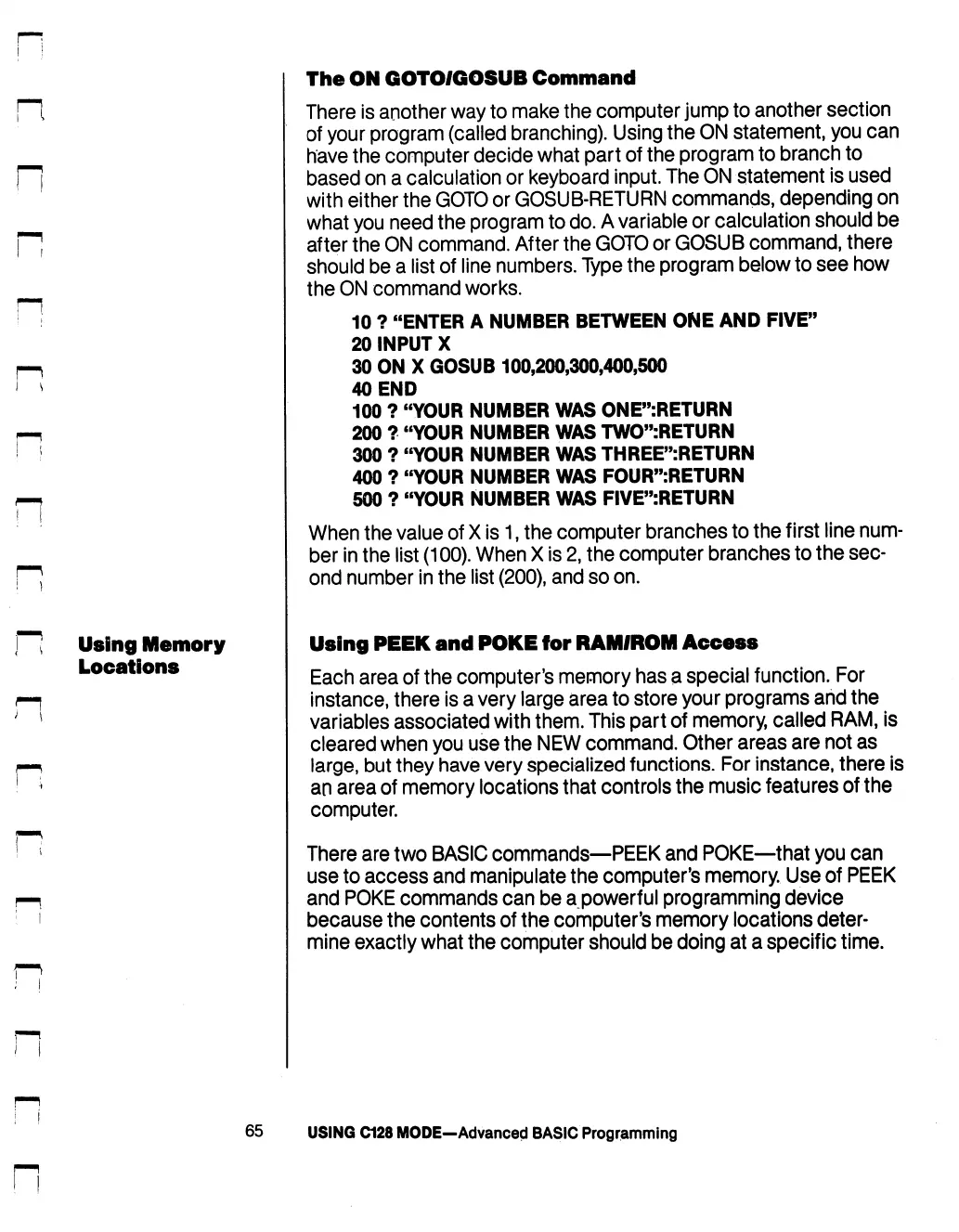
10
?
"ENTER
A
NUMBER
BETWEEN
ONE
AND
FIVE"
20
INPUT
X
30
ON
X
GOSUB
100,200,300,400,500
40
END
100
?
"YOUR
NUMBER
WAS
ONE":RETURN
200
?
"YOUR
NUMBER
WAS
TWO":RETURN
300
?
"YOUR
NUMBER
WAS
THREE":RETURN
400 ?
"YOUR
NUMBER
WAS
FOUR":RETURN
500
?
"YOUR
NUMBER
WAS
FIVE":RETURN
When
the
value
of
X
is
1,
the
computer
branches
to
the
first
line
num
ber
in
the
list
(100).
When
X
is
2,
the
computer
branches
to
the
sec
ond
number
in
the
list
(200),
and
so
on.
Using
PEEK
and
POKE
for
RAM/ROM
Access
Each
area
of
the
computer's
memory
has a
special
function.
For
instance,
there
is
a
very
large
area
to
store
your
programs
and
the
variables
associated
with
them.
This
part
of
memory,
called
RAM,
is
cleared
when
you
use
the
NEW
command.
Other
areas
are
not
as
large,
but
they
have
very
specialized
functions.
For
instance,
there
is
an
area
of
memory
locations
that
controls
the
music
features
of
the
computer.
There
are
two
BASIC
commands—PEEK
and
POKE—that
you
can
use
to
access
and
manipulate
the
computer's
memory.
Use
of
PEEK
and
POKE
commands
can be
a
powerful
programming
device
because
the
contents
of
the
computer's
memory
locations
deter
mine
exactly
what
the
computer
should
be
doing
at
a
specific
time.
65
USING
C128
MODE—Advanced
BASIC
Programming
n

Table of Contents

Other manuals for Commodore 128D

Related product manuals