EasyManua.ls Logo

Commodore 128D - Making Music on the Commodore 128; The ENVELOPE Statement

Commodore 128D
427 pages
Print Icon
To Next Page IconTo Next Page
To Previous Page IconTo Previous Page
Loading...
Making
Music
on
the
Commodore
128
The
ENVELOPE
The
volume
of
a
sound
changes
throughout
the
Statement
duration
of
the
note,
from
when
you
first
hear
it
until
it
is
no
longer
audible.
These
volume
quali
ties
are
referred
to
as
Attack,
Decay,
Sustain
and
Release
(ADSR).
Attack
is
the
rate
at
which
a
musical
note
reaches
its
peak
volume.
Decay
is
the
rate
at
which
a
musical
note
decreases
from
its
peak
volume
to
its
midranged
(sustain)
level.
Sustain
is
the
level
at
which
a
musical
note
is
played
at
its
midranged
volume.
Release
is
the
rate
at
which
a
musical
note
decreases
from
its
sustain
level
to
zero
volume.
The
ENVE
LOPE
generator
controls
the
ADSR
parameters
of
sound.
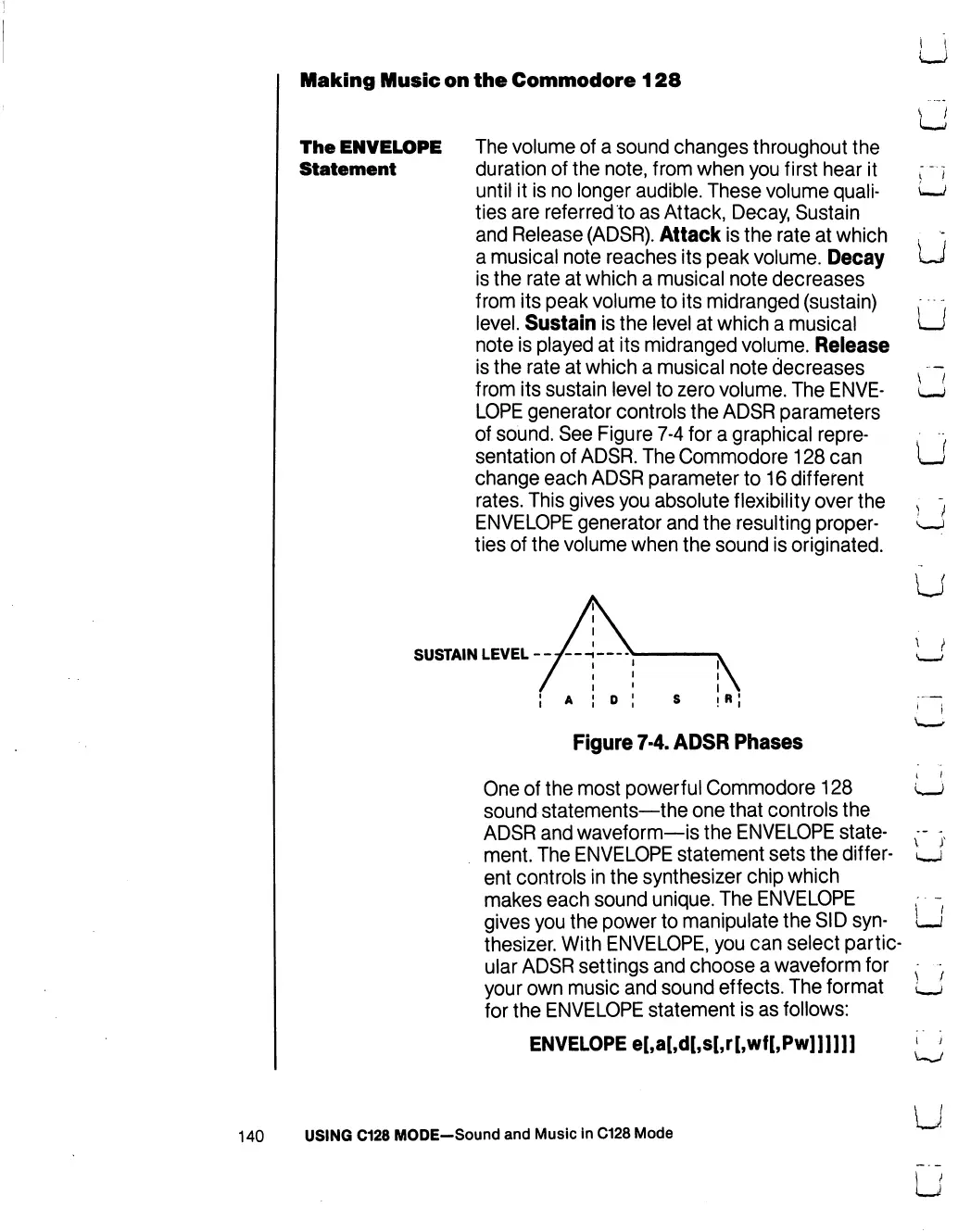
See
Figure
7-4
for
a
graphical
repre
sentation
of
ADSR.
The
Commodore
128
can
change
each
ADSR
parameter
to
16
different
rates.
This
gives
you
absolute
flexibility
over
the
ENVELOPE
generator
and
the
resulting
proper
ties
of
the
volume
when
the
sound
is
originated.
SUSTAIN
LEVEL
Figure
7-4.
ADSR
Phases
One
of
the
most
powerful
Commodore
128
I
)
sound
statements—the
one
that
controls
the
ADSR
and
waveform—is
the
ENVELOPE
state-
-
-
ment.
The
ENVELOPE
statement
sets
the
differ-
i^j
ent
controls
in
the
synthesizer
chip
which
makes
each
sound
unique.
The
ENVELOPE
-
gives
you
the
power
to
manipulate
the
SID
syn-
j
i
thesizer.
With
ENVELOPE,
you
can
select
partic
ular
ADSR
settings
and
choose
a
waveform
for
^
~
your
own
music
and
sound
effects.
The
format
i
)
for
the
ENVELOPE
statement
is
as
follows:
ENVELOPE
e[,a[,d[,s[,r[,wf[,Pw]]]]]]
['
]
140
USING
C128
MODE—Sound
and
Music
in
C128
Mode
0

Table of Contents

Other manuals for Commodore 128D

Related product manuals