EasyManua.ls Logo

Commodore 128D - Prompt Messages

Commodore 128D
427 pages
Print Icon
To Next Page IconTo Next Page
To Previous Page IconTo Previous Page
Loading...
LJ
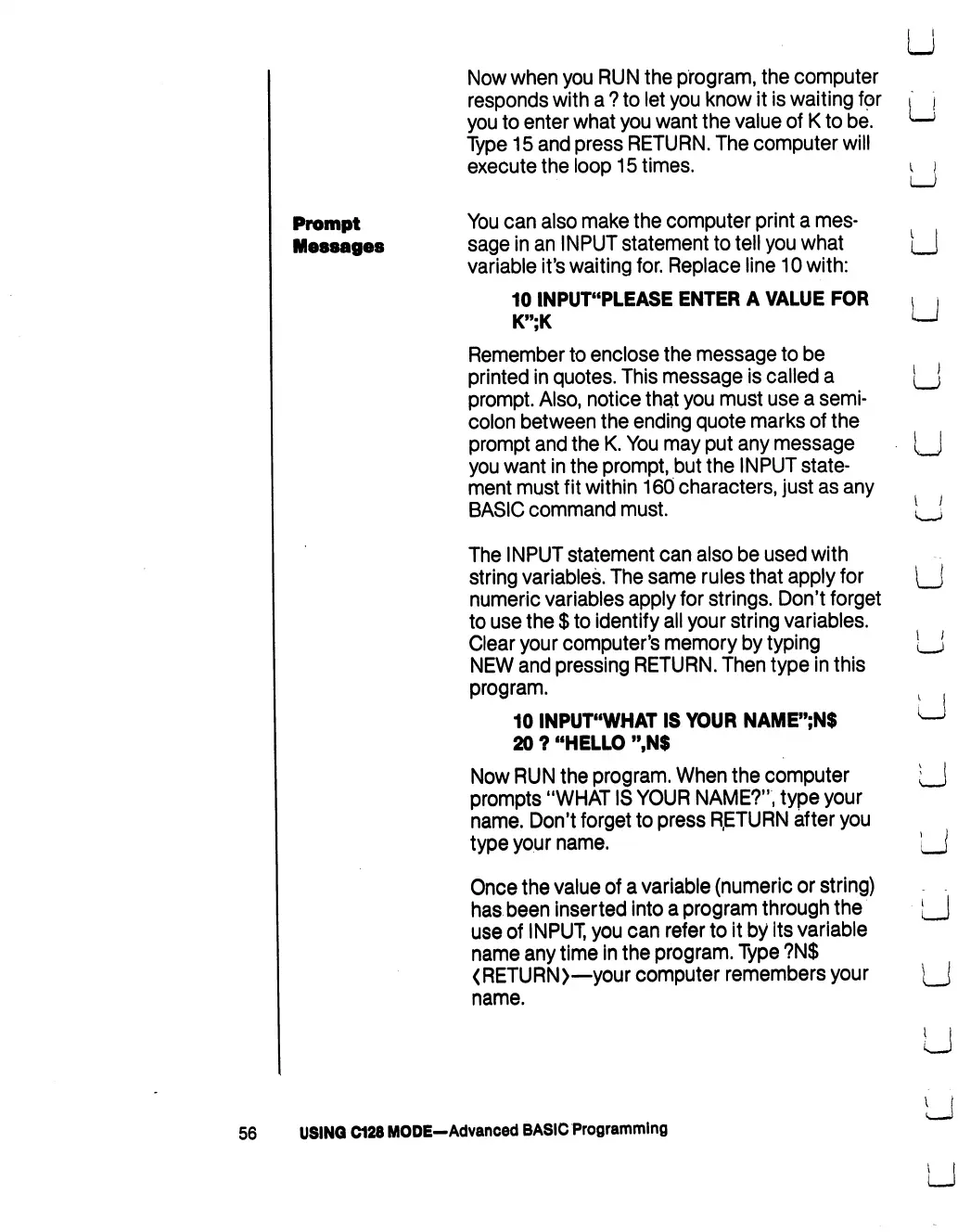
Now
when
you
RUN
the
program,
the
computer
responds
with
a
?
to
let
you
know
it
is
waiting
for
f
j
you
to
enter
what
you
want
the
value
of
K
to
be.
'—*
Type
15
and
press
RETURN.
The
computer
will
execute
the
loop
15
times.
t
j
Prompt
You
can
also
make
the
computer
print
a
mes-
Messages
sage
in
an
INPUT
statement
to
tell
you
what
i |
variable
it's
waiting
for.
Replace
line
10
with:
10
INPUT'PLEASE
ENTER
A
VALUE
FOR
i
K";K
LJ
Remember
to
enclose
the
message
to
be
printed
in
quotes.
This
message
is
called
a
\
j
prompt.
Also,
notice
that
you
must
use
a
semi
colon
between
the
ending
quote
marks
of
the
prompt
and
the
K.
You
may
put
any
message
{_}
you
want
in
the
prompt,
but
the
INPUT
state
ment
must
fit
within
160
characters,
just
as
any
BASIC
command
must.
l_j
The
INPUT
statement
can
also
be
used
with
string
variables.
The
same
rules
that
apply
for
\
j
numeric
variables
apply
for
strings.
Don't
forget
to
use
the
$
to
identify
all
your
string
variables.
Clear
your
computer's
memory
by
typing
j_J
NEW
and
pressing
RETURN.
Then
type
in
this
program.
10
INPITTWHAT
IS
YOUR
NAME";N$
20 ?
"HELLO
",N$
Now
RUN
the
program.
When
the
computer
prompts
"WHAT
IS
YOUR
NAME?",
type
your
name.
Don't
forget to
press
R.ETURN
after
you
type
your
name.
Once
the
value
of
a
variable
(numeric
or
string)
has
been
inserted
into
a
program
through
the
use
of
INPUT,
you
can
refer
to
it
by
its
variable
name
any
time
in
the
program.
Type
?N$
<RETURN>—your
computer
remembers
your
name.
56
USING
C128
MODE—Advanced
BASIC
Programming

Table of Contents

Other manuals for Commodore 128D

Related product manuals