EasyManua.ls Logo

Commodore 128D - Advanced Sound and Music in C128 Mode; A Brief Background: the Characteristics of Sound

Commodore 128D
427 pages
Print Icon
To Next Page IconTo Next Page
To Previous Page IconTo Previous Page
Loading...
Advanced
Sound
and
Music
in
C128
Mode
A
Brief
Background:
The
Characteristics
of
Sound
Every
sound
you
hear
is
actually
a
sound
wave
traveling
through
the
air.
Like
any
wave,
a
sound
(sine)
wave
can
be
represented
graphi
cally
and
mathematically
(see
Figure
7-1).
Figure
7-1.
Sine
Wave
The
sound
wave moves
(oscillates)
at
a
particular
rate
(frequency)
which
determines
the
overall
pitch
(the
highness
or
lowness
of
the
sound).
The
sound
is
also
made
up
of
harmonics,
which
are
accompanying
multiples
of
the
overall
frequency
of
the
sound
or
note.
The
combina
tion
of
these
harmonic
sound
waves
give
the
note
its
qualities,
called
timbre.
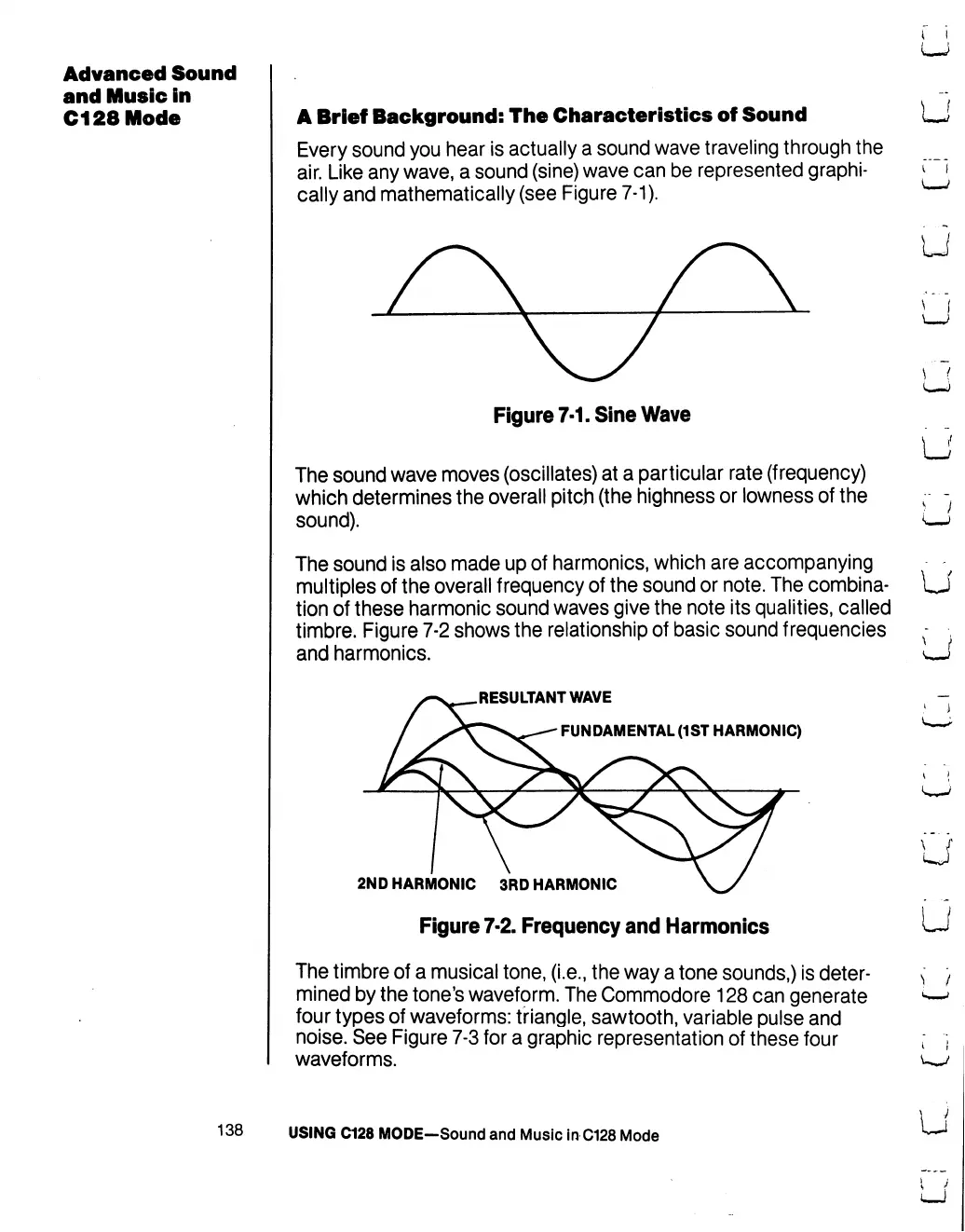
Figure
7-2
shows
the
relationship
of
basic
sound
frequencies
and
harmonics.
.RESULTANT
WAVE
FUNDAMENTAL
(1ST
HARMONIC)
2ND
HARMONIC
3RD
HARMONIC
Figure
7-2.
Frequency
and
Harmonics
The
timbre
of
a
musical
tone,
(i.e.,
the
way
a
tone
sounds,)
is
deter
mined
by
the
tone's
waveform.
The
Commodore
128
can
generate
four
types
of
waveforms:
triangle,
sawtooth,
variable
pulse
and
noise.
See
Figure
7-3
for
a
graphic
representation
of
these
four
waveforms.
U
138
USING
C128
MODE—Sound
and
Music
in
C128
Mode
U

Table of Contents

Other manuals for Commodore 128D

Related product manuals