EasyManua.ls Logo

Commodore 128D - A Simple Loop-The GOTO Statement

Commodore 128D
427 pages
Print Icon
To Next Page IconTo Next Page
To Previous Page IconTo Previous Page
Loading...
n
!
I
A
Simple
Loop—The
GOTO
Statement
The
line
numbers
in
a
program
have
another
purpose
besides
put
ting
your
commands
in
the
proper
order
for
the
computer.
They
serve
as
a
reference
for
the
computer
in
case
you
want
to
execute
the
command
in
that
line
repetitively
in
your
program.
You
use
the
GOTO
command
to
tell
the
computer
to
go
to
a
line
and
execute
the
command(s)
in
it.
Now
type:
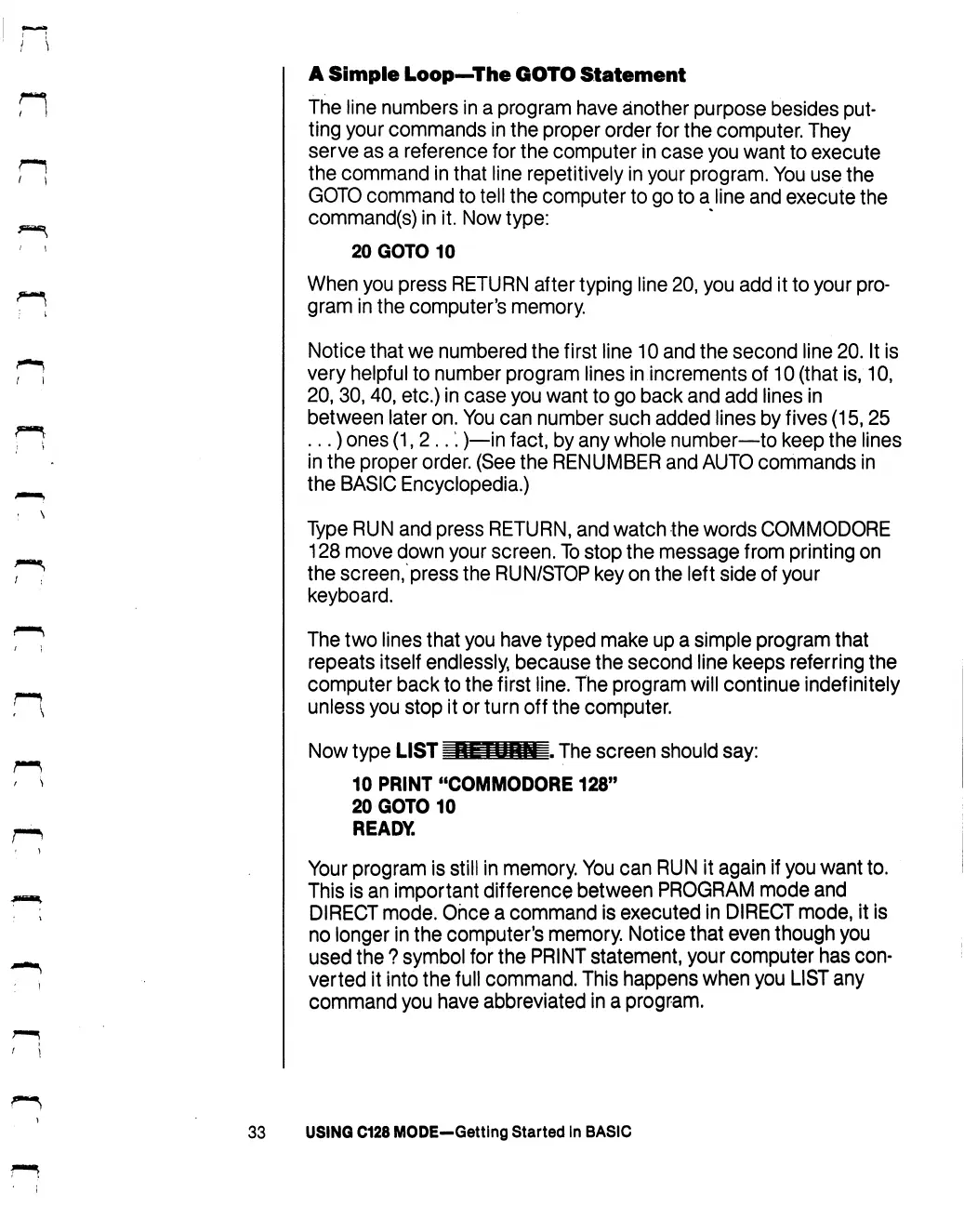
20
GOTO
10
When
you
press
RETURN
after
typing
line
20,
you
add
it
to
your
pro
gram
in
the
computer's
memory.
Notice
that
we
numbered
the
first
line
10
and
the
second
line
20.
It
is
very
helpful
to
number
program
lines
in
increments
of
10
(that
is,
10,
20,
30,40,
etc.)
in
case
you
want
to
go
back
and
add
lines
in
between
later
on.
You
can
number
such
added
lines
by
fives
(15,25
...)
ones
(1,2...)—in
fact,
by
any
whole
number—to
keep
the
lines
in
the
proper
order.
(See
the
RENUMBER
and
AUTO
commands
in
the
BASIC
Encyclopedia.)
Type
RUN
and
press
RETURN,
and
watch
the
words
COMMODORE
128
move
down
your
screen.
To
stop
the
message
from
printing
on
the
screen,
press
the
RUN/STOP
key
on
the
left
side
of
your
keyboard.
The
two
lines
that
you
have
typed
make
up
a
simple
program
that
repeats
itself
endlessly,
because
the
second
line
keeps
referring
the
computer
back
to
the
first line.
The
program
will
continue
indefinitely
unless
you
stop
it
or
turn
off
the
computer.
Now
type
LIST
I
i.
The
screen
should
say:
10
PRINT
"COMMODORE
128"
20
GOTO
10
READY
Your
program
is
still
in
memory.
You
can
RUN
it
again
if
you
want
to.
This
is
an
important
difference
between
PROGRAM
mode
and
DIRECT
mode.
Once
a
command
is
executed
in
DIRECT
mode,
it
is
no
longer
in
the
computer's
memory.
Notice
that
even
though
you
used
the
?
symbol
for
the
PRINT
statement,
your
computer
has
con
verted
it
into
the
full
command.
This
happens
when
you
LIST
any
command
you
have
abbreviated
in
a
program.
33
USING
C128
MODE-Getting
Started
in
BASIC

Table of Contents

Other manuals for Commodore 128D

Related product manuals