EasyManua.ls Logo

Commodore 128D - Page 150

Commodore 128D
427 pages
Print Icon
To Next Page IconTo Next Page
To Previous Page IconTo Previous Page
Loading...
synthesizer.
The
Commodore
128
has
10
prede
fined
envelopes
for
10
different
musical
instru
ments.
In
using
the
predefined
envelopes
you
do
not
have
to
specify
the
ADSR
parameters,
waveform
and
pulse
width
settings—this
is
already
done
for
you.
All
you
have
to
do
is
spec
ify
the
envelope
number.
The
rest
of
the
parame
ters
are
chosen
automatically
by
the
Commo
dore
128.
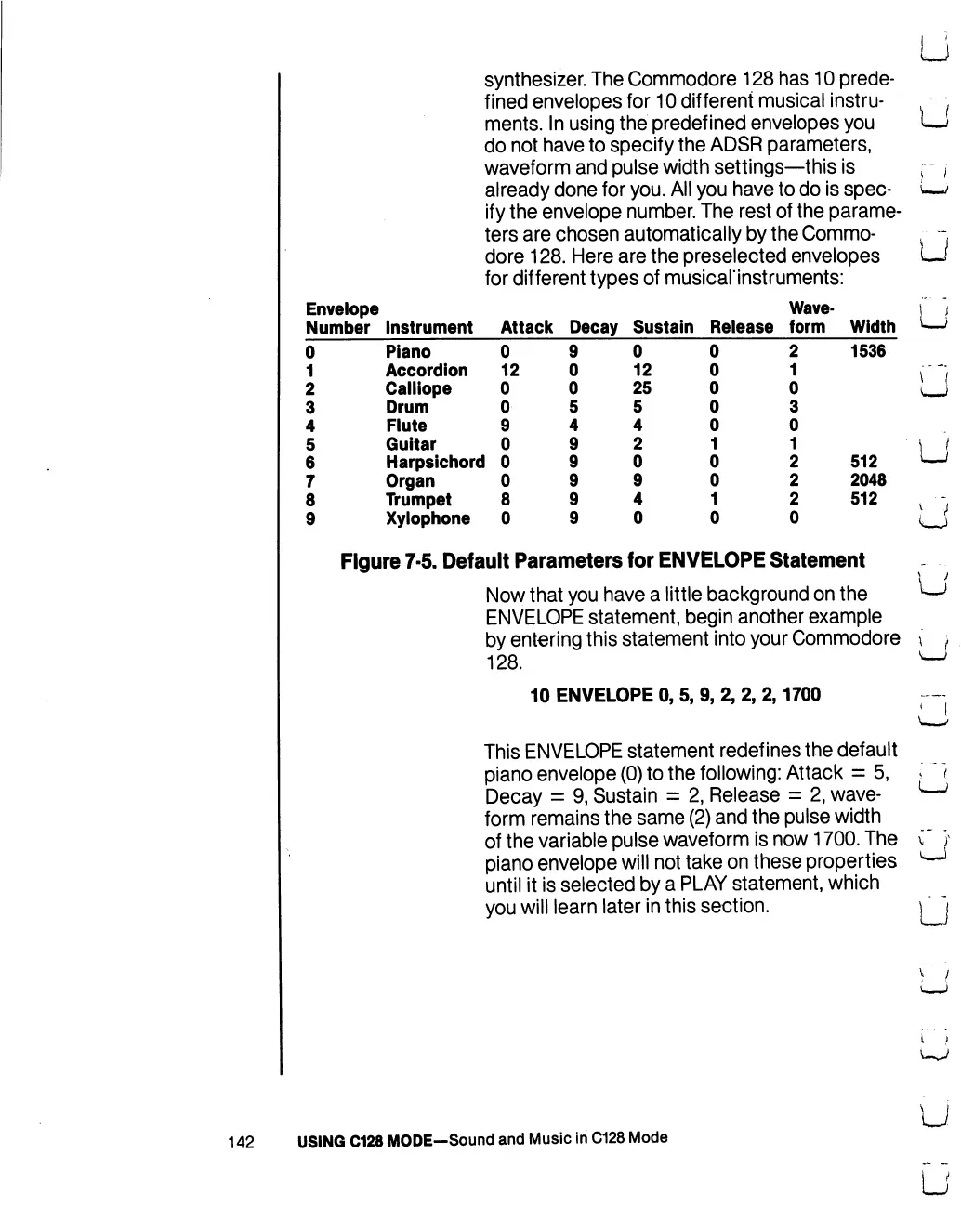
Here
are the
preselected
envelopes
for
different
types
of
musical'instruments:
Envelope
Number
0
1
2
3
4
5
6
7
8
9
Instrument
Piano
Accordion
Calliope
Drum
Flute
Guitar
Harpsichord
Organ
Trumpet
Xylophone
Attack
0
12
0
0
9
0
0
0
8
0
Decay
9
0
0
5
4
9
9
9
9
9
Sustain
0
12
25
5
4
2
0
9
4
0
Release
0
0
0
0
0
1
0
0
1
0
Wave
form
2
1
0
3
0
1
2
2
2
0
Width
1536
512
2048
512
Figure
7-5.
Default
Parameters
for
ENVELOPE
Statement
Now
that
you
have
a
little
background
on
the
l—'
ENVELOPE
statement,
begin
another
example
by
entering
this
statement
into
your
Commodore
\
j
128.
^
10
ENVELOPE
0,
5, 9, 2, 2,
2,1700
This
ENVELOPE
statement
redefines
the
default
piano
envelope
(0)
to
the
following:
Attack
=
5,
i""
1
Decay
=
9,
Sustain
=
2,
Release
=
2,
wave-
—'
form
remains
the
same
(2)
and
the
pulse width
of
the
variable
pulse
waveform
is
now
1700.
The
i~
}
piano
envelope
will
not
take
on
these
properties
**—l
until
it
is
selected
by
a
PLAY
statement,
which
you
will
learn
later
in
this
section.
\
1
142
USING
C128
MODE—Sound
and
Music
in
C128
Mode

Table of Contents

Other manuals for Commodore 128D

Related product manuals