EasyManua.ls Logo

Commodore 128D - Page 227

Commodore 128D
427 pages
Print Icon
To Next Page IconTo Next Page
To Previous Page IconTo Previous Page
Loading...
/ I
I
\
i i
I
i
(
\
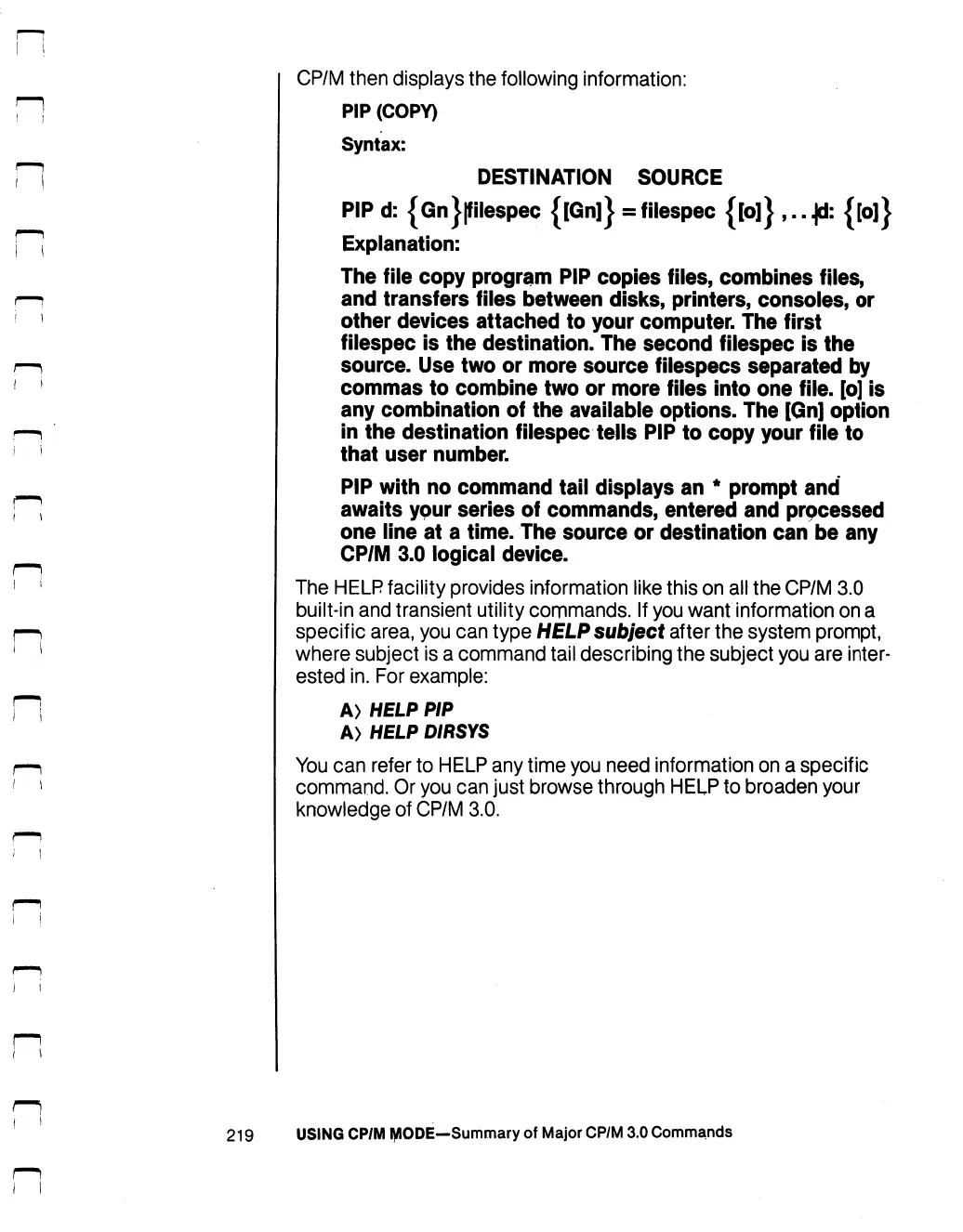
CP/M
then
displays
the
following
information:
PIP
(COPY)
Syntax:
DESTINATION
SOURCE
PIP
d:
{Gn}|file$pec
{[Gn]}
=filespec
{[o]}
,..Jd:
{[o]}
Explanation:
The
file
copy
program
PIP
copies
files,
combines
files,
and
transfers
files
between
disks,
printers,
consoles,
or
other
devices
attached
to
your
computer.
The
first
filespec
is
the
destination.
The
second
filespec
is
the
source.
Use
two
or
more
source
filespecs
separated
by
commas
to
combine
two
or
more
files
into
one
file,
[o]
is
any
combination
of
the
available
options.
The
[Gn]
option
in
the
destination
filespec
tells
PIP
to
copy
your
file
to
that
user
number.
PIP
with
no
command
tail
displays
an
*
prompt
and
awaits
your
series
of
commands,
entered
and
processed
one
line
at
a
time.
The
source
or
destination
can
be
any
CP/M
3.0
logical
device.
The
HELP
facility
provides
information
like
this
on
all
the
CP/M
3.0
built-in
and
transient
utility
commands.
If
you
want
information
on
a
specific
area,
you
can
type
HELP
subject
after
the
system
prompt,
where
subject
is
a
command
tail
describing
the
subject
you
are
inter
ested
in.
For
example:
A>
HELP
PIP
A>
HELP
DIRSYS
You
can
refer
to
HELP
any
time
you
need
information
on
a
specific
command.
Or
you
can
just
browse
through
HELP
to
broaden
your
knowledge
of
CP/M
3.0.
219
USING
CP/M
MODE—Summary
of
Major
CP/M
3.0
Commands

Table of Contents

Other manuals for Commodore 128D

Related product manuals