EasyManua.ls Logo

Commodore 128D - Page 275

Commodore 128D
427 pages
Print Icon
To Next Page IconTo Next Page
To Previous Page IconTo Previous Page
Loading...
j i
I
1
GET
i
\
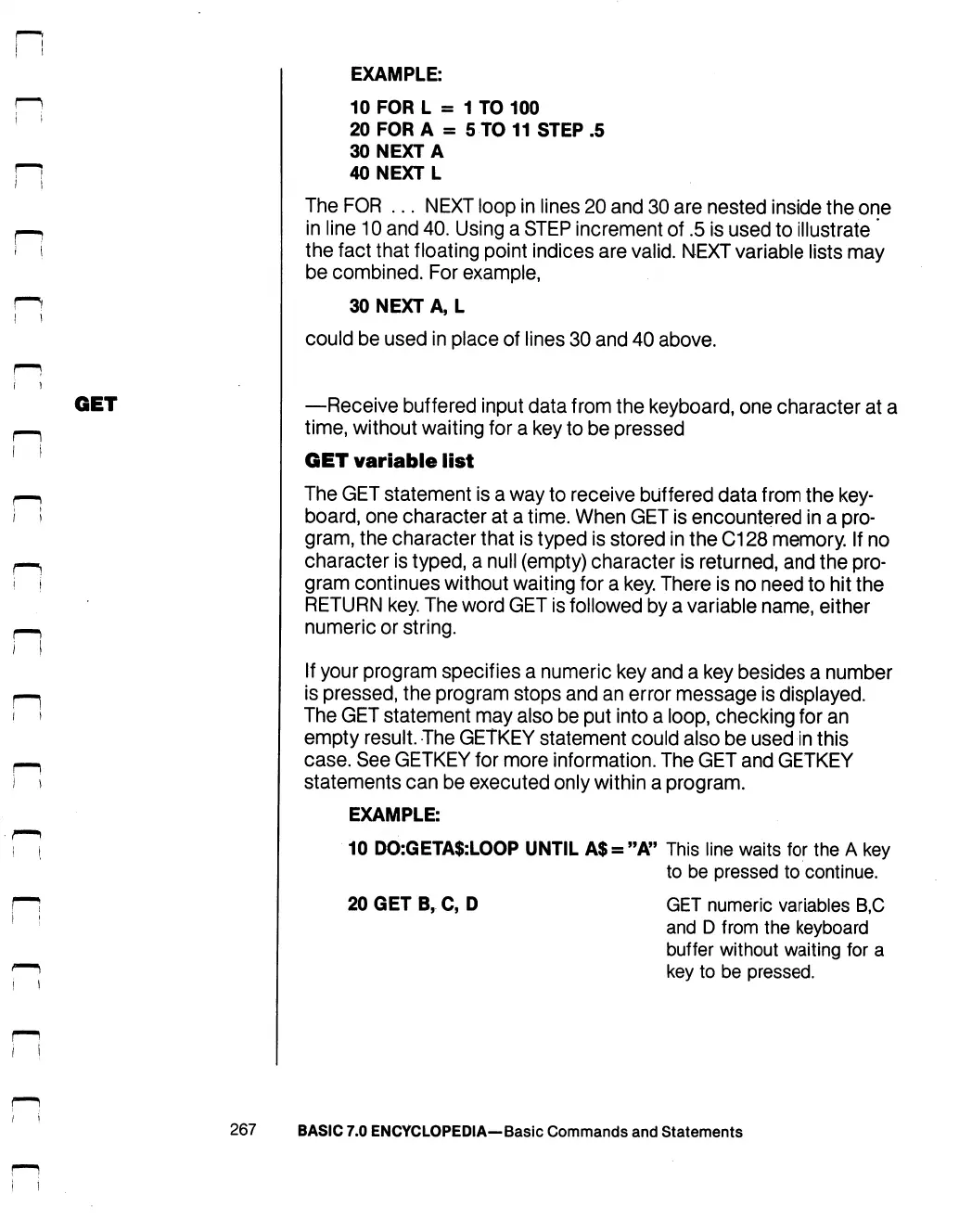
EXAMPLE:
10
FOR
L
=
20
FOR
A
=
30
NEXT
A
40
NEXT
L
1
TO
100
5
TO
11
STEP
.5
The
FOR
...
NEXT
loop
in
lines
20
and
30
are
nested
inside
the
one
in
line
10
and
40.
Using
a
STEP
increment
of
.5
is
used
to
illustrate
'
the
fact
that
floating
point
indices
are
valid.
NEXT
variable
lists
may
be
combined.
For
example,
30
NEXT
A,
L
could
be
used
in
place
of
lines
30
and
40
above.
—Receive
buffered
input
data
from
the
keyboard,
one
character
at
a
time,
without
waiting
for
a
key
to
be
pressed
GET
variable
list
The
GET
statement
is
a
way
to
receive
buffered
data
from
the
key
board,
one
character
at
a
time.
When
GET
is
encountered
in
a
pro
gram,
the
character
that
is
typed
is
stored
in
the
C128
memory.
If
no
character
is
typed,
a
null
(empty)
character
is
returned,
and
the
pro
gram
continues
without
waiting
for
a
key.
There
is
no
need
to
hit
the
RETURN
key.
The
word
GET
is
followed
by
a
variable
name,
either
numeric
or
string.
If
your
program
specifies
a
numeric
key
and
a
key
besides a
number
is
pressed,
the
program
stops
and
an
error
message
is
displayed.
The
GET
statement
may
also
be
put
into
a
loop,
checking
for
an
empty
result.
The
GETKEY
statement
could
also
be
used
in
this
case.
See
GETKEY
for
more
information.
The
GET
and
GETKEY
statements
can
be
executed
only
within
a
program.
EXAMPLE:
10
DO:GETA$:LOOP
UNTIL
A$
=
"A"
20
GET
B,
C,D
This
line
waits
for
the
A
key
to
be
pressed
to
continue.
GET
numeric
variables
B,C
and
D
from
the
keyboard
buffer
without
waiting
for
a
key
to
be
pressed.
267
BASIC
7.0
ENCYCLOPEDIA—Basic
Commands
and
Statements

Table of Contents

Other manuals for Commodore 128D

Related product manuals