EasyManua.ls Logo

Commodore 128D - Page 301

Commodore 128D
427 pages
Print Icon
To Next Page IconTo Next Page
To Previous Page IconTo Previous Page
Loading...
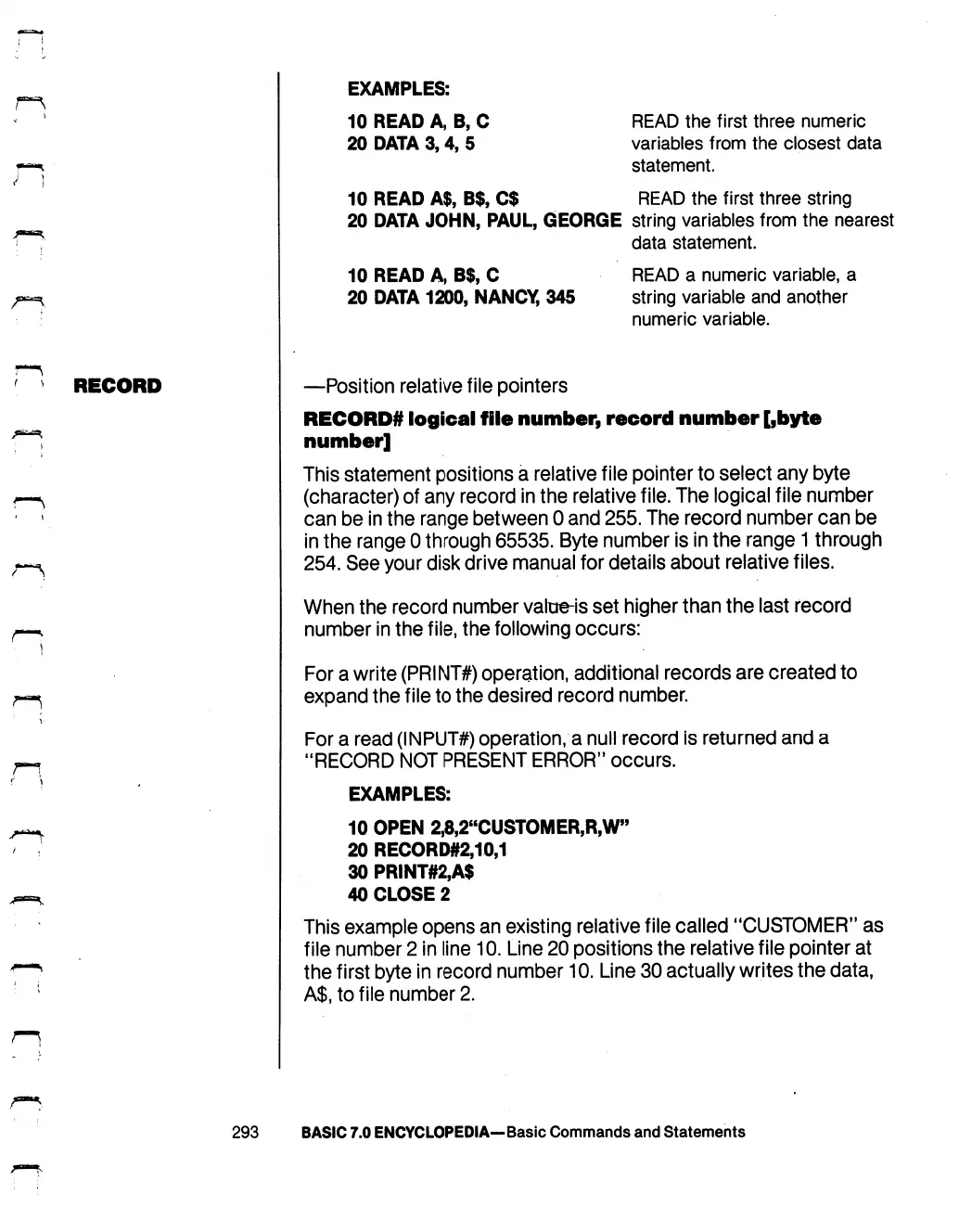
RECORD
r-\
EXAMPLES:
10
READ
A,
B,
C
20
DATA
3,
4,
5
READ
the
first
three
numeric
variables
from
the
closest
data
statement.
10
READ
A$,
B$,
C$
READ
the
first
three
string
20
DATA
JOHN,
PAUL,
GEORGE
string
variables
from
the
nearest
data
statement.
10
READ
A,
B$,
C
20
DATA
1200,
NANCY,
345
READ
a
numeric
variable,
a
string
variable
and
another
numeric
variable.
—Position
relative
file
pointers
RECORD#
logical
file
number,
record
number
[,byte
number]
This
statement
positions
a
relative
file
pointer
to
select
any
byte
(character)
of
any
record
in
the
relative
file.
The
logical
file
number
can
be
in
the
range
between
0
and
255.
The
record
number
can be
in
the
range
0
through
65535.
Byte
number
is
in
the
range
1
through
254.
See
your
disk
drive
manual
for
details
about
relative
files.
When
the
record
number
valoe-is
set
higher
than
the
last
record
number
in
the
file,
the
following
occurs:
For
a
write
(PRINT#)
operation,
additional
records
are
created
to
expand
the
file
to
the
desired
record
number.
For
a
read
(INPUT#)
operation/a
null
record
is
returned
and
a
"RECORD
NOT
PRESENT
ERROR"
occurs.
EXAMPLES:
10
OPEN
2,8,2"CUSTOMER,R,W"
20
RECORD#2,10,1
30
PRINT#2,A$
40
CLOSE
2
This
example
opens
an
existing
relative
file
called
"CUSTOMER"
as
file
number
2
in
line
10.
Line
20
positions
the
relative
file
pointer
at
the
first
byte
in
record
number
10.
Line
30
actually
writes
the
data,
A$,
to
file
number
2.
293
BASIC
7.0
ENCYCLOPEDIA—Basic
Commands
and
Statements

Table of Contents

Other manuals for Commodore 128D

Related product manuals