EasyManua.ls Logo

Commodore 128D - Page 309

Commodore 128D
427 pages
Print Icon
To Next Page IconTo Next Page
To Previous Page IconTo Previous Page
Loading...
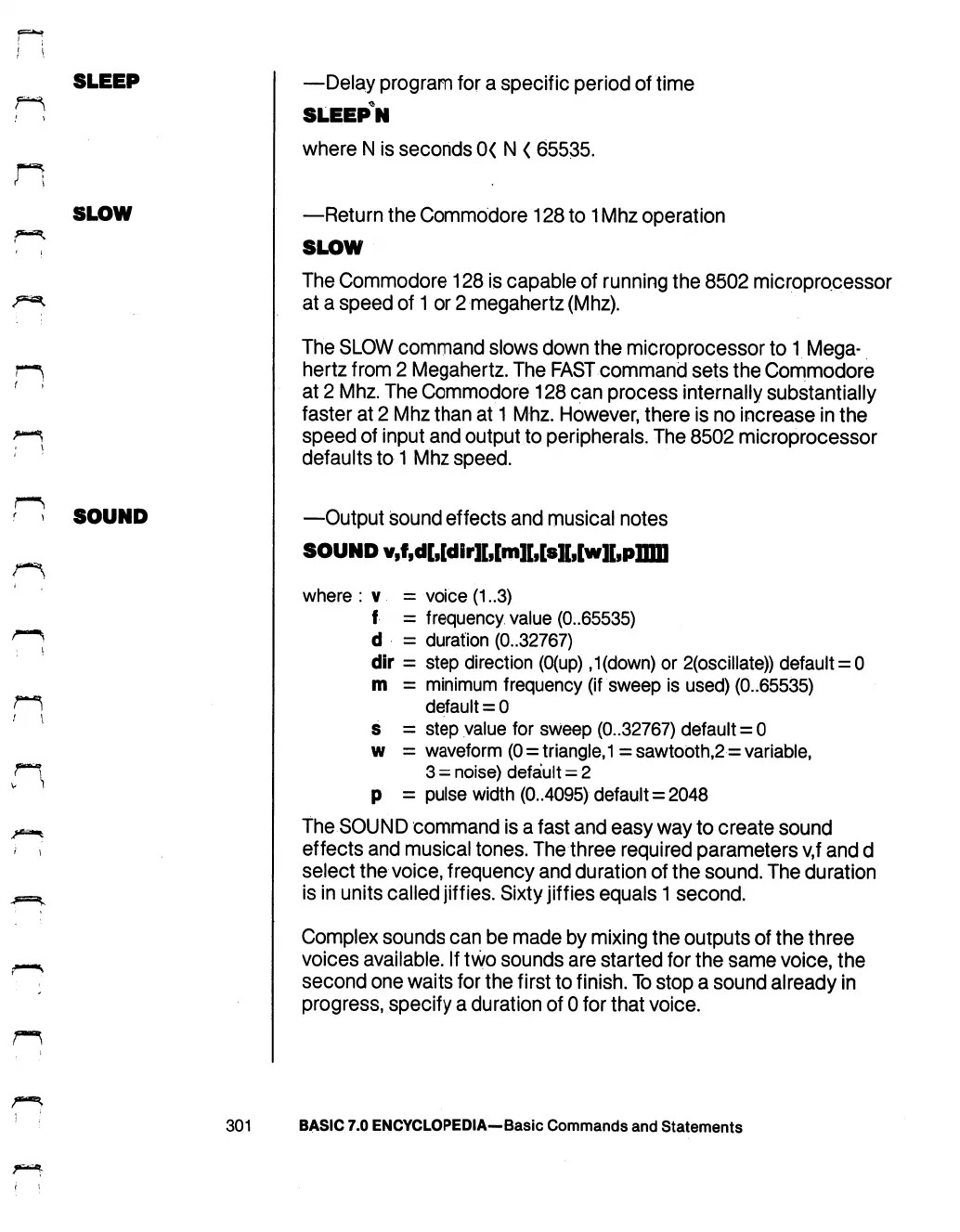
SLEEP
n
SLOW
SOUND
r\
—Delay
program
for
a
specific
period
of
time
SLEEPN
where
N
is
seconds
0<
N
<
65535.
—Return
the
Commodore
128
to
1
Mhz
operation
SLOW
The
Commodore
128
is
capable
of
running
the
8502
microprocessor
at
a
speed
of
1
or
2
megahertz
(Mhz).
The
SLOW
command
slows
down
the
microprocessor
to
1
Mega
hertz
from
2
Megahertz.
The
FAST
command
sets
the
Commodore
at
2
Mhz.
The
Commodore
128
can
process
internally
substantially
faster
at
2
Mhz
than
at
1
Mhz.
However,
there
is
no
increase
in
the
speed
of
input
and
output
to
peripherals.
The
8502
microprocessor
defaults
to
1
Mhz
speed.
—Output
sound
effects
and
musical
notes
SOUND
v9ff>d[l[dir][9[m]I9[s]Ii[wH,Pim]
where
:
v
=
voice
(1..3)
f
=
frequency
value
(0..65535)
d
=
duration
(0..32767)
dir
=
step
direction
(0(up)
,1(down)
or
2(oscillate))
default
=
0
m
=
minimum
frequency
(if
sweep
is
used)
(0..65535)
default
=
0
s
=
step value
for
sweep
(0..32767)
default
=
0
w
=
waveform
(0
=
triangle,
1
=
sawtooth,2
=
variable,
3
=
noise)
default
=
2
p
=
pulse
width
(0..4095)
default
=
2048
The
SOUND
command
is
a
fast
and
easy
way
to
create
sound
effects
and
musical
tones.
The
three
required
parameters
v,f
and
d
select
the
voice,
frequency
and
duration
of
the
sound.
The
duration
is
in
units
called
jiffies.
Sixty
jiffies
equals
1
second.
Complex
sounds
can
be
made
by
mixing
the
outputs
of
the
three
voices
available.
If
two
sounds
are
started
for
the
same
voice,
the
second
one
waits
for
the
first
to
finish.
To
stop
a
sound
already
in
progress,
specify
a
duration
of
0
for
that
voice.
301
BASIC
7.0
ENCYCLOPEDIA—Basic
Commands
and
Statements

Table of Contents

Other manuals for Commodore 128D

Related product manuals