EasyManua.ls Logo

Commodore 128D - Page 47

Commodore 128D
427 pages
Print Icon
To Next Page IconTo Next Page
To Previous Page IconTo Previous Page
Loading...
n
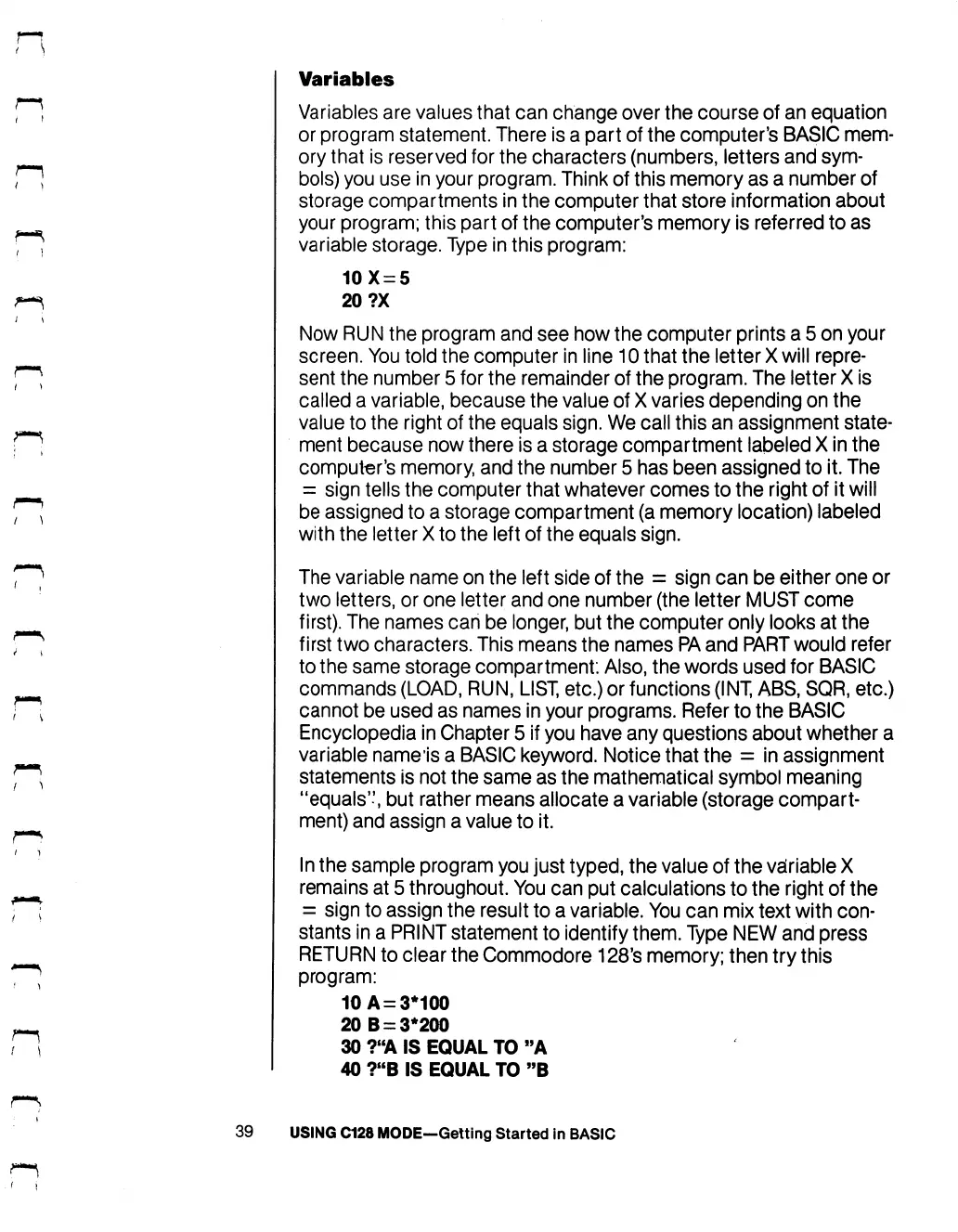
Variables
Variables
are
values
that
can
change
over
the
course
of
an
equation
or
program
statement.
There
is
a
part
of
the
computer's
BASIC
mem
ory
that
is
reserved
for
the
characters
(numbers,
letters
and
sym
bols)
you
use
in
your
program.
Think
of
this
memory
as
a
number
of
storage
compartments
in
the
computer
that
store
information
about
your
program;
this
part
of
the
computer's
memory
is
referred
to
as
variable
storage.
Type
in
this
program:
10X
=
5
20
?X
Now
RUN
the
program
and
see
how
the
computer
prints
a
5
on
your
screen.
You
told
the
computer
in
line
10
that
the
letter
X
will
repre
sent
the
number
5
for
the
remainder
of
the
program.
The
letter
X
is
called
a
variable,
because
the
value
of
X
varies
depending
on
the
value
to
the
right
of
the
equals
sign.
We
call
this
an
assignment
state
ment
because
now
there
is
a
storage
compartment
labeled
X
in
the
computer's
memory
and
the
number
5
has
been
assigned
to
it.
The
=
sign
tells
the
computer
that
whatever
comes
to
the
right
of
it
will
be
assigned
to
a
storage
compartment
(a
memory
location)
labeled
with
the
letter
X
to
the
left
of
the
equals
sign.
The
variable
name
on
the
left
side
of
the
=
sign
can
be
either
one
or
two
letters,
or
one
letter
and
one
number
(the
letter
MUST
come
first).
The
names
can be
longer,
but
the
computer
only
looks
at
the
first
two
characters.
This
means
the
names
PA
and
PART
would
refer
to
the
same
storage
compartment:
Also,
the
words
used
for
BASIC
commands
(LOAD,
RUN,
LIST,
etc.)
or
functions
(INT,
ABS,
SQR,
etc.)
cannot
be
used
as
names
in
your
programs.
Refer
to
the
BASIC
Encyclopedia
in
Chapter
5
if
you
have
any
questions
about
whether
a
variable
nameis
a
BASIC
keyword.
Notice
that
the
=
in
assignment
statements
is
not
the
same
as
the
mathematical
symbol
meaning
"equals'-,
but
rather
means
allocate
a
variable
(storage
compart
ment)
and
assign
a
value
to
it.
In
the
sample
program
you
just
typed,
the
value
of
the
variable
X
remains
at
5
throughout.
You
can
put
calculations
to
the
right
of
the
=
sign
to
assign
the
result
to
a
variable.
You
can
mix
text
with
con
stants
in
a
PRINT
statement
to
identify
them.
Type
NEW
and
press
RETURN
to
clear
the
Commodore
128's
memory;
then
try
this
program:
10
A
=
3*100
20
B
=
3*200
30
?"A
IS
EQUAL
TO
"A
40
?"B
IS
EQUAL
TO
"B
39
USING
C128
MODE-Getting
Started
in
BASIC

Table of Contents

Other manuals for Commodore 128D

Related product manuals