"
" "
line.
They
will
do
this regardless
of
where
the
print
head
is
current-
ly located
on
the line.
The
format
of
the
command
is
ESC
$ chr$(n1) chr$(n2)
where
n1
and n2 are used
to
define the
dot
column
to tab to.
To
determine
the values to use for
n1
and n2, divide the desired
dot
column
by
256.
The
integer
portion
of
the quotient becomes n2; the remainder
is
n1.
You
can use these mathematical formulas to calculate
n1
and
n2,
where
n
is
the desired
dot
column:
N2
=
INT
(N/256)
N1
=
N-(N2*256)
At
60
dot
columns per inch, the
MPS
1200 has 480 columns.
If
you
specify a
dot
column
beyond
the right margin, the results are
unpredictable.
The
maximum
value for
n1
is
244; the
maximum
value for n2
is
1 (if n2
is
less than
1,
however,
then the
maximum
value for
n1
is
255). Let's assume N equals 360:
N2
=
INT
(360/256)
= 1
N1
=
360-(256*1)
=
104
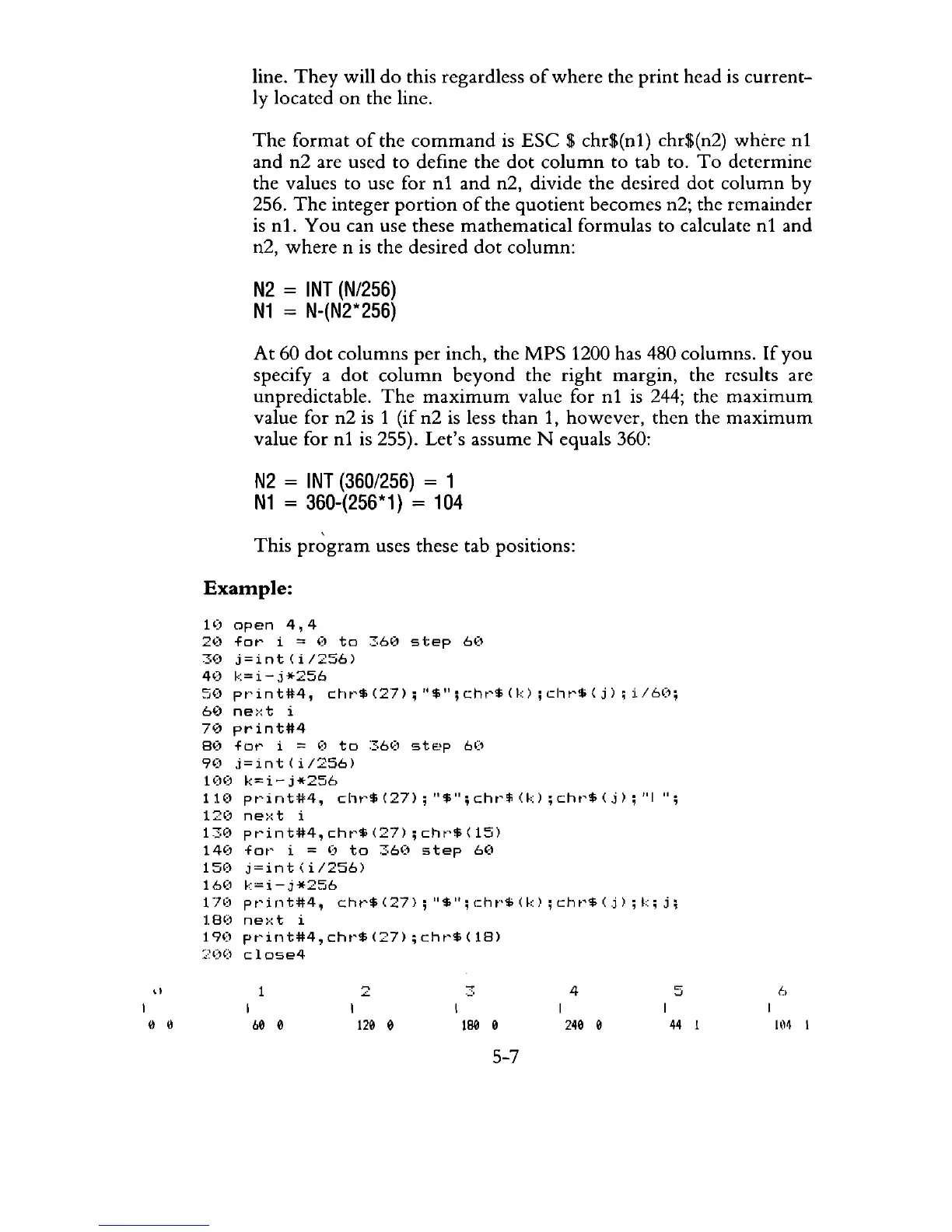
This
pr~gram
uses these tab positions:
Example:
10
open
4,4
20
for
i = 0
to
360
step
60
3(1
j=int(i/256)
40
k=i-.i*256
5(1
pt"int#4,
cht'$(27)
i
"$"icht'$(k)
;cht'$(j);
i/60;
60
ne:-:t
i
7
..
,
print#4
SO
for
i = 0
to
360
step
60
90
.i=int(i/256)
10('
k=i-j*256
11(1
pt'int#4,
cht'$(27)i"$";cht'$(k);cht'$(j)i"l
";
120
ne:-:t
i
130
print#4,chr$(27)ichr$(15)
140
for
i = 0
to
360
step
60
15(1
j=int(i/256)
160
k=i-j*256
17(1
pt'int#4,
cht'$
(27);
"$";
ctw$
(k)
;
cht'$
(j)
i
k;
j;
ISO
ne:-:t
i
190
print#4,chr$(27)ichr$(1S)
:;>()() c
lose4
2 3
I I I
b0
0
120
0
180
0
5-7
4 5
I
240
44
1
104
1



 To Next Page