1
00
t~ead
:.:
110
fla8$=fla8$+chr$(x)
120
ne:·:t
n
130
pt~int#l,
cht~$
(27)
"I<"cht~$
(20)
cht~$
(0)
f
1a8$
140
close
1
200
data
85,42,85,42,85,42,85,42,85,42
210
data
85,85,85,85,85,85,85,85,85,85
220
data
42,42,42,42,42,42,42,42,42,42
230
data
42,42,42,42,42,42,42,42,42,42
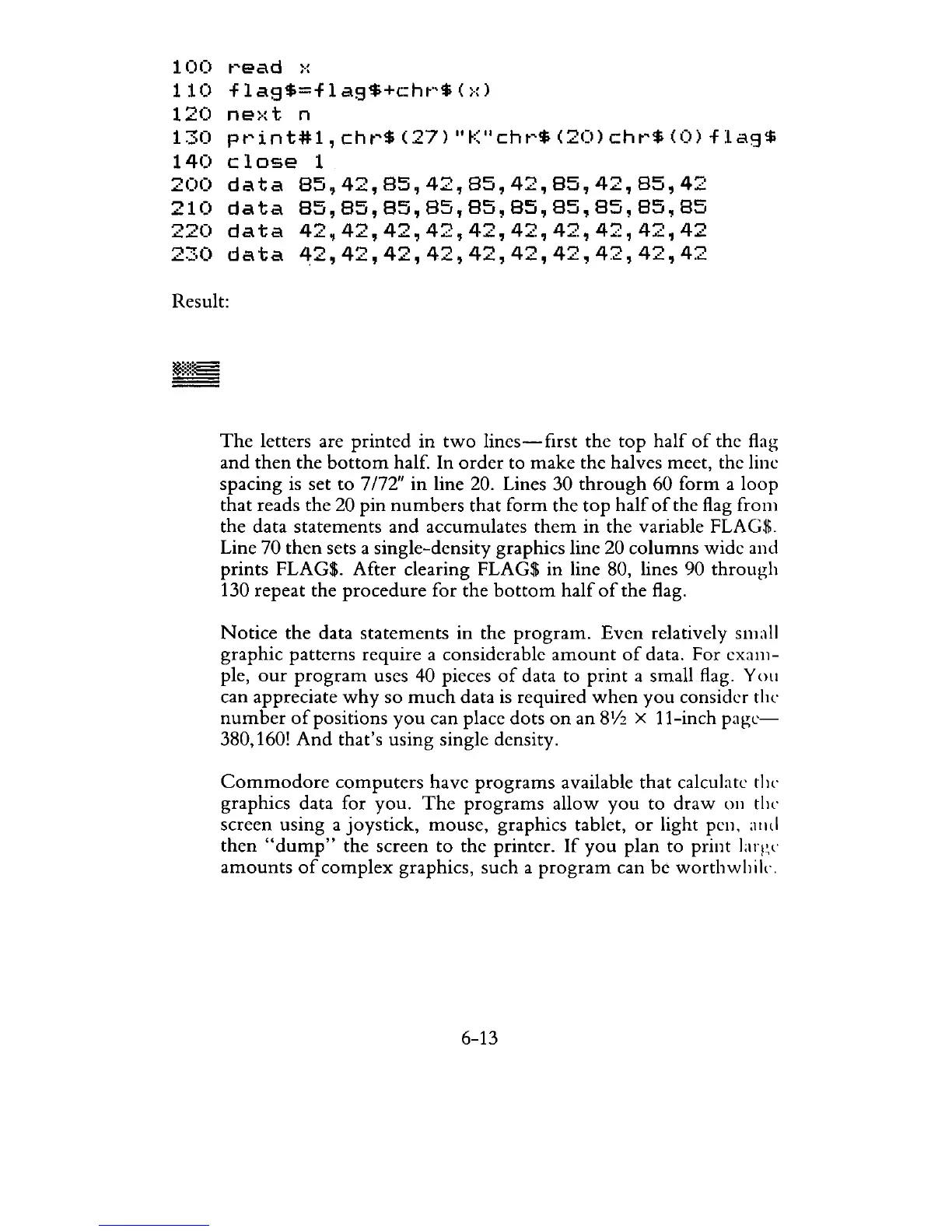
Result:
The
letters are
printed
in
two
lines-first
the
top
half
of
the flag
and
then
the
bottom
half. In
order
to
make
the halves meet, the line
spacing is set
to
7/72"
in
line 20. Lines 30
through
60 form a loop
that
reads the 20 pin
numbers
that
form
the
top
half
of
the flag from
the data statements and accumulates
them
in
the variable FLAG$.
Line
70
then
sets a single-density graphics line 20 columns wide and
prints FLAG$. After clearing FLAG$ in line
80, lines 90
through
130 repeat the
procedure
for the
bottom
half
of
the flag.
Notice
the data statements in the
program.
Even
relatively small
graphic patterns require a considerable
amount
of
data. For
exam-
ple,
our
program
uses 40 pieces
of
data to
print
a small flag. Y
Oil
can appreciate
why
so
much
data
is
required
when
you
consider
thl"
number
of
positions
you
can place dots
on
an
8V2
X
II-inch
page-
380, 160!
And
that's using single density.
Commodore
computers
have
programs
available that calculate till'
graphics data for you.
The
programs
allow
you
to
draw
Oil
the
screen using a
joystick,
mouse, graphics tablet,
or
light
pm,
alld
then
"dump"
the screen
to
the printer.
If
you
plan to print large
amounts
of
complex
graphics, such a
program
can be
worthwhik.
6-13



 To Next Page