|
27
OPERATING INSTRUCTIONS
7.1.3 Check tyres
Risk of Personal Injury and Material
Damage!
Does not apply to tubeless tyres.
If the valve is angled, the base of the
valve can rip o when riding which causes
sudden loss of tyre pressure.
This can lead to dangerous riding con-
ditions, falling, accidents and material
damage.
•
Have the tyre seating corrected by a specia-
list workshop.
You can undertake this job yourself if you are
familiar with tting and removing the road
wheels (see Chapter 11.1) and replacing the
tyre and tube.
•
Remove the valve nut.
•
Check the valve position:
The valves must point directly towards the
centre axis of the road wheel.
The valves must point directly towards the centre
axis of the road wheel.
Risk of Personal Injury and Material
Damage!
Too low a tyre pressure leads to increa-
sed likelihood of punctures but mostly
dangerous handling.
The tyre can come o the rim on bends
and cause the tyre to become detached
from the rim.
This can lead to dangerous riding con-
ditions, falling, accidents and material
damage.
•
Inate your tyres to the correct pressure.
The valve does not point to the traversing wheel
c
entre
Check the tyre pressure:
1. Determine your tyre type
Mountain bikes can be tted with racing bike type
tyres and racing bikes with trekking tyres.
Rule of thumb:
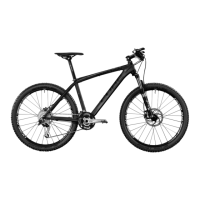
Mountain bike tyres:
Tyre width greater than 40 mm
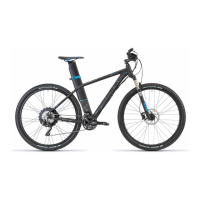
Trekking / cross-country and
tness bike tires:
Tyre width from 25 mm – 42 mm
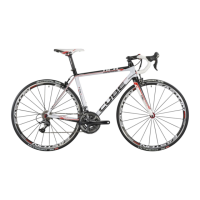
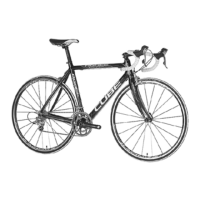
Racing bike style tyres:
Tyre width from 21mm - 28 mm
Consult your dealer to determine your tyre
type.
Pressures:
• Mountain bike tyres: 2.5 – 3.5 bar
• FAT bike tyres: 0.7 – 2.0 bar
• Trekking and city bike tyres: 3.5 - 5.0 bar
• Racing bike tyre: 6.0 - 10.0 bar
• For the correct air pressure for categories
not listed here, please refer to the infor
mation on the tire or consult your dealer.



 To Next Page