DF4910HD-DN | DDF4910HDV-DN-IM/-SM
www.dallmeier.com 51
9.2.1.3 TTL
The TTL value (Time To Live) denes the lifetime of an IP packet.
Each router an IP packet passes through reduces the time-to-live value by one (1). As
soon as the value has reached zero (0), the IP packet is discarded.
While preventing IP packets from endlessly circulating in the network due to routing er-
rors, this method stops IP packets from breaking through the limits of the LAN and being
sent to the WAN (TTL = 1).
Depending on the requirements, a TTL value ranging from 1 – 255 can be entered. When
entering 0 (zero), the default values are used (TTL = 1 for multicast, TTL = 64 for unicast).
9.2.1.4 RTCP
The Real-time Transport Control Protocol (RTCP) is an extension to the Real-time Trans-
port Protocol (RTP) and is used for i.a. the transmission of periodic status information
such as timestamps of the transmitted video streams.
9.2.2 Dynamic Servers
A dynamic server is created whenever a UDP or TCP data transmission is actively re-
quested, for example, via the ActiveX-based Dallmeier control, the DaVid Protocol, the
Real Time Streaming Protocol (RTSP) or via SMAVIA Viewing Client.
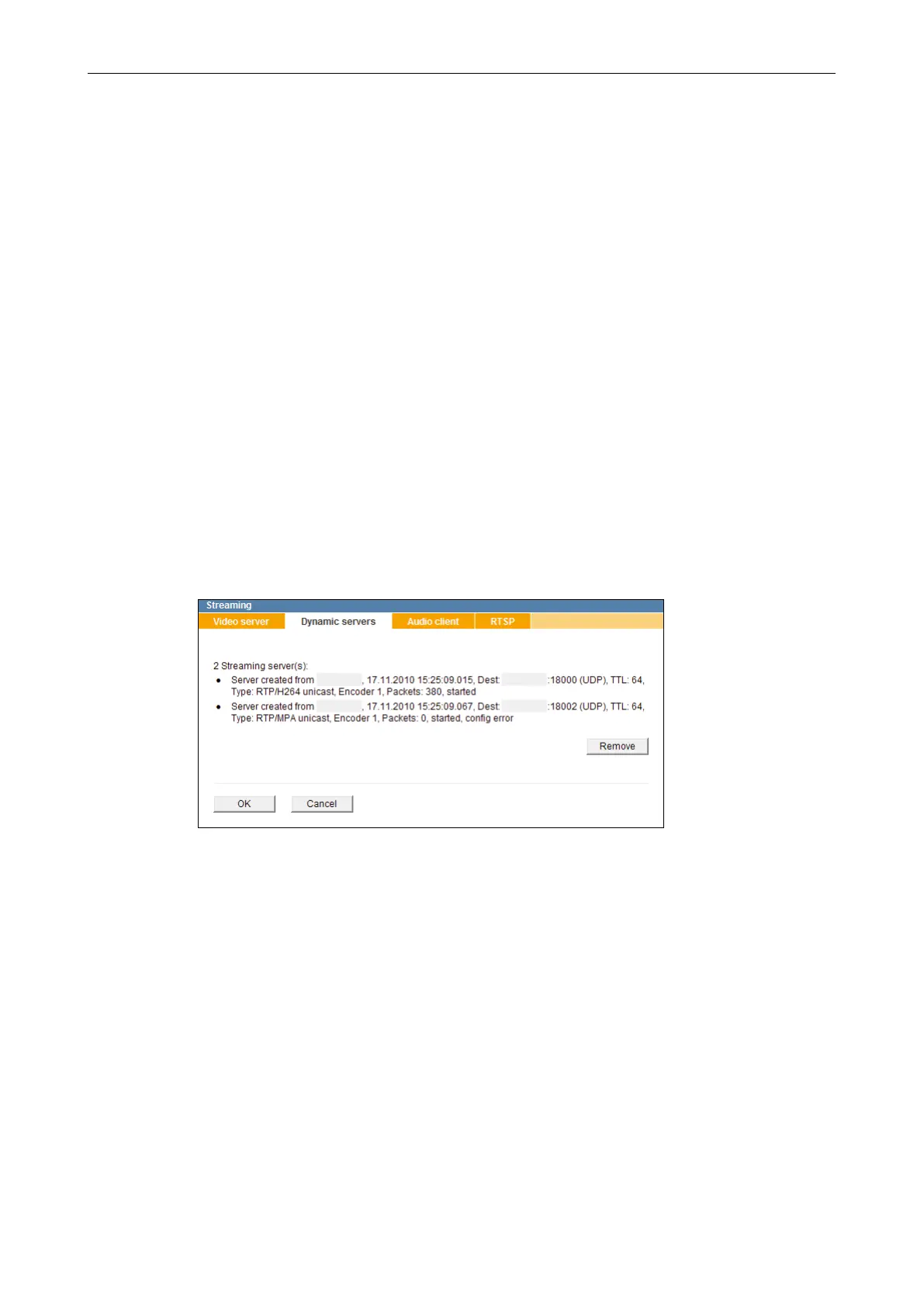
The Dynamic servers tab provides information on the currently created dynamic servers.
Fig. 9-3
The removal of dynamically generated servers is useful whenever servers, which are no
longer used and have not been automatically quit by a request, are to be deleted manu-
ally.


 To Next Page