Adaptive stop
prole
Application
Late deceleration High-head systems, where even a small
decrease in motor/pump speed results in a
rapid transition between forward ow and
reverse ow.
Constant
deceleration
Low to medium head, high-ow applications
where the uid has high momentum.
Early deceleration Open pump systems, where uid must drain
back through the pump without driving the
pump in reverse.
Table 5.1 Selection of Adaptive Control Deceleration Proles
5.4.5 Brake
Brake reduces the time the motor requires to stop.
During braking, an increased noise level from the motor
may be audible. This noise is a normal part of motor
braking.
CAUTION
EQUIPMENT DAMAGE
If the brake torque is set too high, the motor stops
before the end of the brake time. The motor suers
unnecessary heating, which could result in damage.
Careful conguration is required to ensure safe operation
of the soft starter and the motor.
A high brake torque setting can result in peak currents
up to motor DOL being drawn while the motor is
stopping. Ensure that protection fuses installed in the
motor branch circuit are selected appropriately.
CAUTION
RISK OF OVERHEATING
Brake operation causes the motor to heat faster than the
rate calculated by the motor thermal model. If using
brake functionality, install a motor thermistor or allow
sucient restart delay (parameter 2-11 Restart Delay).
When brake is selected, the soft starter uses DC injection
to slow the motor.
Braking
•
Does not require the use of a DC brake contactor.
•
Controls all 3 phases so that the braking currents
and associated heating are evenly distributed
through the motor.
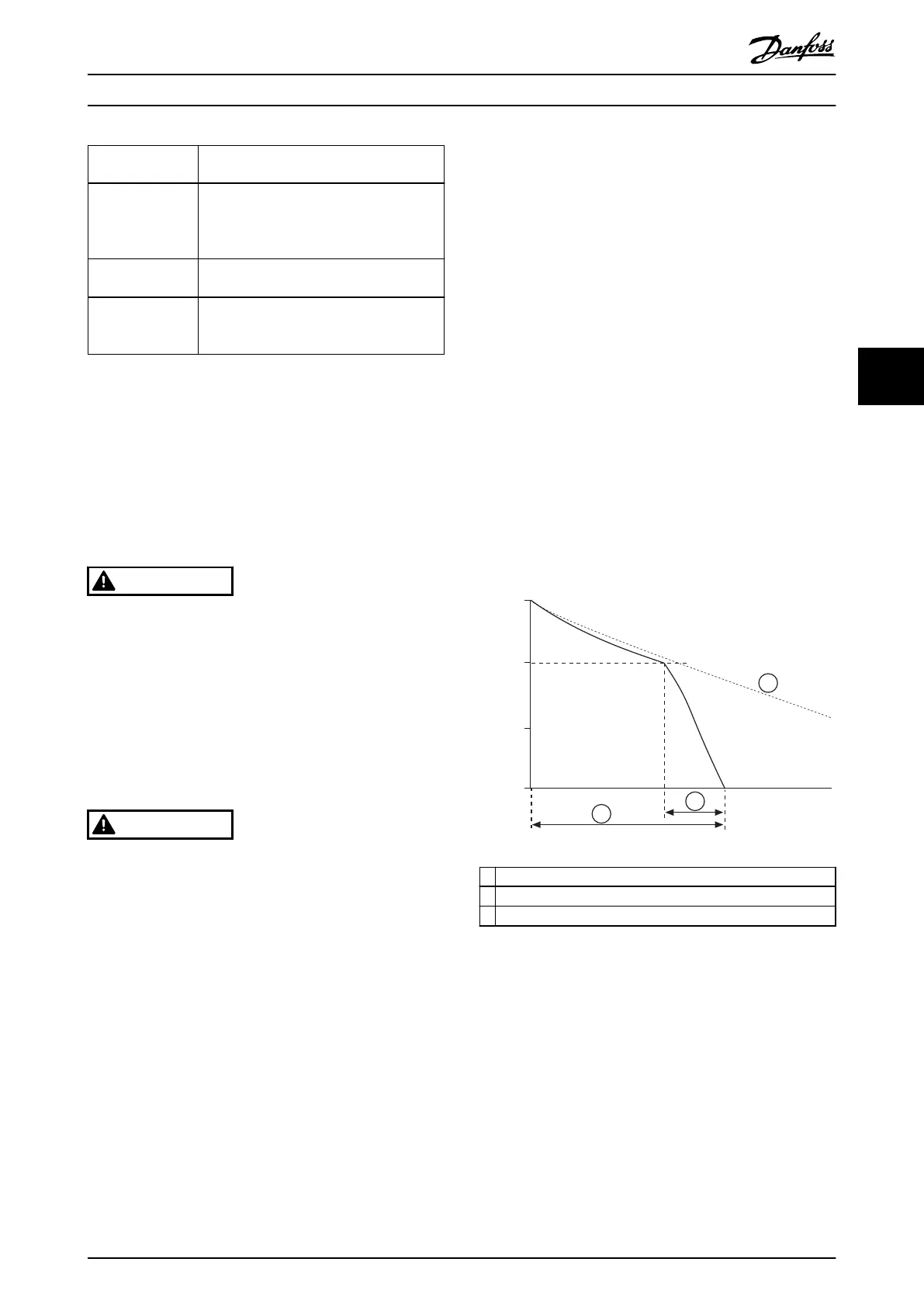
Braking has 2 stages:
1. Pre-brake: Provides an intermediate level of
braking to slow motor speed to a point where
full brake can be operated successfully (approxi-
mately 70% speed).
2. Full brake: Provides maximum braking torque but
is ineective at speeds greater than approxi-
mately 70%.
To congure the VLT
®
Soft Starter MCD 500 for brake
operation:
1. Set parameter 1-11 Stop Time for the wanted
stopping time duration (1). The stop time is the
total brake time. Set the stop time suciently
longer than the brake time (parameter 1-16 Brake
Time) to allow the prebraking stage to reduce
motor speed to approximately 70%. If the stop
time is too short, braking is not successful and
the motor coasts to stop.
2. Set parameter 1-16 Brake Time to approximately
25% of the programmed stop time. The brake
time sets the time for the full brake-stage (2).
3. Adjust parameter 1-15 Brake Torque so that the
wanted stopping performance is achieved. If set
too low, the motor does not stop completely and
coasts to stop by the end of the braking period.
100%
70%
0%
30%
1
2
3
177HA511.10
Time
Speed
1 Parameter 1-11 Stop Time
2 Parameter 1-16 Brake Time
3 Coast to stop time
Illustration 5.8 Brake Time
Product Features Operating Guide
MG17K602 Danfoss A/S © 05/2016 All rights reserved. 39
5 5



 To Next Page