VFD-MS300/MH300 EtherNet/IP Communication Card CMM-EIP01
CMM-EIP01 Operation Manual
18
4.2 Using old Delta Standards (only speed mode is supported)
4.2.1 Basic VFD Configurations
In order to operate the drive via Delta-defined control modes, refer to the following
configuration procedure.
1. Wiring (refer to 3.3 EtherNet/IP wiring).
2. Setting source of operation: Drive parameter setting 00-21=5. Selected operational
command comes from EtherNet/IP settings. (Run / stop, forward / reverse rotation, etc.)
3. Setting frequency source: Drive parameter setting 00-20=8. Selected frequency
command comes from EtherNet/IP settings.
4. Selecting control mode by using old Delta definitions: Drive parameter setting 09-30=0.
5. Setting EtherNet/IP format: Drive parameter 09-75 can be used to set up the IP
configuration format (default 0 = static IP; 1 = dynamic IP / DHCP).
6. Setting the IP address of the EtherNet/IP communication card: Drive parameters 09-76,
09-77, 09-78, and 09-79 can be used to configure the IP address (default IP address:
192.168.01.05).
7. Setting EtherNet/IP communication card's netmask: Netmask can be set via drive
parameters 09-80, 09-81, 09-82, and 09-83 (default netmask: 255.255.255.0).
8. Setting the gateway for the EtherNet/IP communication card: Gateway can be configured
via drive parameters 09-84, 09-85, 09-86, and 09-87 (default gateway: 192.168.01.01).
4.2.2 Using Speed Mode as a Control Method
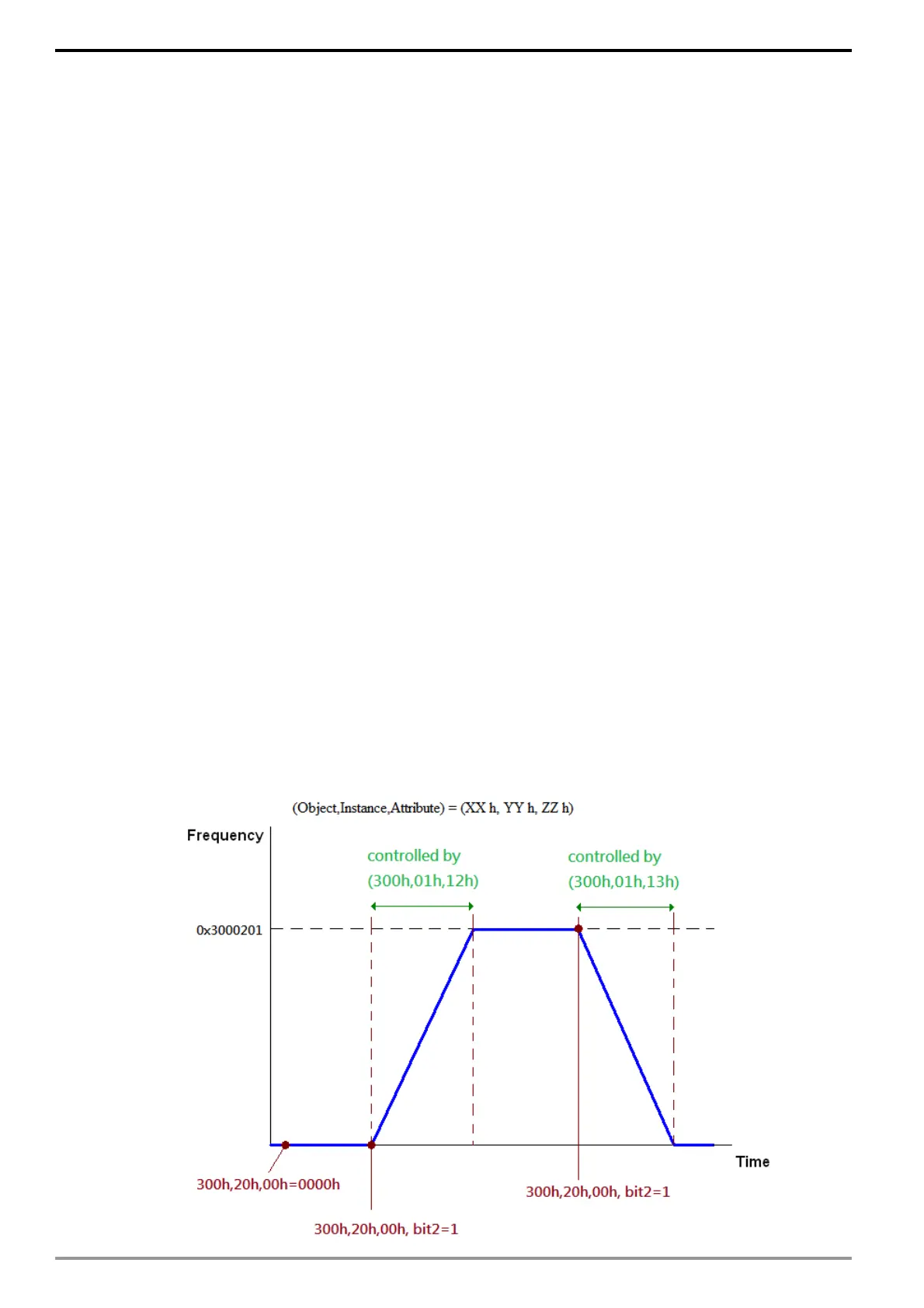
1. Setting the target frequency: Set (Object, Instance, Attribute) = (300h, 20h, 01h),
Unit = Hz, with a decimal precision at the hundredths position. Example: 1000 represents
10.00.
2. Operation: Setting (Object, Instance, Attribute) = (300h, 20h, 00h) = 0002H indicates run,
and (Object, Instance, Attribute) = (300h, 20h, 00h) = 0001H indicates stop.
3. Acceleration/deceleration time operations: If the first acceleration / deceleration section
is used as the basis, the acceleration time is set to (Object, Instance, Attribute) = (300h,
01h, 12h) and the time is set to (Object, Instance, Attribute) = (300h, 01h, 13h) , with unit
= seconds and a decimal precision at the tenths position. Example: 100 represent 10.0
seconds.



 To Next Page