5.2 TROUBLE SHOOTING
Have a good VOM meter to check voltages and continuity. A Meg-Ohm meter capable of checking
up to 500 meg-ohms of resistance is necessary to properly check the integrity of the ground loops.
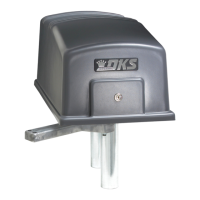
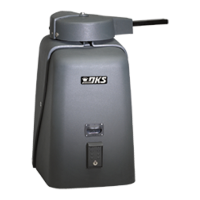
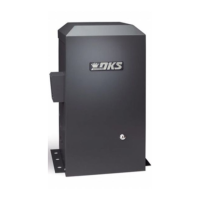
When a malfunction occurs, isolate the problem to one of three areas: 1) the operator, 2) the loop
system or 3) the keying devices. Use caution when checking high voltage areas: terminals 1
through 6, the motor capacitor and the motor.
1. Check the input indicator LEDs. They should only come ON when a keying device (card
reader, push button, etc.) is activated. If any of the input LEDs are ON continuously, this
will cause the operator to hold the arm up. Disconnect the keying devices one at a time
until the LED goes OFF.
2. A malfunction in a loop or loop detector can cause the operator to hold open, or to not
detect a vehicle when it is present over the loop. Pull the loop detector circuit boards
from the loop ports on the operator circuit board. If the malfunction persists, the problem
is not with the loop system. For more information on trouble shooting loops and loop
detectors, refer to your loop detector instruction sheet and to the DoorKing Loop and
Loop Detector Information Manual.
3. Check to be sure that there are no shorted or open control wires from the keying devices
to the gate operator. If a keying device fails to raise the arm, momentarily jumper across
terminals 6 and 14 on the operator circuit board. If the arm rises, this indicates that a
problem exist with the keying device and is not with the operator.
4. Check the high voltage supply. A voltage drop on the supply line (usually caused by
using too small supply voltage wires) will cause the operator to malfunction. Refer to the
wire size chart in section 2.2.
SYMPTOM POSSIBLE SOLUTION(S)
Operator will not
run – power LED
on control board is
OFF.
• Be sure AC power switch is on.
• Check for 117 VAC with a voltmeter at control board terminals 1
and 2. If voltage measures 0, check power supply to operator or
check terminal strip. If voltage measures OK, replace control
board.
Operator will not
run – power LED
on control board is
ON.
• Momentarily jumper terminal 6 to terminal 14. If input LED does
not come ON, check terminal strip or replace control board. If LED
does come on, go to the next step.
• Momentarily jumper terminal 2 to terminal 3 (Caution – High
Voltage). The motor should run.
• Momentarily jumper terminal 2 to terminal 4 (Caution – High
Voltage). The motor should run in opposite direction of above.
• If motor does not run in either or both steps above, bad motor,
motor capacitor or wiring to motor.
Arm rotates in
wrong direction.
• See section 4.2 to change direction of arm travel.
44


 To Next Page