EasyManua.ls Logo

Dnepr MT10-36 - Contact Breaker with Ignition Advance Automatic Drive

Dnepr MT10-36
96 pages
Print Icon
To Next Page IconTo Next Page
To Previous Page IconTo Previous Page
Loading...
Contact
Breaker
With
Ign
it
i
on
A
dvan
ce
Automatic
Device
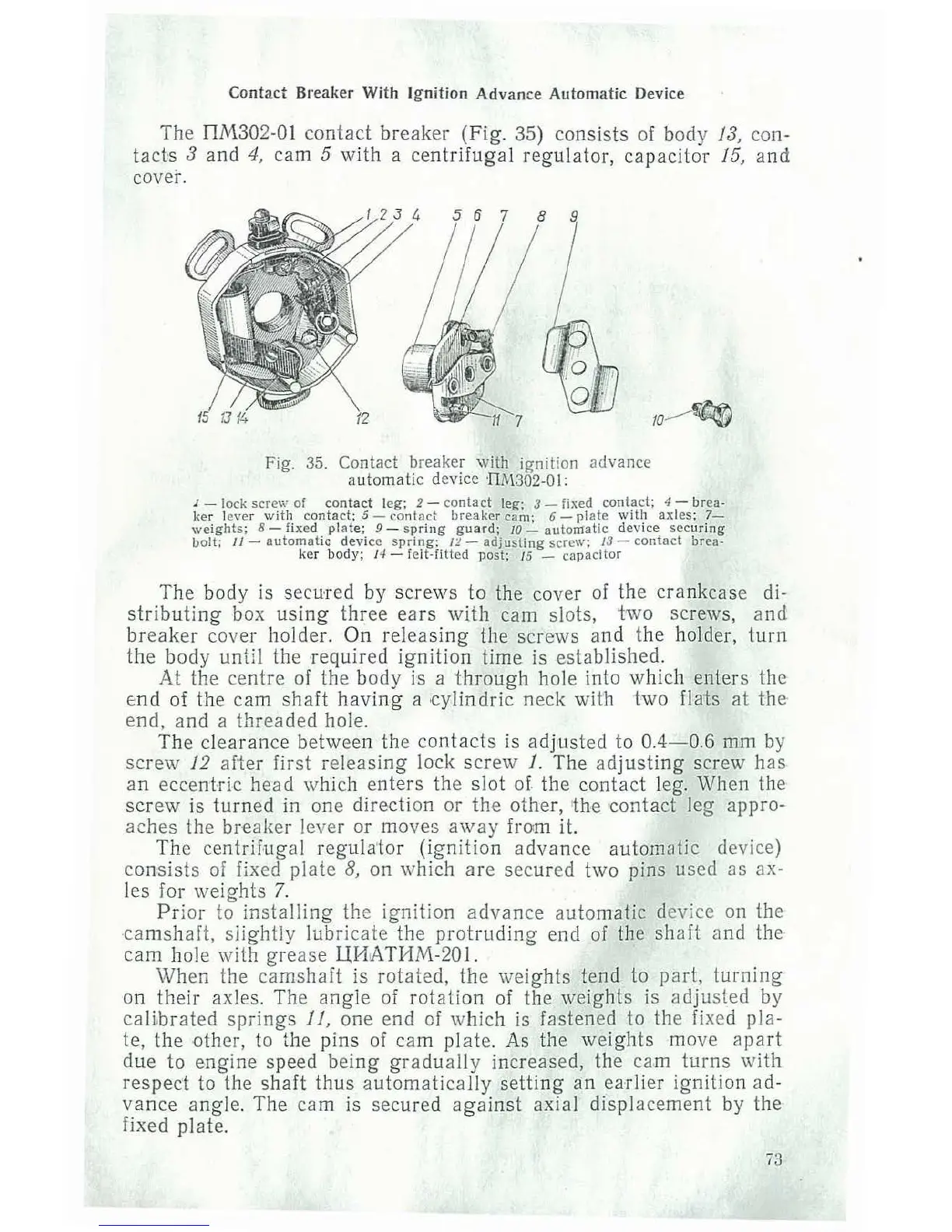
The
TIM302-0l
contact
breaker
(Fig.
35)
cons
i
sts
of body
13,
con-
tacts
3
and
4,
cam
5·
with
a
ce
ntrifugal
regulator,
capacitor
15,
and
cover.
6 7 8 9
I
Fig.
35.
Contact
breaker
with
ignition
advance
automatic
device
Hlv\302-01:
1 - lock
sere"·
of
contact
l
eg;
2 -
contac
t leg;
3-
fixed
cont~ct;
4-
brea-
ke
r lever
with
contact;
S-
contact
breaker
cam;
6-
plate
w1th
axles;
7-
weights;
8-
fixed
plate;
9-
spring
gu
ard
;
10
-
automatic
device
securing
bolt;
II-
automatic
devic
e
spring:
11-
adjusting
screw:
13-
contact
brea-
ker
body;
14 - felt-fitted post;
15
- capacitor
The
body
is
secured
by
screws
to
the
cover
of
the
cra
n
kcase
di-
stributing
box
using
three
ears
with
cam
slots
,
two
screws,
and
breaker
cover
holder.
On
releasing
the
screws
an
d
the
holder,
turn
the
body
until
the
required
ignition
time
is
established.
At
the
centre
of
the
b
ody
is a
through
hole
into
which
enters
the
E:
nd
of
the
cam
shaft
having
a
cylindric
neck
with
two
flats
at
the
end,
and
a
threaded
hole.
The
clearance
between
the
contacts
is
adjusted
to
0.4- 0.6 mm by
screw
12
after
first
releasing
lock
screw
1.
The
adjusting
screw
has
an
eccentric
head
which
enters
the
slot
of.
the
contact
l
eg
.
When
the
screw
is
turned
in
one
direction
or
the
other,
the
'Contact
leg
appro-
aches
the
breaker
lever
or
moves
away
from it.
The
centrifugal
regulator
(ignition
advance
automatic
device)
consists
of fixed
plate
8,
on
which
are
secured
two
pins
used
as
ax-
les
for
weights
7.
Pri
or
to
installing
the
ignition
advance
automatic
d
evice
on
the
camshaft,
sii
ghtly
lubrica
te
the
protruding
end
of the
shaft
and
the
cam
hole
with
grease
UHATHM-201.
When
the
camshaft
is
rotated,
the
weights
tend
to
part,
turning
on
their
axles.
The
angle
of
rotation
of
the
weights
is
ad
ju
sted
by
calibrated
springs
11,
one
end
of which is
fastened
to
the
fixed
pla-
te,
the
other, to
the
pins
of
cam
plate.
As
the
weights
move
apart
due
to
engine
sp
eed
being
gradually
increased,
the
cam
turns
with
respect
to
the
shaft
thus
automatically
setting
an
earlier
ignition
ad
-
vance
angle
.
The
cam
is
secure
d
against
axial
displacement
by
the
fixed
plate.
73

Table of Contents

Related product manuals