EasyManua.ls Logo

dolycon CT100 Series - User Manual

dolycon CT100 Series
163 pages
Print Icon
To Next Page IconTo Next Page
Loading...
CT100 inverter Content
Operation Manual
CT100 Series Inverter
Document version: V1.0

Table of Contents

Question and Answer IconNeed help?

Do you have a question about the dolycon CT100 Series and is the answer not in the manual?

Overview

The CT100 series inverter is a device designed for controlling electric motors, offering various functionalities for installation, operation, and maintenance. It supports different control modes and provides a range of technical specifications to suit diverse industrial applications.

Function Description

The CT100 inverter provides comprehensive control over motor operation, including:
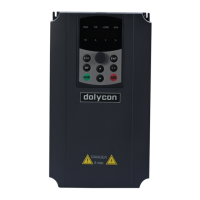
  • Motor Control Modes: It supports V/F control for applications requiring lower speed control precision, such as fans and water pumps, and where one inverter drives multiple motors. For general speed control precision, low-frequency large-torque applications, and scenarios where one inverter drives several similar motors (e.g., machine tools, centrifuges, electric locomotives, injection molding machines, hoisters), speed sensorless vector control is available. Torque control is provided for high-speed control precision, fast dynamic response, and specific torque control needs, such as drawing machines and printing/dyeing machinery.
  • Run Command Channels: The inverter can be controlled via the keypad, external terminals, or 485 communication (Modbus). This flexibility allows for various integration options within a control system.
  • Frequency Sources: The main frequency source can be selected from keypad input, keypad potentiometer, analog inputs (AI1, AI2), HDI pulse input, process PID output, multi-step speed settings, simple PLC, or 485 communication. An auxiliary frequency source can also be configured, with its reference object being either the maximum frequency or the main frequency source.
  • Start and Stop Control: The inverter offers multiple start modes, including starting from a set frequency, starting after DC braking, and starting after rotating speed tracking. Stop modes include deceleration to stop and coast to stop. It also features a dead time for forward/reverse switching and various DC braking parameters.
  • V/F Control: Different V/F curves are available: straight line for constant torque loads, multi-dots for special loads like water extractors and centrifuges, and 2.0th power low torque for variable torque loads such as fans and water pumps. Torque compensation and slip compensation gain are adjustable to improve low-frequency torque characteristics and speed stability.
  • Vector Control: This mode includes proportional and integral gains for low and high speeds, switching frequencies, and a VC slip compensation factor to adjust slip frequency and enhance system speed stability. An upper torque limit and torque setting options are also available.
  • HMI Interface: The keypad provides a 5-figure LED display for monitoring data, including set frequency, output frequency, and alarm codes. It also features unit and status LEDs for frequency, current, voltage, percentage, run status, forward/reverse status, run command reference, and alarm status.
  • Fault and Protection: The inverter includes extensive fault protection mechanisms, such as ACC/DEC overcurrent, constant speed overcurrent, ACC/DEC overvoltage, bus undervoltage, motor/inverter overload, input/output phase loss, rectifier module overheating, external fault, communication fault, and current detection fault. It can also be configured for automatic reset after certain faults.
  • PID Control: PID control is implemented for process control applications (flow, pressure, temperature), allowing adjustment of proportional gain, integral time, differential time, and sampling cycle. PID reference and feedback channels can be configured from various sources.
  • Wobble, Step Length, and Count Value: The inverter supports wobble running, where the output frequency oscillates around a set center frequency. Jump frequency ranges can be set to avoid mechanical resonance. It also includes a counter function for pulse signal counting with designated count values.
  • Multi-step Speed and PLC: The simple PLC function allows the inverter to automatically change output frequency and direction based on preset running times. Multi-step speed settings enable up to 16 steps of speed control via terminal combinations.
  • 485 Communication: The inverter features an RS485 communication interface supporting the Modbus RTU protocol, enabling centralized control by a PC or PLC. Communication parameters like local address, baud rate, and data check can be configured.
  • Auxiliary Functions: These include jogging frequency and ACC/DEC times, FDT (Frequency Detection Threshold) level detection, frequency arrival detection amplitude, droop control for load balancing among multiple motors, braking threshold voltage, overmodulation function, and cooling fan running modes.

Important Technical Specifications

  • Input Voltage: Single-phase 220VAC±15%, three-phase 380VAC±15%, or three-phase 660VAC±15%.
  • Input Frequency: 50~60Hz±5%.
  • Output Voltage: 0~Rated input voltage.
  • Output Frequency: 0~600Hz.
  • Control Mode: V/F control, sensorless vector control, torque control.
  • Speed Ratio (Open Loop Vector Control): 1:100.
  • Speed Control Accuracy: ±0.5%.
  • Starting Frequency: 0.00~10.00Hz.
  • Overload Capacity: 150% of rated current for 60s; 180% for 10s; 200% for 1s.
  • ACC and DEC Time: 0.1~3000.0s.
  • DC Braking Capability: Frequency 0~300Hz, waiting time 0~50s, current 0.0~100.0%, time 0.0~50.0s.
  • Digital Inputs: Standard 8-channel inputs, one of which can be a high-speed pulse input (HDI).
  • Analog Inputs: Standard 2-channel inputs (AI1: 0~10V or 4~20mA; AI2: -10V~+10V).
  • Digital Outputs: Standard 2-channel multi-function collector outputs, one of which can be a high-speed pulse output (HDO).
  • Analog Outputs: Standard 2-channel outputs (AO1, AO2: 0~10V or 4~20mA optional).
  • Relay Outputs: Standard 2-channel relay outputs (contact capacity: 250VAC/3A, 30VDC/1A).
  • Communication Interface: RS485 with Modbus protocol (RTU mode).
  • Running Environment: Indoors, less than 1km above sea level, without dust, corrosive gases, or direct sunlight.
  • Ambient Temperature: -10~+40℃ (derate 1% for every additional 1℃ when between 40~50℃).
  • Humidity: 5~95% (no condensation).
  • Altitude: 0~2000m (derate 1% for every additional 100m above 1000m).
  • Vibration: Less than 0.5g.
  • Storage Temperature: -40~+70℃.

Usage Features

  • Installation Flexibility: The inverter should be installed vertically on fire-retardant materials, ensuring adequate cooling space. For multiple inverters in a cabinet, horizontal installation or vertical installation with a wind board is recommended for heat dissipation.
  • Peripheral Components: The manual specifies standard peripheral components such as circuit breakers, contactors, input/DC/output reactors, input/output filters, braking units, and braking resistors, along with their functions and selection guidelines.
  • Wiring Guidelines: Detailed instructions are provided for main circuit and control circuit wiring, emphasizing the use of shielded cables, proper grounding, and separation of signal and power cables to prevent interference.
  • Keypad Operation: The keypad allows for parameter setting, fault reset, motor parameter self-identification, and password setting. It provides a clear display of operational status and fault information.
  • Motor Parameter Self-Identification: To achieve optimal control performance, the inverter can perform self-identification of motor parameters, which requires accurate input of motor nameplate data and decoupling the motor from the load (or using static autotuning if decoupling is not possible).
  • Password Protection: A user password function is available to protect parameters from unauthorized modification.
  • EMC Considerations: The manual addresses electromagnetic compatibility (EMC) problems, providing guidelines for noise control, grounding, and managing leakage current to ensure reliable operation and minimize interference with other equipment.

Maintenance Features

  • Daily Maintenance: Regular checks include environmental temperature, humidity, dust, vibration, noise, odor, appearance, fan operation, motor temperature, and monitoring inverter input current and voltage.
  • Periodic Maintenance (Every Three Months): This involves tightening control, main circuit, and grounding terminal screws, cleaning PCB boards, checking for abnormal fan noise/vibration (and replacing if cumulative time exceeds 20,000 hours), inspecting electrolytic capacitors for changes in color or smell, and cleaning radiators and power components.
  • Replacement of Wear Parts: Key wear parts include the fan (recommended replacement after 20,000 hours) and electrolytic capacitors (recommended replacement after 30,000 to 40,000 hours).
  • Storage Guidelines: The inverter should be stored in a controlled environment (temperature -40℃ to 70℃, humidity 5% to 95% non-condensing, no direct sunlight, dust, corrosive gases, or vibration). For long-term storage, electrolytic capacitors should be energized every two years with a slowly rising rated voltage to prevent degradation.

dolycon CT100 Series Specifications

General IconGeneral
Branddolycon
ModelCT100 Series
CategoryInverter
LanguageEnglish

Related product manuals