THIS DOCUMENT CONTAINS CONFIDENTIAL INFORMATION PROPRIETARY TO ENERGATE INC. NO PART OF ITS CONTENTS MAY BE DISCLOSED OR CONVEYED TO,
USED BY, OR COPIED TO A THIRD PARTY WITHOUT PRIOR WRITTEN CONSENT BY ENERGATE INC. PRINTED COPIES WILL BE CONSIDERED UNCONTROLLED.
AW000873-G 15
2 General Installation Procedures
1. Before installing the new thermostat or replacing an existing one, it is very important to test all heating and
cooling stages to verify that the existing HVAC equipment is working correctly.
2. In general, the thermostat installation or replacement should not be attempted if the HVAC equipment does
not appear to be working correctly, as this can lead to future misunderstandings with the home owner.
3. If this is a replacement installation, record the schedule and equipment settings for the existing thermostat.
Label all the wires, and identify the terminals that they are connected to on the old thermostat, in case it needs
to be re-installed.
4. If there is no existing thermostat, mount the thermostat and related equipment. See 3 New Installation.
5. For replacement installations, disconnect power from the HVAC equipment and remove the old thermostat.
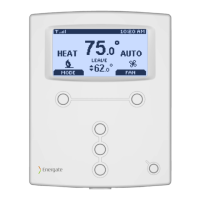
6. Install the Energate thermostat as described in 7 Standard Configurations.
If the thermostat backplate does not cover the hole in the wall, see 9.1 Wall Plate.
7. If there is no common (ground) wire, see 8.1 No Common Wire at Thermostat.
8. After you install the Energate thermostat, reconnect power and use the Installer Setup or Setup menu to
configure the thermostat for the type of equipment that it is connected to. See 6 Configuring the Thermostat
Settings.
9. Verify that all the heating and cooling stages are working correctly. See 10 Testing the System.
10. If the thermostat uses an outdoor sensor, air filter sensor, or heat pump fault sensor, see 9 Options and
Accessories.
11. If the HVAC equipment has two transformers, see 8.2 Dual Transformer .
12. To connect the HVAC equipment to a zone control system, see 8.3 Zone Control Systems.
13. Provision the thermostat to allow it to communicate with the ZigBee gateway or the optional Meter Data
Collector or pager module. See 11 Provisioning the Thermostat and Optional Equipment.
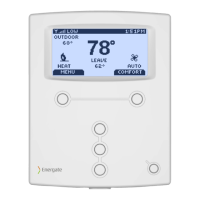
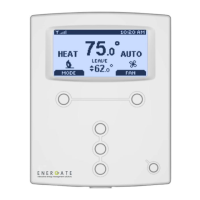
14. Show the homeowner how to use their new thermostat as described in 1.1 Operating the Foundation
Thermostat. In particular make sure they know how to:
a. Change the mode between Heat, Cool, Auto and Off.
b. Set a temporary hold, which they can also use to override an energy or price conservation event.


 To Next Page