5050 CONTROL UNIT
Technical Manual & Cabling Instructions
19.10.2012
Epec Oy reserves all rights for improvements without prior notice
Epec Oy Postiosoite/Postal address Puhelin/Phone Fax Internet
Tiedekatu 6 PL/P.O.Box 194 +358-(0)20-7608 111 +358-(0)20-7608 110 www.epec.fi
FIN-60320 Seinäjoki FIN-60101 Seinäjoki, Finland
V
IL
Digital status input
Output Off 1,9 V
V
I-range
Input voltage range (Note 11) -0,5
VDCPOWERx
V
t
I
Digital Status Input
Pulse Width
(Note 2, 4, 8)
tC + 25% ms
Note 1: Frequency of a (PWM) Pulse Width Modulation is = 1 / Period
Note 2: The duty cycle is defined as the percentage of digital ‘high’ to digital ‘low’ signals
present during a PWM period.
Note 3: The PWM resolution is defined as the maximum number of pulses that you can pack
into a PWM period.
Note 4: tC denotes software cycle time.
Note 5: Current limit for short circuit protection to protect cabling and to limit internal power
dissipation.
Note 6: Exceeding the max value might cause damage to input.
Note 7: The maximum output current depends on the load, PWM frequency and temperature.
Note 8: Pulse width must be greater that the software cycle time. For example with 50/50 pulse
ratio, the pulse frequency is 1 / (2*pulse width)
Note 9: When the limit is exceeded, the output voltage circuit starts to limit the current by
switching the output voltage. The switching does not effect the application software
Note 10: When the frequency increases, the actual duty cycle may be bigger than the value that
has been set.
Note 11: Overload conditions
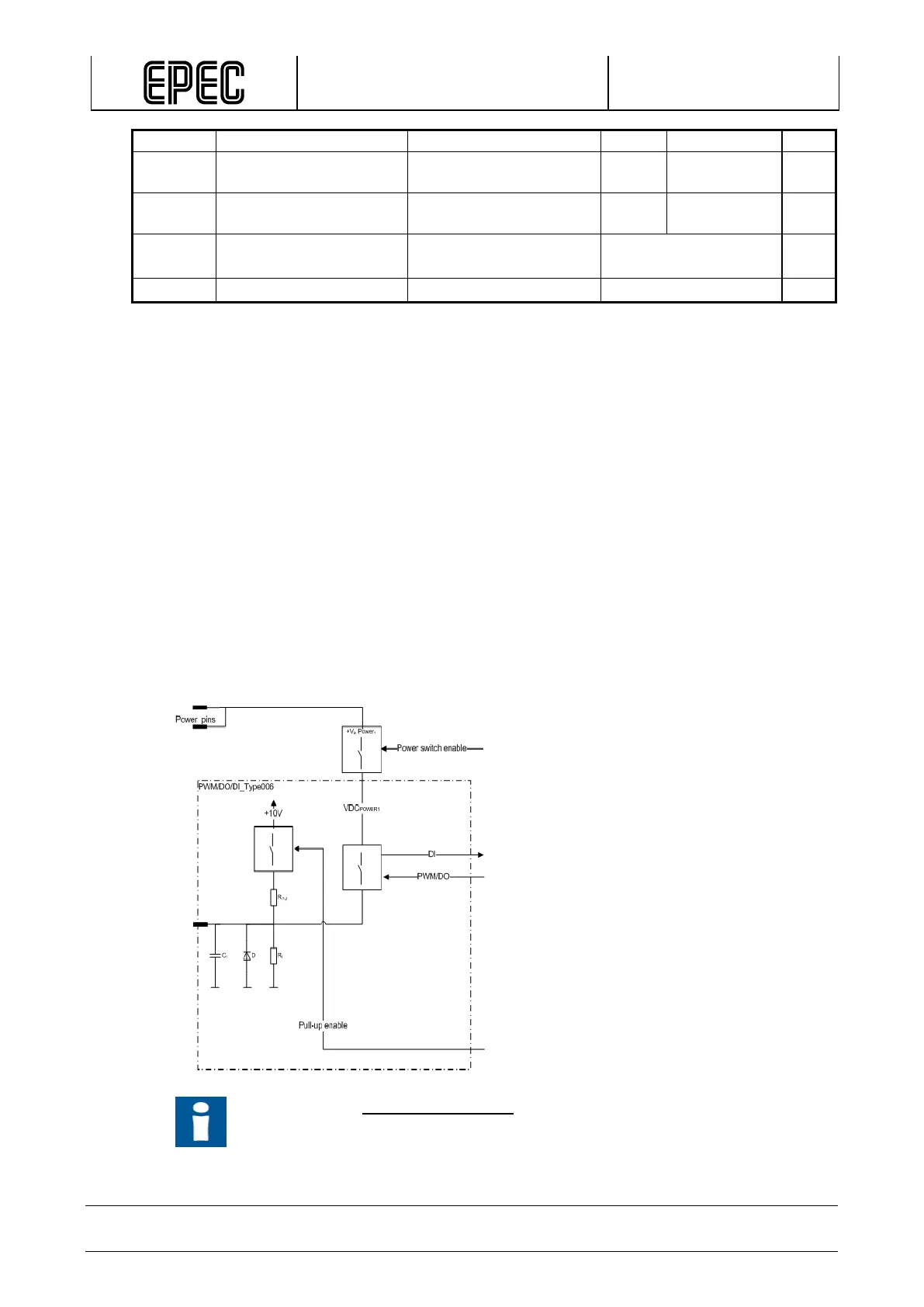
Functional block diagram
Refer to section Connection Examples to see examples on how to connect some
external actuators or sensors when using this type of pin.



 To Next Page