20
© Ferno s.r.l. Rel.05042024
XT Series Extrication Devices
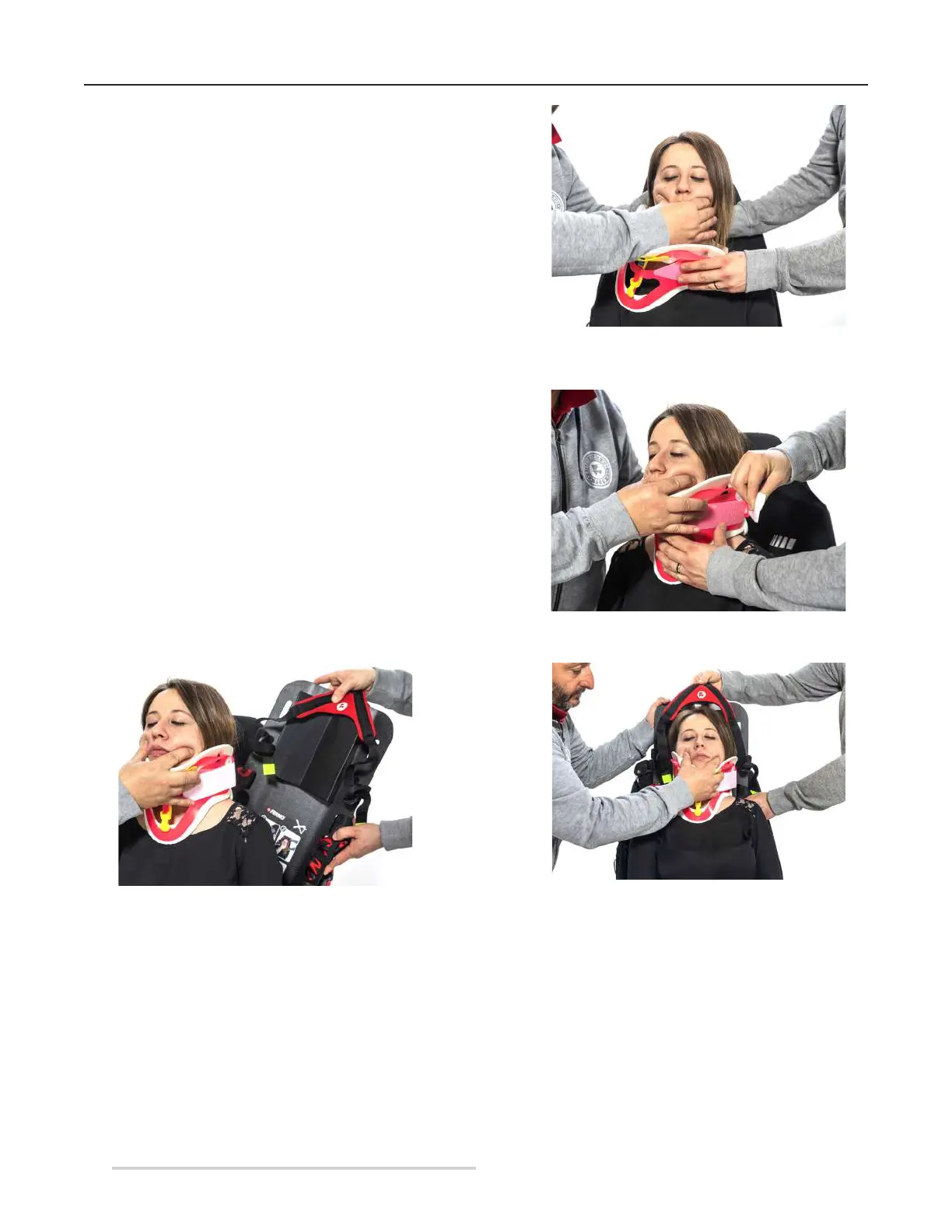
Figure 15 - Cervical spine supporting
Figure 16 - Neck brace applied
3.4.5 Precautionary extrication
A precautionary extrication requires the presence of at
least two trained and qualied operators, who are able
to assess the patient's conditions and are familiar with
the correct positioning and use of the extrication device.
1. Operator 1: holds the cervical spine to make it easier
for operator 2 to apply the neck brace (Figure 15).
For the application of the neck brace, refer to local
guidelines.
2. Operator 2: applies the neck brace correctly (Figure
16).
3. Operator 1: moves the patient forwards while holding
their head and neck to create the necessary space for
operator 2 to place the extrication device behind their
back (Figure 17).
4. Operator 2: having previously ensured that the chest
and groin restraints are positioned laterally in the
"Ready-to-use" conguration (See Section “Ready-
to-use” conguration) inserts the extrication device
behind the patient so that it is correctly centred and
reaches down to the base of the coccyx.
5. Operator 1: repositions the patient on the device
(Figure 18).
Figure 17 - Extrication device insertion Figure 18 - Patient repositioning
6. Operator 2: while operator 1 keeps holding the cervical
spine of the patient, operator 2 applies the triangular head
immobiliser, arranging it with care immediately above
the patient's eyebrows (Figures 19A, 19B and 19C).
The correct positioning of the head immobiliser
reduces the risk of it moving upwards or downwards.
It is advisable to hold the triangular head immobiliser
in place with one hand and with the other to fasten the
straps, starting with the side ones and, only last, the
middle one.



 To Next Page