Description
3.1 Design of the couplings
M4602-02en Edition 09/2022 23
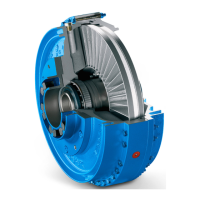
The housing and the inner rotor are double mounted one inside the other and sealed by
shaft sealing rings.
With series FN, the hub carrier part (120, at the same time carrier hub and large precham-
ber) is attached to the blade shell (101). The prechamber (7) holds part of the fluid filling
when the coupling is stationary, and so reduces the effective amount of fluid in the working
chamber (8) when starting. This significantly lowers the starting torque. When the coupling is
rotating, the oil from the prechamber flows back into the working chamber via small holes,
depending on the time, so that the entire filling is effective during continuous operation.
For filling the coupling, two filling plugs (153) are located in filling channels offset by 180° (to
prevent overfilling) in the blade shell (101). For size 887, two additional fusible safety plugs
(103) are installed on the side of the outer flange. There are further openings in the cover
(102) in which fusible safety plug (103) or screw plugs (163) are installed, depending on the
size. These are used for bleeding during filling, for checking the fill level and for draining the
operating fluid.
In the standard version, the fusing temperature of the fusible safety plug is 140°C. This seal
is made of NBR (for a maximum continuous operating temperature of 85°C). As an up-
graded standard (for continuous operating temperatures up to 110°C and/or synthetic oil),
the coupling can be equipped with seals made of FPM. In this case, a fusible safety plug with
a fusing temperature of 160°C is used in the coupling.
NOTICE
Couplings for use in potentially explosive atmospheres are designed with 110°C fusible
safety plugs. These fusible safety plugs are also marked with the Ex symbol.
The fusing temperature of the fusible safety plugs is stamped on their front panels. The
screws are also colour-coded:
• 110°C is yellow
• 140°C is red
• 160°C is green
In applications where frequent drive malfunctions or blockages are possible, thermal monit-
oring is recommended. It can be used to prevent leakage and loss of the operating fluid and
the associated contamination and danger to the environment. The transmitter (EOC system)
or the thermal circuit breaker (mechanical switching device) is screwed into the coupling
flange instead of the screw plug (163). The fusible safety plug (103) stays in the coupling as
an emergency backup.
In a coupling with NBR seals (standard version) and a 140°C fusible safety plug, a thermal
circuit breaker with 110°C fusing temperature can be used instead of the screw plug (153).
In a coupling with FPM seals and a 160°C fusible safety plug, a thermal circuit breaker with
140°C fusing temperature can be used instead of the screw plug (153).
When using the EOC system (transmitter fusing temperature of 125°C), a 160°C fusible
safety plug is also used with seals made of NBR.
Type FNO only includes the components of the hydraulic coupling (without add-on) and
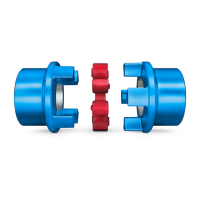
provides a connection shaft end on the output side. The types FNA and FND have a N‐
EUPEX coupling on the output side for mounting on a shaft. The types FNDB and FNDS are-
FND couplings with a brake drum or brake disk, whereby the FNDS-SB is suitable for stop
and blocking brakes, the FNDS HB only for blocking brakes.
The N‐EUPEX coupling contains elastomer components in standard hardness.



 To Next Page