FRICK
®
QUANTUM™ LX COMPRESSOR CONTROL PANEL S90-020 M
MAINTENANCE Page 21
Analog Outputs
An Analog Output is the portion of the hardware that the
Quantum™ uses to provide control. With the Quantum™,
this output is dedicated for a 4-20 mA signal that is
outputted to an external device, and cannot be changed
through the software configuration. This device is usually a
customer specific application, such as to simply receive a
signal back from the Quantum™ providing the Slide Valve
Position to an external application (perhaps a PLC), as an
example.
Troubleshooting the Analog Inputs and Outputs
Some problems that are encountered involve
troubleshooting the Analog inputs and outputs. The
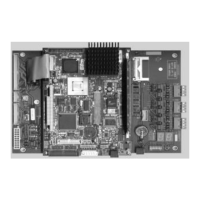
Analog Board has twelve Analog I/O board connectors
labeled P4 through P10. The external Analog devices are
wired to a connector plug. Position 1 connects to the plus
(+) of the external device for channel 1, position 2
connects to the signal (SIG) of the external device for
channel 1 and position 3 connects to ground (GND) of the
external device for channel 1. Position 4 connects to the
plus (+) of the external device for channel 2, position 5
connects to the signal (SIG) of the external device for
channel 2 and position 6 connects to ground (GND) of the
external device for channel 2, as shown below:
Each input channel is configurable through the operating
software. There are twenty-four analog input channels that
can be selected for 4-20 mA, 0-5 Vdc, ICTD, or RTD.
Channel #16 will also take the 0-5 Amp motor CT as an
input. Besides properly setting the software configuration,
each channel is setup through software calibration for the
proper transducer type and range, and each transducer
must be calibrated through the appropriate sensor
calibration screen. Improper setup of either the hardware
or software will result in improper operation or range.
The most common fault associated with the improper
reading of the analog channels other than hardware or
software setup problems fall into one of the following
categories:
• Sensor fault
• Wiring problem
• Improper grounding of system.
An open wire, shorted wire, or faulty sensor will usually
give a reading at either the minimum or maximum end of
the range scale. An erratic reading or a reading that
seems to float up and down is usually indicative of a
grounding problem. When a single transducer or cable is
shorted to earth (or system) ground, this can show up as a
whole assortment of problem channels. The easiest way
to find a short to earth problem is to disconnect all the
sensor plugs and ohm out each plug screw terminal to
earth for open (infinite) impedance. All sensors should
read open to earth with the exception of the CT motor
current channel. One side of the CT is grounded in the
Motor Control Center (MCC). (The third pin on pressure
sensors is ground.)
Replacing a Defective Analog Board
The procedure to replace an Analog board is outlined
below:
1. Ensure that all channel configuration information
for the board being replaced has been written
down.
2. Shut off control power.
3. Unplug all connectors from the board.
4. Remove the old board from the machine and
remove the new board from its packing and place
both on an anti-static surface.
5. Check that all jumpers and dipswitches are
properly setup on the new board as it was on the
old board.
6. Install the modified replacement board in the
panel.
7. Plug all connectors back in.
8. Turn on control power.
9. After the Quantum™ has rebooted, access the
Analog Board Configuration Setup screen for the
board that was replaced (board #1 or #2), and re-
enter the correct channel configuration. The
default setup of the new board will be loaded to
the processor. It is imperative that the channel
configuration screen for the board that was
replaced (analog board 1 or 2) is accessed to
ensure that the channels are configured properly
for the application.
After replacing or installing an Analog Board and powering
on the control panel, select [Redetect I/O Boards] from
the Communications screen in Panel Setup (this section
appears later in this manual). This selection provides a
method to detect all connected Analog and Digital boards.
If a board has been removed, a communication error
shutdown will be issued until this key is selected. The
About screen will show what was detected.
The [Redetect I/O Boards] key resets the memory of the
processor as to which boards it requires communications
from. Therefore, it is important to check the [About]
screen to see which boards have been detected relative to
the I/O boards actually in the panel.
GND
Channel 2
+
Channel 1
+
Channel 1
Signal
Channel 2
Signal
GND



 To Next Page