Gun Setup
Check Fluid Re
sistivity
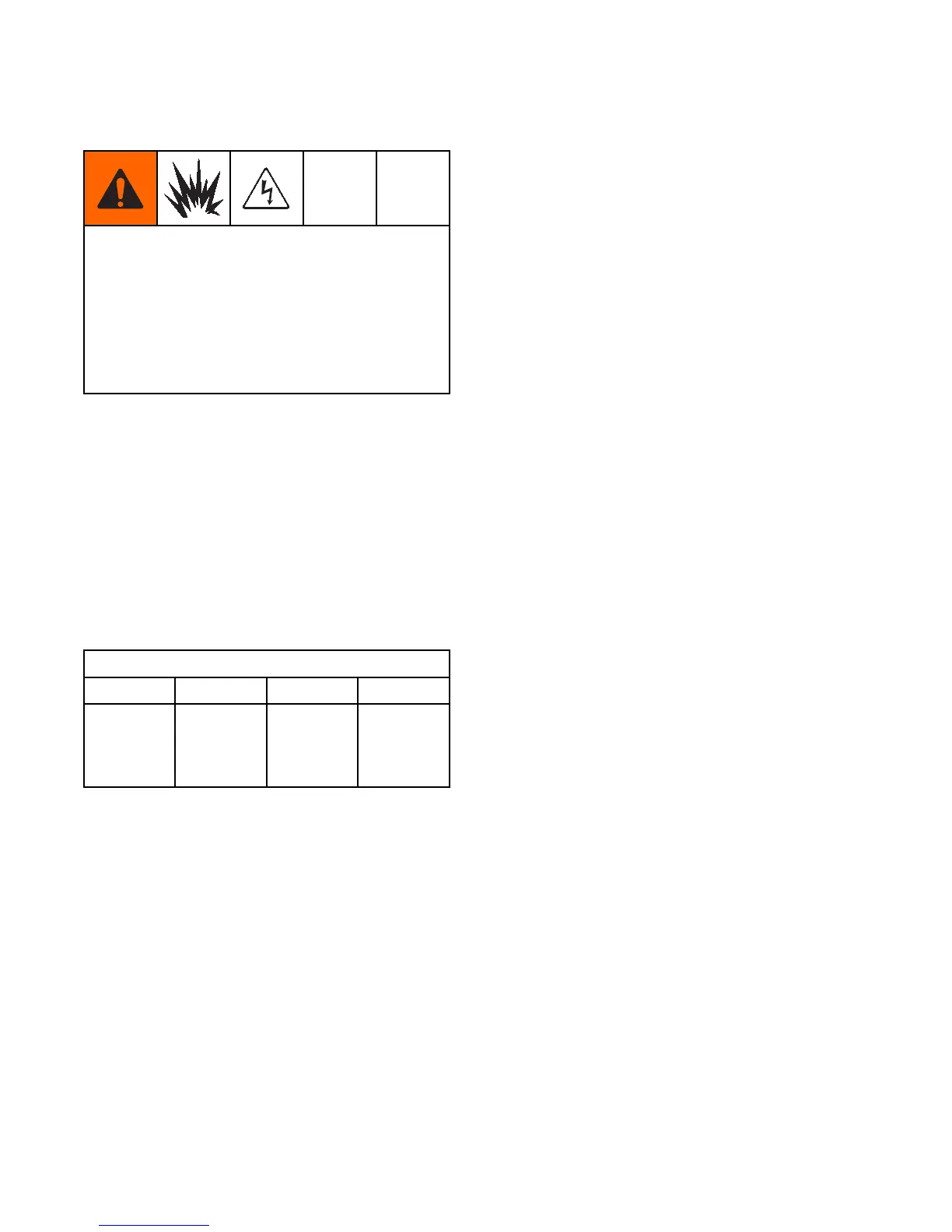
To reduce the risk of fire, explosion, or electric
shock, check the fluid resistivity in a non-hazardous
area only. Resistance Meter 722886 and Probe
722860 are not approved for use in a hazardous
area.
Failure to follow this warning could cause fire,
explosion, or electric shock and result in serious
injury and property damage.
Graco Part No. 722886 Resistance Meter and
722860 Probe are available as accessories to check
that the resistivity of the fluid being sprayed meets
the requirements of an electrostatic air spray system.
Follow th
e instructions included with the meter and
probe. Re
adings of 25 megohms-cm and above
provide t
he best electrostatic results.
A high conductivity kit or high conductivity hose may
be required for readings less than 25 megohm-cm.
Table 4 .
Fluid Resistivity Levels
Megohms
-cm
1–7 7–25 25–200 200–2000
High C
on-
ducti
vity
Kit re
com-
mende
d
High C
on-
ducti
vity
Kit ma
ybe
neede
d
Best elec-
trostatic
results
Good e
lec-
trost
atic
resul
ts
Check Fluid Vi
scosity
To check fluid viscosity you will need:
• a viscosity cu
p
• a stopwatch.
1. Completely submerge the viscosity cup in
the fluid. Lift the cup out quickly, starting the
stopwatch as soon as the cup is completely
removed.
2. Watch the stream of fluid coming from the bottom
of the cup. As soon as there is a break in the
stream, shut off the stopwatch.
3. Record the fluid type, elapsed time, and size of
the viscosity cup.
4. If the viscosity is too high or too low, contact the
material supplier. Adjust as necessary.
Flush Before Using Equipment
The equipment was tested in fluid at the factory. To
avoid contaminating your fluid, flush the equipment
with a compatible solvent before using the equipment.
Guidelines for Abrasive Materials
When spraying abrasive materials, follow these
guidelines:
• Order Part No. 24N704 Electrode (blue) for
abrasive materials.
• Size the nozzle properly to reduce fluid pressure
below 30 psi (0.21 MPa, 2.1 bar), producing an
8–12 in. (200–300 mm) fluid stream.
• Operate the gun with the fluid adjustment knob in
the full flow position at all times. Use an external
fluid regulator, not the fluid adjustment knob, to set
the fluid pressure.
• Use the minimum atomizing and fan air pressures
possible to achieve a good pattern.
• Follow all procedures under
Clean the Gun Daily, page 29.
• Inspect the electrode daily and replace if damaged.
See Electrode Replacement, page 39.
26 3A2494E


 To Next Page