User manual C4 – C6
44
6.5. Setting the outriggers
To prevent contact between the ballast and outrigger legs
during slewing make sure that the outrigger legs are not
extended too far, e.g. one outrigger placed on an
elevation.
Make sure the outrigger leg is horizontal, with a maximum
tilt of 5°, to prevent instability.
Do not raise the compact crane higher on the outriggers
than necessary; once the tracks have been lifted off the
ground it is high enough.
Assess the ground condition and use outrigger pads to
reduce the ground pressure.
Make sure the outrigger foot sits in the recessed circle on
the outrigger pad when setting the outriggers. This is
particularly important when raising the machine high on
the outriggers, in connection with the folding legs.
Check that the crane is retracted.
6.5.1. Order of operations
Outriggers may only be used on a suitable surface; this
means it must be horizontal and have sufficient load
bearing capacity.
Maintain a close watch on the active outrigger leg
during extension to prevent foot entrapment.
Preparation
Make sure the ground has sufficient load bearing capacity.
Position the machine in the ideal position; consider safety, obstacles
within slewing range, horizontal outreach of the load, capacity and
limits of the crane and ground.
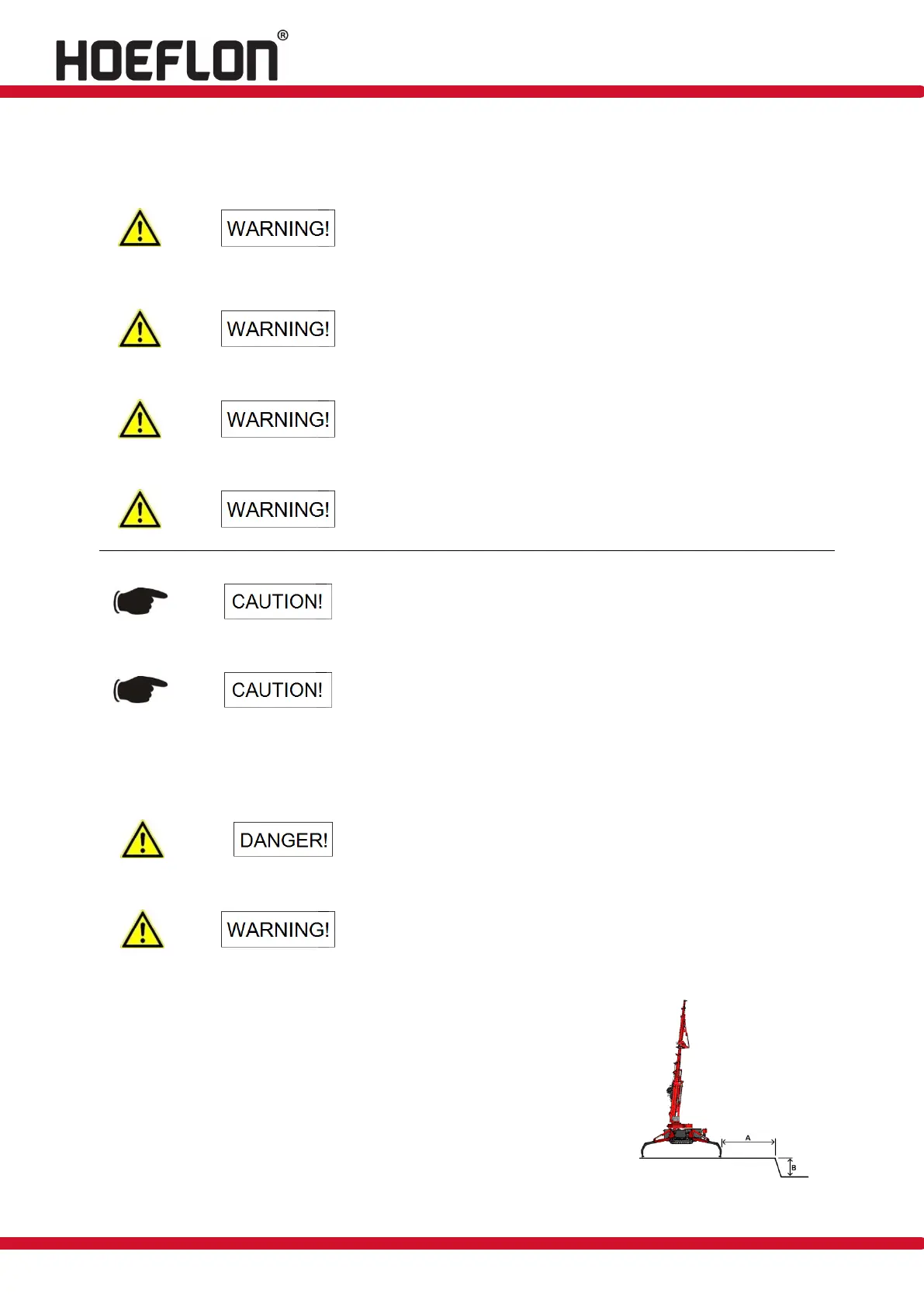
If the crane is raised on the outriggers in the vicinity of a ditch or
slope, it is recommended that distance A from the outrigger to the
edge be at least twice as long as depth B of the ditch (see figure 40).



 To Next Page