Need help?
Do you have a question about the ISE Sonos and is the answer not in the manual?
Details the capabilities and features of the ise smart connect KNX Sonos device.
Explains the integration of Sonos audio systems with KNX technology for enhanced control.
Provides definitions for key terms like Sonos device, Room/Zone, and Group.
Demonstrates using a door contact to dynamically create Sonos groups for synchronized audio.
Details how Sonos systems can function as a smart door gong with customizable audio signals.
Highlights how the device simplifies Sonos operation via KNX light switches and motion detectors.
Explains how Sonos playlists can trigger home automation scenes like dimming lights or adjusting heating.
Discusses using Sonos audio for security simulations, scaring off intruders with sound scenarios.
Shows how Sonos can contribute to energy efficiency by managing device usage and announcements.
Describes using the device for automated announcements in commercial spaces triggered by buttons or time.
Details implementing stereo pairs and combining them into groups for synchronized playback.
Explains the general concept and configuration of dynamic group creation for multiple Sonos devices.
Illustrates how to combine different rooms' Sonos devices into a single controllable group.
Describes activating 'Party Mode' to play the same music across all grouped Sonos devices simultaneously.
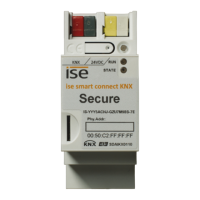
Details the physical layout, dimensions, and connectors of the ise smart connect KNX Sonos.
Provides critical safety warnings and precautions for electrical installation and device handling.
Covers the procedures for mounting the device and connecting KNX and power supply cables.
Guides on importing the ETS device application for the ise smart connect KNX Sonos.
Explains how to assign a physical KNX address to the device within the ETS.
Details setting the device's IP address, subnet mask, and default gateway for network communication.
Covers the general settings for the device, including master-slave configuration and text display.
Describes common parameters for master-slave group configuration and text display options.
Details configuring IP addresses for master and slave devices within specific groups.
Explains how to find the IP addresses of Sonos devices using the Sonos PC software.
Lists available group objects for connecting KNX group addresses to device functions.
Details KNX group objects essential for enabling dynamic group creation of Sonos devices.
Covers basic operation and interaction with the device's buttons and indicators.
Explains the meaning of different LED states during device start-up and operation.
Details the LED combinations indicating the device's status during the initial start-up phase.
Describes the LED indicators and their meaning when the device is operating normally.
Recommends using the IP path for faster programming transfers from ETS to the device.
Outlines the steps for programming the device's physical address via ETS.
Explains the process of transferring application programs and configuration settings to the device.
Provides methods for resetting the device to its factory default settings.
Details how to configure playlists and select music sources via the device's web interface.
Describes the initial display of available music sources on the playlist configuration page.
Explains the process and importance of saving the playlist configuration for persistent access.
Covers clearing the current list and creating custom lists of music sources.
Describes copying configurations between different groups using the website interface.
Addresses common issues encountered during playlist configuration and playback.
Explains how to use a microSD card for storing and playing audio files with the device.
Provides instructions on how to download log files for support when issues occur.
Guides on accessing the device status page for software version and connection status.
Offers a step-by-step error resolution guide for common device operational problems.
Defines key terms and roles (Licensor, Licensee, Firmware) related to the software agreement.
Specifies the subject matter of the agreement: the software and its documentation.
Outlines the non-exclusive, non-transferable rights granted to the Licensee for using the software.
Details limitations on copying, modification, reverse engineering, and transfer of the software.
Covers requirements for software creation and restrictions on license management mechanisms.
Addresses ownership of documentation, confidentiality, and potential changes to the software.
Specifies warranty terms for software and documentation, and limitations on liability.
Defines the governing law, jurisdiction, and conditions for terminating the license agreement.
Covers stipulations for subsidiary agreements, changes, and reserved rights not explicitly mentioned.
 General
| Category | Gateway |
|---|---|
| Ethernet Ports | 1 |
| Model | Sonos |
| Connectivity | Ethernet |
| Wireless Connectivity | Wi-Fi |


 To Next Page