
 Need help?
Do you have a question about the kaarta STENCIL 2 and is the answer not in the manual?
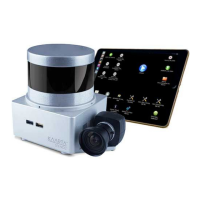
Concise description of Kaarta Stencil 2 as a mobile mapping platform.
Guidelines for maintaining the precision instrument for longevity.
Specifies the document's coverage for Stencil 2 Software Version S2-20.02.
Details new features and benefits in the S20.02 software release.
Lists all components included in the Kaarta Stencil 2 package.
Introduces the main components and features of the Stencil 2 device.
Details components and features specific to older Stencil 2 unit serial numbers.
Explains the meaning of different LED colors and states for device status.
Describes the function of the Stencil 2 power and mode control button.
Explains how to power the Velodyne Lidar on and off using its dedicated button.
Pre-mapping checks and ensuring readiness of Stencil 2 and Lidar.
Step-by-step instructions on how to initiate the mapping process.
Procedure for safely stopping the mapping process and saving data.
Details the types of files generated during mapping/localization scans.
Highlights Stencil 2's computing capabilities and use with external devices.
Explains how to use the iPad for controlling Stencil 2 operations in the field.
Describes the main icon for initiating and terminating mapping/localization.
Details icons for saving images and replaying raw sensor data.
Icon for uploading scan data to Kaarta Cloud for post-processing.
Icon to display mapping and localization confidence values.
Tool for localizing using current GNSS data if a geo-registered map is loaded.
Tool for leveling, sectioning, and generating 2D images from point cloud sections.
Tool to correct global drift errors using GNSS and trajectory paths.
Guidance on when the Feature Tracker provides optimal mapping results.
Best practices for using the Feature Tracker for optimal scan quality.
How Stencil 2 captures and saves color images during mapping.
Explanation of icons used to change operating modes for mapping/localization.
Default mapping configuration for Stencil 2.
Mapping mode that uses the Feature Tracker for sparser environments.
Describes various modes for localizing against a prior map.
Explains how Stencil 2 organizes scan data into top-level folders for each scan run.
How to align starting position with a prior map for localization.
Tool for global smoothing using loop closure techniques to correct drift.
Tool to compress flat surfaces and reduce lidar blur.
Tool to auto-level, rotate, and generate 2D images from point cloud sections.
Utility to convert .yaml file to scan_info.txt for easier reading.
Utility to repair ply files with incorrect vertex numbers.
Adjusts point clouds and trajectories to share a common UTM offset.
Utility to convert Stencil .ply files to .las format without CloudCompare.
Tool for building and executing CloudCompare commands non-visually.
How to use external point clouds for localization and map merging.
How to connect and use a GNSS unit with Stencil 2.
Steps to configure the GNSS unit and Stencil 2 for data acquisition.
Displays the status of GNSS connection and data reception.
Procedure to synchronize Stencil 2's clock with GNSS time for accurate timestamps.
How to record raw GNSS data for accurate post-processing corrections.
Steps for processing GNSS data using CORS or base station data.
Explains the function of the Loop Closure Tool for global smoothing.
Defines terms and processes for aligning point clouds with external spatial data.
How confidence values are used to improve loop closure matches.
Using GNSS data to aid the loop closure process.
Configuration options within the Loop Closure Tool dialog box.
Demonstrates loop closure for fixing double registrations without GNSS data.
How Stencil 2 pose output can be used for ground vehicle navigation.
Combining ground and aerial mapping for comprehensive 3D models.
General advice for planning and executing scans for optimal results.
Techniques for effective handheld scanning in indoor environments.
Techniques for effective handheld scanning in outdoor environments.
Guidelines for mounting Stencil 2 on a vehicle for scanning.
Best practices for performing aerial scanning with Stencil 2.
Troubleshooting steps for errors during .ply file creation or saving.
How sun glare can affect point clouds and methods for mitigation.
Reasons for double registration and how to address them using loop closure.
Challenges and considerations for scanning in confined spaces.
How reflective surfaces can cause incorrect point cloud registration.
Adjusting camera settings for optimal performance in varying light conditions.
Fundamental steps for loading and visualizing point clouds in CloudCompare.
Methods to colorize point clouds based on elevation (Z-coordinates).
Visualizing point clouds by coloring points based on their recorded time.
Applying colorization scales to intensity values for enhanced point cloud visualization.
Aligning point clouds to world coordinates using Ground Control Points (GCPs).
Steps for cleaning and preparing point cloud data for further processing.
Procedures for combining multiple point clouds into a single dataset.
Using the Iterative Closest Point algorithm for fine registration of point clouds.
Detailed instructions and pinout for wiring the Velodyne LEMO connector correctly.
Configuration options for replaying recorded sensor data files.
Recommended parameter values for structured environments.
Recommended parameter values for vegetated or cluttered environments.
Recommended parameter adjustments for scanning in tight indoor spaces.
ROS commands to remotely switch Stencil 2's operating modes.
ROS commands to remotely start and stop mapping/localization.
ROS command to specify a reference map for the localization process.
Information on coordinate systems and messages used in Stencil 2 localization.
Key considerations for successful localization operations.
How to initialize localization using current GNSS coordinates.
Details on Stencil 2's sensor calibration parameters and settings.
Network configuration details for connecting Stencil 2 via Ethernet.
How to replay .bag files in localization mode for analysis.
Steps for setting up a Linux computer with ROS for synchronization.
Configuring Ethernet connection between computer and Stencil 2.
Configuring the ROS master URI for computer-to-Stencil 2 communication.
Highlights new features and improvements in the R2018.11_SP1 release.
New features related to the user interface in the S19.07 release.
Hardware improvements introduced in the S19.07 release.
Improvements in file size management for scans in the S19.07 release.
Enhancements to data post-processing in the S19.07 release.
Updates to the Adaptive Data Replay tool in the S19.07 release.
New GNSS features and synchronization options in the S19.07 release.
Improvements to localization capabilities in the S19.07 release.
 General
| Environment | Indoor/Outdoor |
|---|---|
| IMU | Yes |
| Real-time processing | Yes |
| IP Rating | IP54 |
| Laser | Class 1 |
| Field of View | 360° horizontal |
| Connectivity | Wi-Fi |
| Operating Temperature | 0°C to 40°C |
| Storage Temperature | -20°C to 60°C |

 To Next Page
