General Description of the Instrument
3.2 Two Different Versions
The force plate 9287C... is available in two versions:
Type 9287C with external 8 channel amplifier
(e.g. Type 9865…)
Type 9287CA with built-in charge amplifier
3.3 Application Examples
The force plate is particularly suitable to measure fast
actions and impact in sports but it can also be used for
a wide range of other applications
Biomechanical investigations, e.g. recording the forces
exerted by the human foot when standing, walking or
running (gait analysis)
Orthopaedic examinations
Determining progress in rehabilitation, e.g. with pros-
thesis, after fractures etc.
Analysis of high dynamic sports activities to optimize
training and for competition analysis (e.g. starting and
takeoff behaviour, performance measurement etc.)
Coefficients of friction can be determined dynamically
and statically with the BioWare software system
3.4 Functional Principle
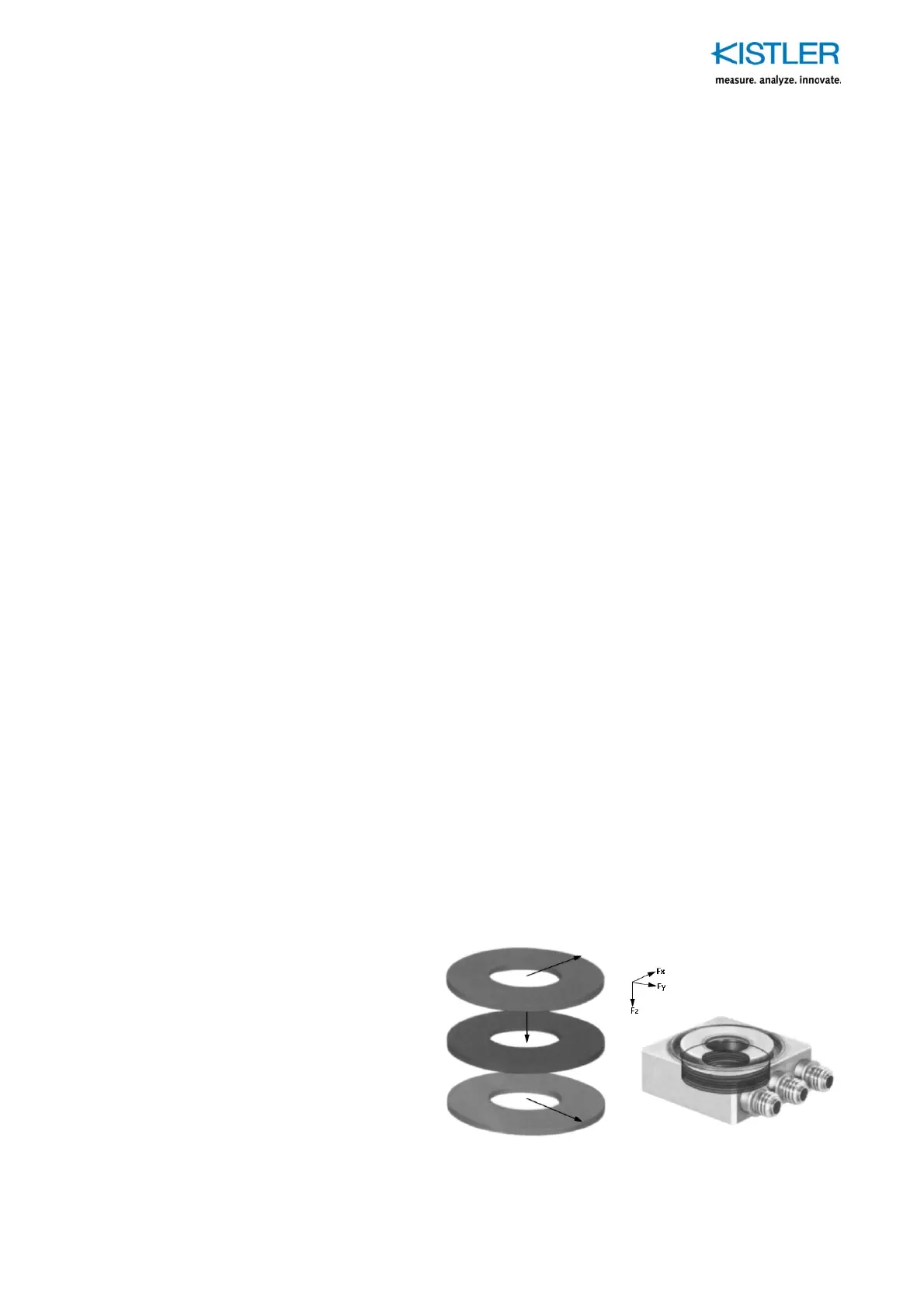
The force to be measured is introduced via a top plate and
distributed between four 3-component force sensors ar-
ranged between mounting base and top plate. Each of the
sensors has three pairs of quartz plates, one sensitive to
pressure in the z-direction and the other two to shear in
the x- and y-directions respectively. The measurement is
virtually without displacement. In these four force sensors
the force introduced is resolved into three components.
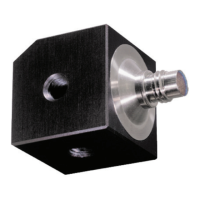
Fig. 2: 3-component force sensor
9287C
_002-462e-03.11 Page 9



 To Next Page