Page 4-10
MPS Motor Protection System Rev. 6-F-022117
Operation and Setup
The sequence for set-point characters depends upon
the set-point type. The character sequence for numeric
set points is:
. . . 0 1 2 3 4 5 6 7 8 9 . 0 1 2 3 . . . . .
The character sequence for string set points is:
. . . [0…9] [A…Z] [a…z] SP - . / [0…9] [A…Z] . . . . .
Characters forming a series are shown in brackets and
“SP” represents the space character.
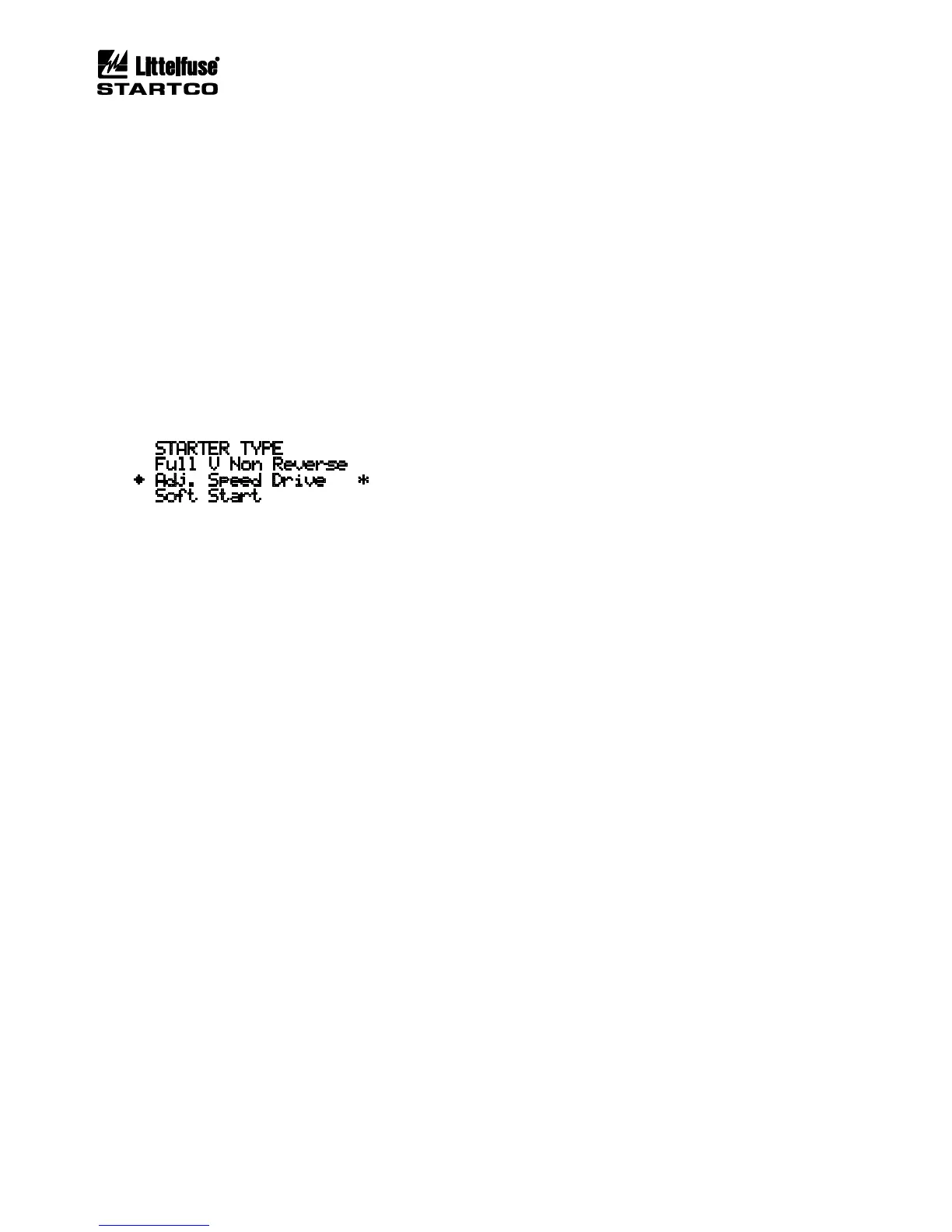
For set points requiring selection from a list, the up
and down arrow keys are used to scroll through the
items. In the same manner as menu items, selections are
displayed using one of the three cursor symbols (½«²)
preceding the item. Pressing ENTER selects the item
and that item is indicated by the “∗” symbol to its right.
EXAMPLE:
4.4 MPS-RTD
OPI Menu: Setup | Hardware | RTD Modules
OPI Menu: Setup | Protection | RTD Temperature
The MPS-RTD module extends MPS protective
functions to include multiple-RTD temperature
monitoring. It has eight inputs that can be individually
configured for RTD type, trip and alarm settings, name,
and function. The RTD types are 10-Ω copper, 100-Ω
nickel, 120-Ω nickel, and 100-Ω platinum. Functions are
stator, bearing, load, and ambient.
Control voltage for the MPS-RTD (24 Vdc) is
supplied by the MPS-CTU and communication is
through an RS-485 link. This allows the MPS-RTD to
be mounted up to 1.2 km (4,000’) from the MPS-CTU.
To enable RTD protection, the total number of
modules must be selected in the Total Modules menu and
Temperature Trip Action or Alarm Action must be
enabled. If RTD protection is disabled, metering
information is still provided. Up to three modules can be
used. In the RTD Modules menu, the action to be taken
by the MPS-CTU in response to loss of communication
is selected.
When the hardware has been configured, temperature
set points and sensor-failure action selections in the RTD
Temperature menu are used for RTD temperature
protection. See Section 5.27.
4.5 MPS-DIF
OPI Menu: Setup | Hardware | DIF Module
OPI Menu: Setup | Protection | Differential
The MPS-DIF Differential Module extends MPS
protective functions to include phase-differential
monitoring. It has three differential-CT inputs that can
be used in a three-CT core-balance connection, a six-
differential-CT connection, or a six-CT connection that
includes phase-CT MPS inputs. The core-balance, three-
CT connection is recommended.
Control voltage for the MPS-DIF (24 Vdc) is supplied
by the MPS-CTU and communication is through an
RS-485 link. This allows the MPS-DIF to be mounted
up to 1.2 km (4,000’) from the MPS-CTU, and the link
can be shared by other MPS I/O modules.
Enable the module and loss-of-communications
protection in the Hardware | Dif Module menu, and
choose protection settings in the Protection | Differential
menu. See Section 5.25.
4.6 WAVEFORM CAPTURE
The MPS continuously samples seven channels of data
consisting of the three-phase currents, three-phase
voltages, and the earth leakage current. The sample rate
is fixed at 16 samples/cycle and sample data (Trace
Data) for each channel are stored in a 4800 sample
memory. This provides a record depth of 300 cycles, or
5 seconds of pre-trip data at 60 Hz.
When a trip occurs, Trace Data capture is halted and a
date and time stamp is added. Trace Data values are
retrieved using SE-Comm-RIS which generates an
industry-standard COMTRADE and CSV file. See
Appendix E for data mapping definitions and conversion
formulas.
The Setup | System Config | Trace Auto-Start menu is
used to set the Trace Data start mode after a trip has
occurred. When enabled, Trace Data capture
automatically starts when reset is pressed. When
disabled, Trace Data capture requires a manual re-start
using the Messages | Re-Start Trace. This allows the
MPS to be reset and the trip data to be analyzed at a later
time. Trace Data start can also be activated using
Command 13 via the communications interface.
Trace Data are stored in volatile memory and are lost if
the MPS loses supply voltage. Regardless of the Trace
Auto-Start setting, waveform capture starts automatically
on power-up if there are no previous trips.


 To Next Page