Page 1-1
MPS Motor Protection System Rev. 6-F-022117
Introduction
1. INTRODUCTION
1.1 GENERAL
The Littelfuse Startco Motor Protection System (MPS)
is a modular system with integrated protection, control,
metering, and data-logging functions. The Control Unit
(MPS-CTU) is the core module. It can operate as a stand-
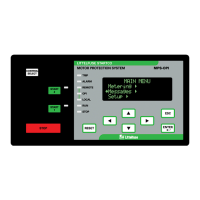
alone unit or with the Operator Interface (MPS-OPI),
RTD Modules (MPS-RTD), and Differential Module
(MPS-DIF). The CTU can be programmed using the OPI
or the communications network. Programmable inputs
and outputs provide a flexible hardware platform and
custom software can be easily loaded from a PC to the
CTU’s flash memory. The MPS block diagram is shown
in Fig. 1.1.
1.2 MPS FEATURES
1.2.1 PROTECTION
• Overload (49, 51)
• Overcurrent (50, 51)
• Earth fault (50G/N, 51G/N)
• Unbalance (voltage and current) (46, 47)
• Phase loss (voltage and current) (46, 47)
• Phase reverse (voltage and current) (46, 47)
• Jam
• Undercurrent (37)
• Failure to accelerate
• Underspeed (14)
• Overvoltage (59)
• Undervoltage (27)
• Underpower (37)
• Reversepower (32)
• Power factor (55)
• Overfrequency (81)
• Underfrequency (81)
• PTC overtemperature (49)
• RTD temperature (38, 49)
• Starts per Hour (66)
• Differential (87)
1.2.2 CONTROL—STARTING METHODS
(1)
• Non-reversing
• Reversing
• Soft start
• Soft start with bypass
• Adjustable-speed drive
• Two speed
• Wye-delta (open or closed transition)
• Reactor (open or closed transition)
• Resistor (open or closed transition)
• Autotransformer
• Part winding
• Slip ring
• Two winding
• Double delta
(1)
Only three CT’s required for all starting methods.
1.2.3 METERING
• Line currents
• Current unbalance
• Positive-sequence current
• Negative-sequence current
• Earth-leakage current
• Differential currents
• Line-to-line voltages
• Line frequency
• Voltage unbalance
• Positive-sequence voltage
• Negative-sequence voltage
• Power
§ Apparent, Reactive, Real, and Power factor
• Energy
§ kWh, kVAh, and kVARh
• Used thermal capacity
• Thermal trend
• Motor speed
• RTD temperatures
• Analog input and output
1.2.4 DATA LOGGING
• Sixty-four records
§ Date and time of event
§ Event type
§ Line currents
§ Current unbalance
§ Earth-leakage current
§ Differential currents
§ Line-to-line voltages
§ Voltage unbalance
§ Thermal capacity
§ Thermal capacity used during starts
§ Start time
§ Analog-input value
§ Frequency
§ Power (P, S, Q, PF)
§ RTD temperatures
§ Trip counters
§ Running hours
§ Waveform Capture
§ 5 seconds of pre-trip waveform data
§ 16 samples per cycle
§ COMTRADE and CSV file generation
1.2.5 INPUTS AND OUTPUTS
• Three ac-current inputs
• Three ac-voltage inputs
• Earth-leakage-current input
• Seven programmable digital (ac/dc) inputs
• 24-Vdc source for digital inputs
• Tachometer (high-speed pulse) input
• 4-20-mA analog input
• 4-20-mA analog output
• PTC thermistor temperature input


 To Next Page