Page 7-1
MPS Motor Protection System Rev. 6-F-022117
Theory of Operation
7. THEORY OF OPERATION
7.1 SIGNAL-PROCESSING ALGORITHMS
The sampling frequency of the MPS is variable. It can
be set for 50-Hz, 60-Hz, or variable-frequency
applications. The MPS obtains sixteen samples per cycle
of each current and voltage signal. For an adjustable-
speed drive (ASD) application, a speed or frequency
output from the ASD can be connected to the 4-20-mA
input to synchronize the sampling rate to the ASD output
frequency. This maintains accurate measurements of
power and sequential components.
The sampling rate is sixteen samples per cycle of the
fundamental frequency. A Discrete-Fourier-Transform
(DFT) algorithm is used to obtain the magnitude and
phase angles of the fundamental-frequency components of
the current and voltage waveforms. These values provide
true positive- and negative-sequence components. True
RMS values of line currents are calculated for use by the
thermal-model algorithm. RMS values include up to the
8
th
harmonic. All calculated values are updated at the
sampling frequency to achieve a fast response to fault
conditions. RMS values of the fundamental components
of current and voltage are displayed.
The MPS uses the input voltage VA for frequency
measurement. The input voltage must be above 30 Vac
and a sixteen-cycle interval is used to determine
frequency. Frequency protection is inhibited when system
voltage is less than 50% of the System Voltage setting.
7.2 POWER ALGORITHM
Apparent power (S) is calculated by:
Real power (P) is determined from the in-phase
components of I and V, and reactive power (Q) is
determined from the quadrature components of I with
respect to V. Power factor is the magnitude of the ratio of
P to S.
The one-PT connection assumes balanced voltages for
power calculations. Power calculations for the other
connections are valid for both balanced and unbalanced
conditions. In all cases, power calculations use the two-
wattmeter method and assume 3-wire loads.
The IEEE convention is used for power displays:
+Watts, +Vars, -PF (Lag) Importing Watts,
Importing Vars
+Watts, -Vars, +PF (Lead) Importing Watts,
Exporting Vars
-Watts, -Vars, -PF (Lag) Exporting Watts,
Exporting Vars
-Watts, +Vars, +PF (Lead) Exporting Watts,
Importing Vars
7.3 OPERATOR INTERFACE (MPS-OPI)
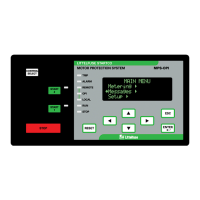
The OPI is a terminal device used to communicate with
the MPS-CTU. All set points, operating parameters, and
menus are stored in the MPS-CTU.
The OPI contains a microprocessor used to
communicate with the MPS-CTU, read key presses, and
perform display functions.
On multiple-OPI systems, all OPI’s display the same
information. Key presses on any OPI will be processed
by the MPS-CTU.
7.4 RTD MODULE (MPS-RTD)
The RTD module contains a microprocessor, A/D
converter, and analog multiplexers used to measure up to
eight RTD’s. The RTD-measuring circuit is isolated from
the I/O Module network. All eight RTD’s are scanned
every three seconds. RTD linearization, open/short
detection, and lead compensation are performed by the
RTD module. RTD temperature is sent to the MPS-CTU
where temperature monitoring occurs.
7.5 DIFFERENTIAL MODULE (MPS-DIF)
The differential module obtains 32 samples per cycle of
the differential current. A Discrete-Fourier-Transform
(DFT) algorithm is used to obtain the magnitude of the
three differential currents. Frequency of operation is set
by the MPS-CTU unit and allows differential protection to
be used in variable-frequency drive applications. The
DFT values are sent to the MPS-CTU where differential
protection is performed.
7.6 FIRMWARE DIAGNOSTICS
Starting with firmware 2.01, diagnostic error handling
has been added. In the event of an internal fault, a
diagnostic error code is generated and can be viewed with
the OPI. The last error code can be viewed by selecting
Setup ç System Config ç Maintenance ç Firmware Version.
The diagnostic code is a two or three digit hexadecimal
number.
02 to FF: Processor Fault
100: Protection-Algorithm Fault
200: Relay-Control Algorithm Fault
300: Starter-Control Fault
400: Menu-Display Fault
500: OPI-Key-Handler Fault
600: Real-Time Clock Fault
700: Communication-Handler Fault
800: RTD Temperature-Handler Fault
900: A/D Communication-Interface Fault
The last diagnostic error code is saved in non-volatile
memory. The diagnostic code is overwritten by any new
codes but can also be manually set to zero. To clear the
error code, press RESET while in the Firmware Version
menu.


 To Next Page