OPERATION
HEADER
FLOTAnON
Header flotation springs are normally
SE!
t so
70
Ibs. force
(311
N)
is required
to
lift
either end
of
the header
just
off
the
ground.
In
rough
or
stony conditions,
it
may
bl~
desirable
to
change setting
to
35-50
Ib
s.
(156-222
N)
to
protect
cuning components.
NOTE: When float setting
Is
Ught,
It
ma.y
be necessary to use a slower ground speed
to
avoid excessive
bouncing and leaving a ragged cut.
To
Increase
h
eade
r
f1otatron,
which
d
ec
r
eases
the
force required to lift
header:
a.
Raise header fully.
b.
Ba
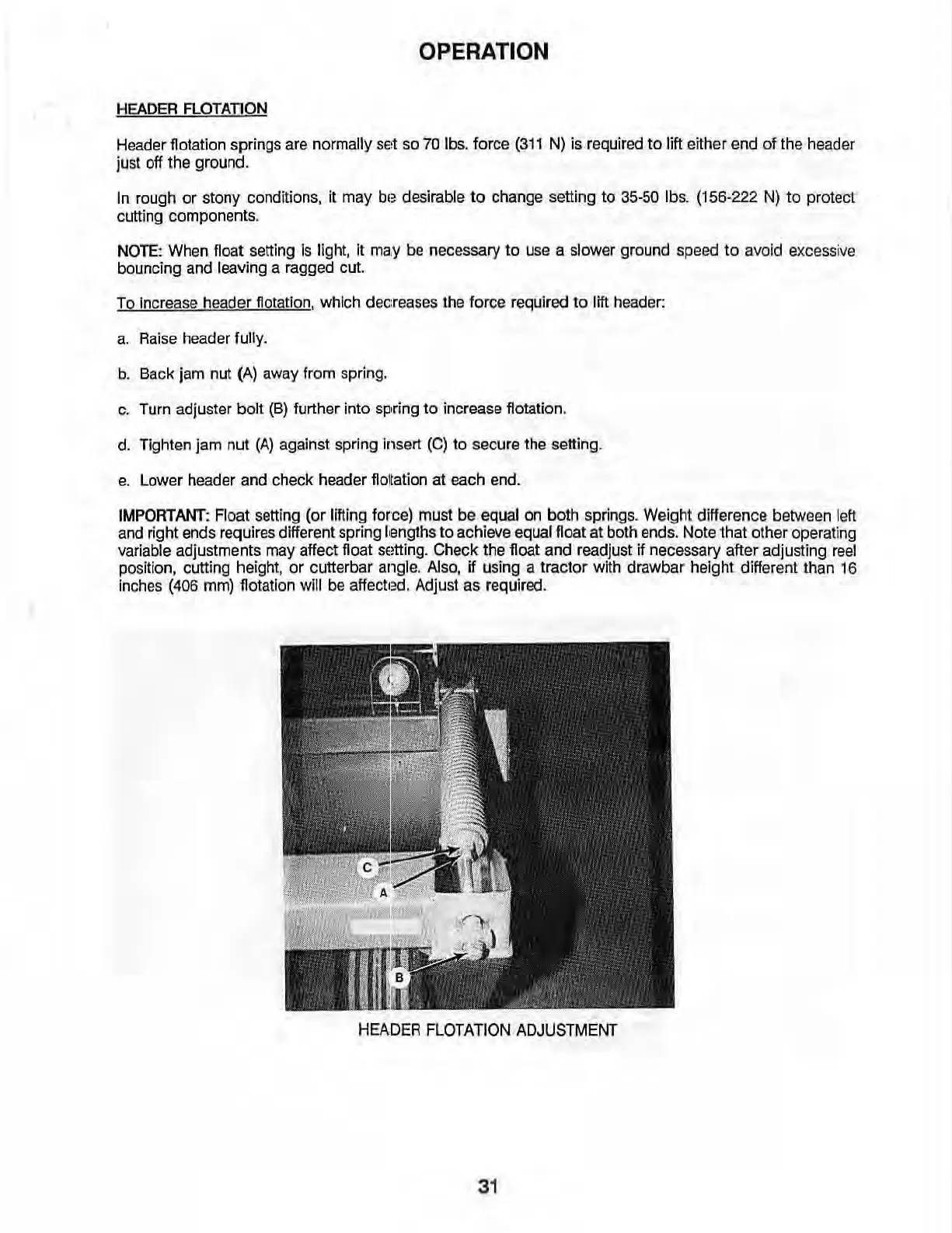
ck jam nut
(A)
away from sprin
g.
c.
Turn adjuster bolt (8) further into spring
to
increase flotation.
d.
Tighten jam nut
(A)
against spring Insert
(C)
to secure the setting.
e.
lower
header and check header
f1o~ation
at each end.
IMPORTANT: Float setting (or lifting force) must be equal on both springs. Weight difference between left
and right ends requires different spring
lengths to achieve equal float
at
both ends. Note
that
other operating
variable adjustments may affect float
sEltting. Check the float and readju
st
if necessary after adjusting
reel
position, cutting height,
or
cutterbar angle. Also,
if
using a tractor with drawbar height different than 16
Inches (406 mm) flotation will be
affectl~.
Adjust as required.
HEADER
FLOTATION
ADJUSTMENT
31


 To Next Page