UNLOADING & ASSEMBLY
PREPARE
TO
UNLOAD
2.
Lower trailer storage stands,
1.
Move
trailer into position
and
block trailer
wheels.
•
,
CAUTION:
To
avoid
injury
from
shifting
orfalling
machines, remove
hauler's
tie~downs
from
one
header
at a time,
after
it
is secured
to
unloading vehicle.
A
1.
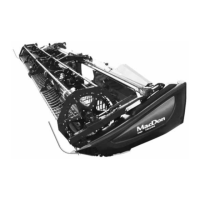
Attach chain hooks at points (A) and
(8)
marked "Lift Here".
UNLOAD HEADER
CAUTION:
To
avoid
injury
to
bystanders from being struck by
machinery,
do
not
allow
persons
to
stand
in
unloading
area.
A
3.
Check that the load has not shifted or other-
wise become unstable
and
check shipping
stands for damage before removing hauler's
tie-downs.
If
it
appears
load
is
unstable,
take
precautions to prevent machines falling down
when tie-downs are removed.
ATIACH
CHAIN HOOKS
UNLOADING EQUIPMENT
2.
Remove hauler's tie-down straps and chains.
A
CAUTION: Unloading equipment
must meet
or
exceed specified
requirements.
Using
inadequate
equipment
may
result
in
vehicle
tipping,
chain
breakage,
ormachine
damage.
A
CAUTION: Be sure
hooks
are
secure before
moving
away from
load. Stand clear when lifting,
machine may sWing. Do
not
alow
anyone
to
walk
under
or
near the
header as
it
is
unloaded
or
moved.
LIFTING VEHICLE REQUIREMENTS
Use a lifting vehicle with minimum 4000
lb.
(1815
kg) lifting capacity and a minimum 15
ft,
(4.5 m)
lifting height.
CHAIN REQUIREMENTS
3.
Raise header 12 inches (300 mm) and
remove from trailer.
4.
Take to storage or
set~up
area.
5.
Set header down securely on level ground.
Check for shipping stand damage and remove
dividers and other attachments wired to
underside
of
header.
6.
Remove chain hooks.
Use overhead lifting quality chain (1/2 in.) with
minimum 5000
lb.
(2270 kg) working
load
limit.
Chain length must be sufficient to provide
minimum 4
ft.
(1.2 m) vertical chain height.
A
WARNING: Header
shipping
stands
are
designed
for
shipping
economy. They
do
not
provide a
base broad enough
for
storage
of
units
in
an
upright
position.
To avoid personal
injury,
death
or
machine
damage
from
headers falling
or
blowing
over,
proceed with
instructions
to
"Lower
Header"
(next page) before leaving
units
in storage.
If
it
is necessary
to
store
machines
upright
on
shipping
stands, ensure that the
ground
is
firm and level. Take factors such as exposure
to
wind, and the effects
of
snow
melt
and
ground thaw
into
consideration. Tie
units
together and brace on both sides,
or
place
against a secure backstop and brace the
unsupported side.
61


 To Next Page